
Consulting Retainer Agreement Template (Free, Copy and Use)
Most retainer agreements fall apart in the same place, and it is not the fee.
It is the month the client decides to stop. If the document says nothing about how that happens, one accountant put it plainly in a thread about exactly this situation: with no early termination clause, it is basically a free for all. Nobody can point to anything, so whoever argues hardest wins.
Below is a consulting retainer agreement template you can copy, along with an explanation of what each clause is actually doing and the three decisions the template cannot make for you.
What a retainer agreement is for
A retainer is not a contract for a job. It is a contract for ongoing availability, paid on a repeating schedule, usually monthly and usually in advance.
That difference is the whole reason the document exists. With a one off project, the work defines the end. With a retainer there is no natural end, so every boundary has to be written down: how much work the fee covers, what happens when there is more, and how either side gets out.
The consulting retainer agreement template
Copy this, change the bracketed parts, and read the section after it before you send it to anyone.
CONSULTING RETAINER AGREEMENT
This agreement is made on [date] between [Consultant name], of [address] (“the Consultant”), and [Client name], of [address] (“the Client”).
1. Services. The Consultant will provide the following services: [describe the work]. Work outside this description is not included and is covered by clause 6.
2. Retainer and allocation. The Client will pay a retainer of [amount] per month. This covers up to [number] hours of the Consultant’s time each month, or the following deliverables: [list]. Unused time [does / does not] carry over to the following month.
3. Payment. The retainer is payable in advance, on the [first] day of each month. Invoices are due within [number] days. Interest of [rate] may be charged on overdue amounts, and the Consultant may pause work while an invoice remains unpaid.
4. Term and renewal. This agreement begins on [date] and continues month to month until ended under clause 5.
5. Termination. Either party may end this agreement by giving [30] days’ written notice. The retainer for the final month is payable in full / pro rated to the notice date [choose one]. On termination the Consultant will hand over [describe: files, drafts, access, documentation] within [number] days.
6. Work beyond the retainer. Work beyond the allocation in clause 2 will be agreed in writing before it begins, and charged at [rate] per hour or at a fixed fee agreed in advance.
7. Client responsibilities. The Client will provide the access, information and approvals the Consultant reasonably needs. Where a delay by the Client prevents work from being done, the retainer remains payable.
8. Availability. The Consultant will respond to messages within [number] working days, during [hours]. This agreement does not create an expectation of availability outside those hours.
9. Confidentiality. Each party will keep the other’s non public information confidential, during this agreement and after it ends.
10. Intellectual property. Ownership of the work produced under this agreement passes to the Client once all invoices have been paid in full.
11. Independent contractor. The Consultant is an independent contractor, not an employee, and is responsible for their own taxes and insurance. The Consultant may work for other clients.
12. Governing law. This agreement is governed by the law of [jurisdiction].
Signed:
Consultant: ________________ Date: ________
Client: ________________ Date: ________
The three decisions the template cannot make for you
Every bracketed choice above is a preference. These three are arguments waiting to happen, so decide them on purpose.
Do unused hours roll over?
This is the clause that causes the most friction, and both answers are defensible.
If hours roll over, the client carries no risk in a quiet month, but they can bank three months of unused time and hand you all of it at once, in a week when you are already full. If hours are forfeited, your capacity is protected and your income is predictable, but a client who used almost nothing in January feels they paid for air.
A middle option works for most people: let unused time roll over for one month only, and no further. The client does not lose a quiet month and you never face a stockpile.
What happens to work beyond the allocation?
Something has to, because a retainer with no overflow rule simply absorbs the overflow, and the person absorbing it is you.
Name an hourly rate for extra work in clause 6 and require written agreement before it starts. The written part matters more than the rate. It turns a casual request into a short, specific conversation, which is the thing that was missing.
Watching the allocation helps as much as the clause does. Tell the client when they are around three quarters of the way through the month’s hours, not when they have gone past. The conversation is easy before the overrun and awkward after it.
How much notice to end it?
Thirty days is the common standard, and sixty is normal for larger engagements. Pick one and write it down.
Then answer the question most templates skip: what happens to the final month’s fee. If the client gives notice on the 10th, are they paying for the whole month or up to the notice date? Both are defensible, and the only bad answer is silence.
Silence is where that accountant’s point lands. When the contract says nothing, the fair default most people land on is pro rating the final month to the notice date and refunding the difference, and the firm has no right to insist on a notice period it never asked for. If you want a full final month, you have to say so in advance.
Which retainer are you actually selling?
Clause 2 quietly asks you to choose a model, and the four common ones behave very differently.
- Hours. A set number of hours a month. Simple to price, easy to argue about, and it invites clients to use the full allocation whether they need it or not.
- Deliverables. A fixed set of outputs, such as four reports a month. Scope is clear, but quality becomes the thing people dispute instead.
- Access. The client pays for availability and advice rather than a measured quantity. Common in senior advisory work. It needs the availability clause to be tight, or it becomes unlimited.
- Capacity. A percentage of your working week. Clear for both sides, but only if the agreement says what a full week means.
Pick the one that matches what the client actually values, then write that into clause 2 rather than leaving it implied.
Before you send it
Three practical points.
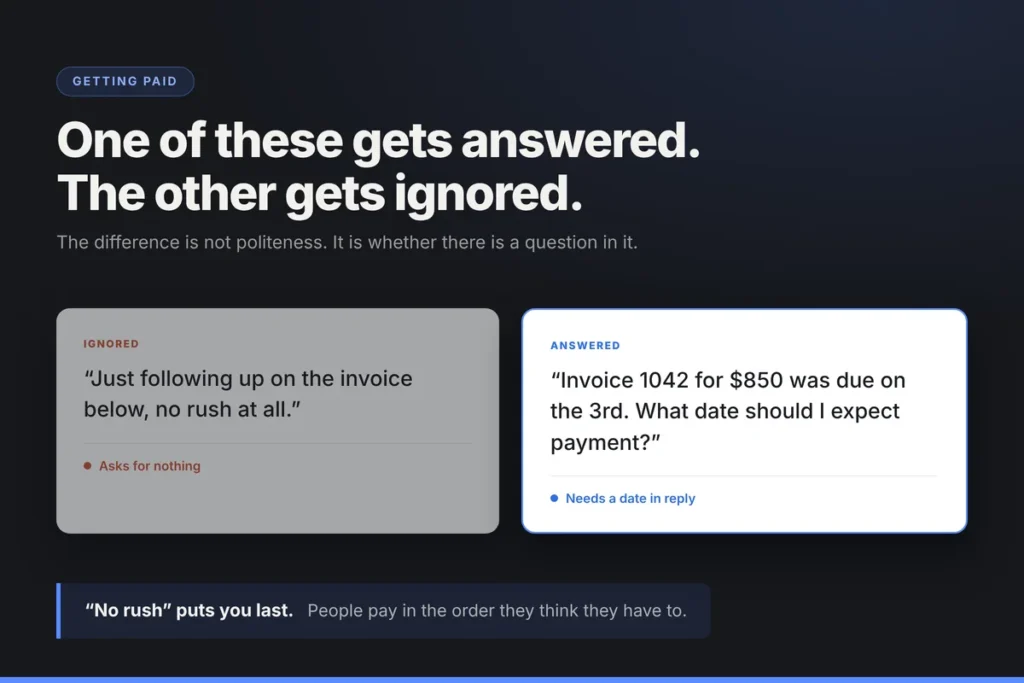
Bill in advance. A retainer paid at the start of the month protects you when the client’s own delays stall the work, which is the most common reason a retainer month goes quiet. If invoicing is where things usually slip, it is worth tightening how you ask for payment and what your net 30 payment terms actually commit you to.
Keep the quote and the agreement consistent. If you priced the work in a proposal first, the scope wording in clause 1 should match it, because a mismatch between what you quoted and what you signed is the gap clients negotiate in. The same thinking that goes into writing a quote for a job applies here.
Have it looked at. This template is a starting point written for general use, not legal advice, and contract rules differ by country. If the retainer is a meaningful share of your income, paying a lawyer once to review your standard agreement is cheap compared with one bad exit.
Frequently asked questions
Is a retainer agreement legally binding?
Yes, once both parties sign it and there is an exchange of value, which the monthly fee provides. The enforceable parts are the ones written down, which is why the blanks above matter more than the overall format.
Should a retainer be paid upfront?
Usually yes. Paying in advance is what separates a retainer from ordinary project billing, and it is what compensates you for holding capacity whether or not the client uses it that month.
What if the client wants to cancel mid month?
Your notice clause decides it. If the agreement is silent, pro rating the fee to the notice date is the outcome most people treat as fair, which is a good reason to write your preferred answer into clause 5 instead.
Can a retainer agreement be month to month?
Yes, and for a first engagement it usually should be. A rolling monthly term with a notice period gives both sides an exit without needing to negotiate a long commitment before anyone knows how the relationship works.
The short version
A consulting retainer agreement template is only as useful as the blanks you fill in deliberately. Decide whether unused hours roll over, decide what happens to work beyond the allocation, and decide how the agreement ends, including who pays for the final month.
Those three answers are what the document is really for. Everything else is paperwork.