How to Start a Cleaning Business in 2026: 10 Steps (US & UK Guide)
A cleaning business is one of the cheapest service businesses to start. You don’t need a degree, a shop or expensive equipment. A few hundred dollars of supplies, the right paperwork and your first handful of clients are enough to get going. Demand is steady too: homes and offices need cleaning every week, whatever the economy is doing.
This guide shows you how to start a cleaning business step by step, including starting from home, starting with little or no money, what to charge and the legal basics in both the US and the UK.
In this guide
- Is a cleaning business worth starting?
- How to start a cleaning business in 10 steps
- How to start a cleaning business from home
- How to start a cleaning business with no money
- Start-up cost checklist
- Example: how to price a regular home clean
- Room-by-room cleaning checklist
- How to hire your first cleaner
- 7 mistakes new cleaning businesses make
- Frequently asked questions
Is a cleaning business worth starting?
- Low start-up cost: residential cleaning can start with basic supplies and a phone.
- Recurring revenue: weekly and fortnightly clients give you predictable income.
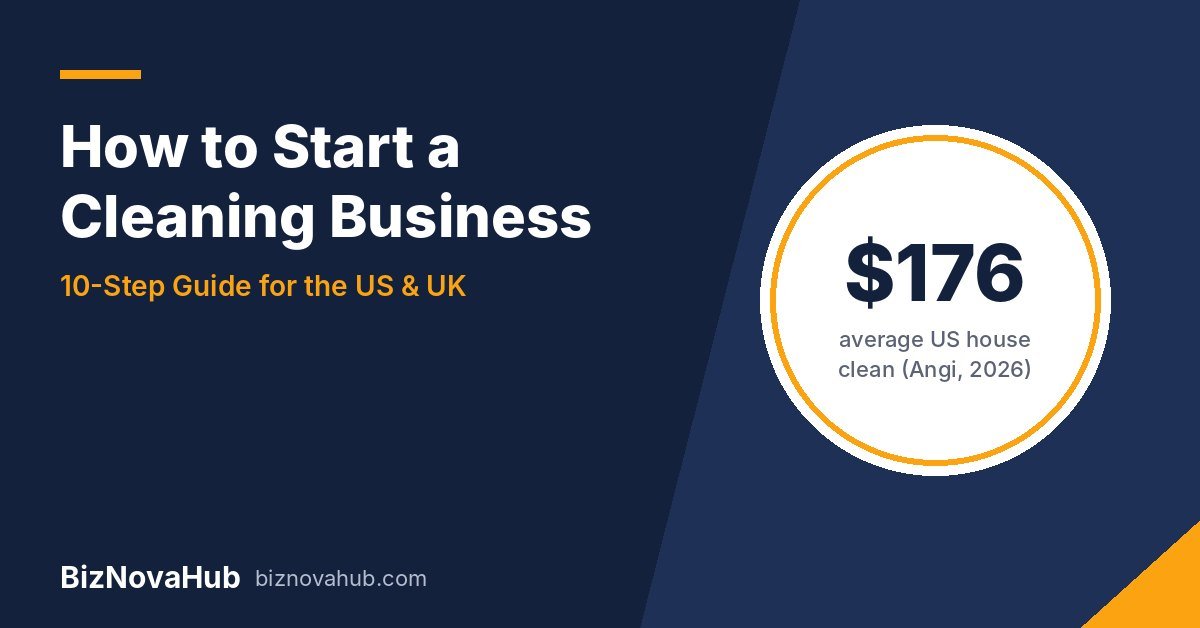
- Healthy pricing: according to Angi’s 2026 cost guide, US homeowners pay an average of $176 per clean, typically between $118 and $238.
- Room to grow: once you hire, you earn the margin between what clients pay and what you pay staff. The US Bureau of Labor Statistics puts the median wage for janitors and building cleaners at $17.71 an hour (May 2025).
The downsides are physical work, client turnover and competition from other local cleaners. Good systems, reliability and reviews are what set successful cleaning companies apart.
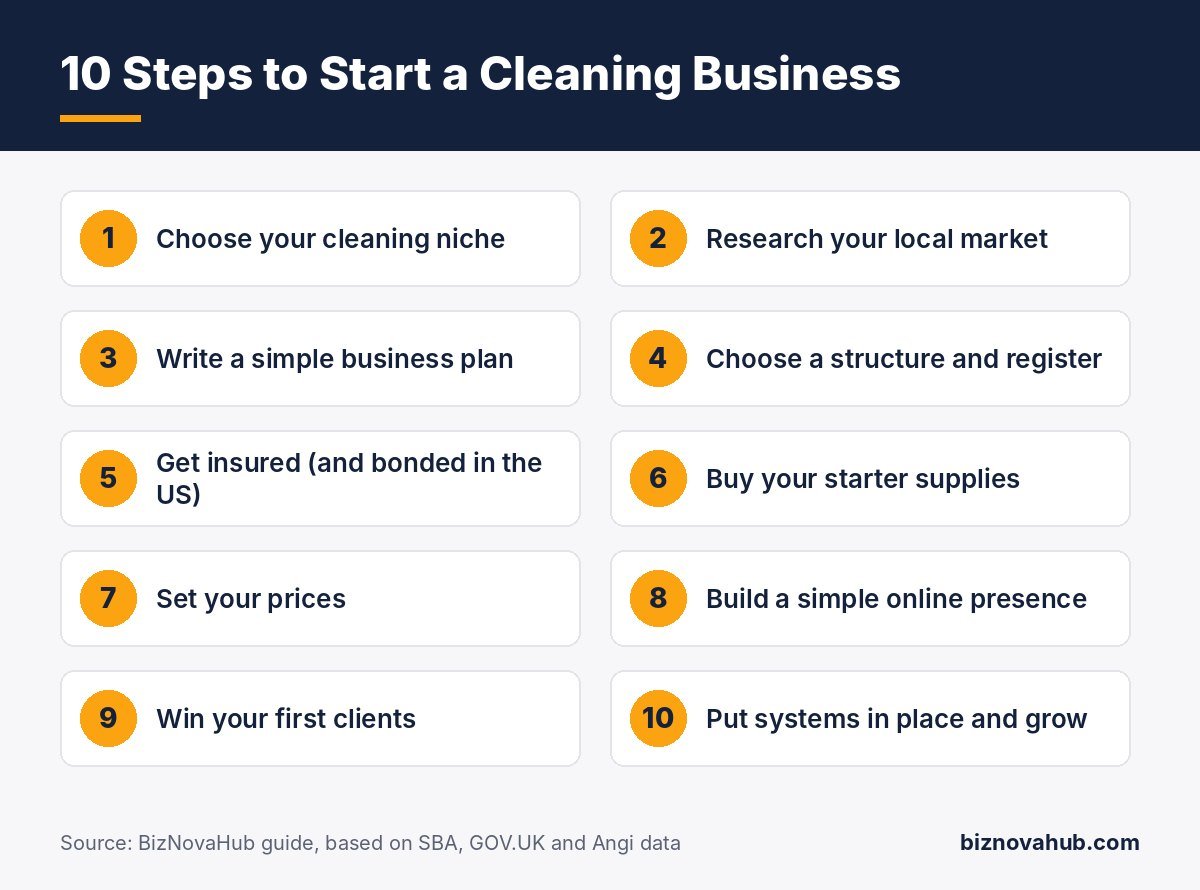
How to start a cleaning business in 10 steps
1. Choose your cleaning niche
Pick one or two services to start. Being specific makes marketing easier and lets you price with confidence.
| Niche | Best for | Notes |
|---|---|---|
| Residential (regular home cleaning) | Beginners, solo starters | Lowest start-up cost; recurring weekly or fortnightly work |
| Deep cleaning and move-out cleaning | Higher ticket jobs | Angi reports deep cleans at $200–$400 and move-outs up to about $500 |
| Short-term rental (Airbnb) turnovers | Tourist and city areas | Fast turnarounds, often linen changes; very regular work |
| Commercial / office cleaning | People who can work evenings | Contracts, larger jobs; usually needs more insurance and staff |
| Specialist (carpet, windows, post-construction) | Those willing to buy equipment | Higher prices, higher equipment costs |
2. Research your local market
Search Google Maps for “cleaners near me” in your town. Note how many companies there are, their prices (many list them), their reviews and what customers complain about. Gaps you can fill include evening availability, eco-friendly products, pet-friendly cleaning or faster booking.
3. Write a simple business plan
One page is enough to start: your services, target customers, prices, how you’ll find clients and your monthly costs. This also tells you how many clients you need to break even.
4. Choose a business structure and register
In the US: most new cleaners start as a sole proprietorship or form an LLC. A sole proprietorship costs nothing to set up, while an LLC separates your personal assets from business debts. See our full comparison: LLC vs sole proprietorship. You may also need a local business licence from your city or county.
In the UK: you can start as a sole trader and must register for Self Assessment with HMRC once your self-employed income is over £1,000 in a tax year, according to GOV.UK. Many cleaners later switch to a limited company. Compare the options in sole trader vs limited company.
5. Get insured (and bonded in the US)
- General liability / public liability insurance: covers damage to a client’s property or injury caused by your work. Most clients and almost all commercial contracts expect it.
- Janitorial bond (US): protects clients if an employee steals. Many homeowners look for “bonded and insured”.
- Employers’ liability insurance (UK): a legal requirement as soon as you employ staff. Cover must be at least £5 million, and you can be fined £2,500 for every day you’re not properly insured (GOV.UK).
- Workers’ compensation (US): required in most states once you have employees.
6. Buy your starter supplies
For residential cleaning you only need the basics:
- Microfibre cloths (colour-coded for kitchen, bathroom, general)
- All-purpose cleaner, glass cleaner, degreaser, bathroom descaler and disinfectant
- Vacuum cleaner with attachments, mop and bucket
- Scrub brushes, sponges, squeegee, duster with extension pole
- Gloves, caddy to carry supplies, bin bags
Keep safety data sheets for your chemicals. In the UK, employers must assess risks from hazardous substances under the COSHH regulations, which include many cleaning chemicals.
7. Set your prices
Most cleaners use one of three pricing methods:
| Method | Typical US range (Angi 2026) | Good for |
|---|---|---|
| Hourly, per cleaner | $25–$50 per hour | New businesses, unpredictable jobs |
| Per square foot | $0.10–$0.20 per sq ft (standard clean) | Larger homes, quotes by size |
| Flat rate per visit | $75–$175 standard; $200–$400 deep clean | Regular clients; easiest to sell |
To set a flat rate: estimate the hours a job takes, multiply by your target hourly rate, then add the cost of supplies and travel. Check that your price is competitive with the local companies you found in step 2.
8. Build a simple online presence
- Google Business Profile: free and the main way local customers find cleaners. Choose the right category (for example “House cleaning service”) and set your service area.
- A one-page website: services, prices or “from” prices, areas covered, reviews and a booking or quote form.
- Local listings: Nextdoor and Facebook groups in the US; local Facebook groups and directories in the UK.
9. Win your first clients
- Tell friends, family and neighbours, and ask them to share.
- Offer a first-clean discount to people who book a recurring service.
- Drop flyers in streets near your ideal clients.
- Contact local estate agents, property managers and Airbnb hosts.
- Ask every happy client for a Google review, and follow up with a short link.
10. Put systems in place and grow
Use a checklist for every type of clean so quality stays consistent. A booking and invoicing app saves hours each week. When you’re fully booked, hire your first cleaner, but price jobs so your margin covers wages, insurance and payroll taxes.
How to start a cleaning business from home
Almost every residential cleaning company starts from home. You need space to store supplies, a phone and a car or good public transport. Use your home address for admin, or a virtual mailing address if you don’t want clients to see it. In the US, check that your area doesn’t need a home-occupation permit.
How to start a cleaning business with no money
Starting with almost nothing is possible if you keep costs tiny:
- Begin by cleaning with the client’s own supplies and equipment (many homeowners prefer it).
- Start as a sole proprietor or sole trader to avoid formation fees.
- Use free marketing: Google Business Profile, Facebook groups and word of mouth.
- Reinvest your first payments into insurance and your own supply kit.
Don’t skip insurance for long. One accident in a client’s home can cost far more than a year’s premium.
Start-up cost checklist
| Item | Needed? |
|---|---|
| Cleaning supplies and equipment | Yes (or use clients’ supplies at first) |
| Liability insurance | Strongly recommended from day one |
| Bond (US) | Recommended for residential work |
| Business registration / licence | Depends on structure and location |
| Website and booking software | Optional at first; free tools available |
| Transport | Needed if clients are spread out |
Example: how to price a regular home clean
Here’s a simple worked example you can copy for your own quotes. Adjust the numbers to your local market.
| Item | Example |
|---|---|
| Home | 3 bedrooms, 2 bathrooms, about 1,800 sq ft |
| Estimated time (1 cleaner) | 3 hours for a standard clean |
| Target rate | $40 per hour (within Angi’s $25–$50 range) |
| Labour | 3 × $40 = $120 |
| Supplies and travel | $12 |
| Quote | $132 per visit, or about $120 for fortnightly regulars |
Check the result against square-foot pricing: 1,800 sq ft at Angi’s $0.10–$0.20 range gives $180–$360. If your quote is well below that, you’re probably undercharging. The first clean usually takes longer, so many cleaners charge 1.5–2× for the first visit or sell it as a deep clean.
Room-by-room cleaning checklist
A written checklist keeps quality consistent, avoids complaints and makes it easy to train staff later.
- Kitchen: wipe worktops and splashbacks, clean hob and outside of appliances, clean sink and taps, wipe cupboard fronts, empty bins, vacuum and mop floor.
- Bathrooms: clean and disinfect toilet, sink, bath and shower; descale taps and screens; polish mirrors; replace towels if requested; mop floor.
- Bedrooms: dust surfaces and skirting boards, make beds or change linen, vacuum floors and under beds where reachable.
- Living areas: dust surfaces, electronics and picture frames; plump cushions; vacuum upholstery and floors; wipe light switches and door handles.
- Finishing: empty all bins, check every room against the client’s notes, lock up and send a “job done” message.
How to hire your first cleaner
US: decide whether workers are employees or independent contractors. The IRS looks at behavioral control, financial control and the type of relationship. If you set schedules, supply equipment and tell people how to clean, they are likely employees, and you must withhold income tax and pay Social Security, Medicare and unemployment taxes. Getting this wrong can lead to back taxes and penalties.
UK: before anyone starts, check they have the right to work in the UK. Register as an employer with HMRC and run payroll, and remember employers’ liability insurance is a legal requirement from day one.
In both countries, pay for a trial shift, give new staff your checklist and accompany them on their first few cleans.
7 mistakes new cleaning businesses make
- Underpricing to win clients, then having no margin left to hire help.
- Skipping insurance because “nothing will go wrong”.
- No written cancellation policy. Late cancellations wipe out income; charge a fee for cancellations within 24–48 hours.
- Taking jobs too far apart, so travel eats your hourly rate.
- Not asking for reviews. Reviews are how new clients choose a cleaner.
- Mixing personal and business money, which makes taxes harder (and can weaken LLC protection in the US).
- No checklist, so quality varies from visit to visit.
Frequently asked questions
Do I need a licence to start a cleaning business?
In the US, there’s no special cleaning licence in most places, but many cities and counties require a general business licence. In the UK, you don’t need a licence to clean homes, but you must register with HMRC and you need employers’ liability insurance once you hire staff.
How much can you make with a cleaning business?
It depends on your prices and how many clients you have. As a guide, if you charge $150 per visit and complete 15 cleans a week, that’s $2,250 a week in revenue before costs. Your profit depends on supplies, travel, insurance, taxes and wages if you employ people.
What is the most profitable type of cleaning business?
Commercial contracts, deep cleans, move-out cleans and specialist services such as carpet cleaning usually earn more per job. Regular residential cleaning earns less per visit but gives steady, recurring income.
Can I start a cleaning business on my own?
Yes. Most cleaning companies start as one person. Begin with a few regular clients, build reviews, then hire help when you can’t take on more work.
This guide is general information, not legal or tax advice. Check local rules with your city, state or county in the US, or with GOV.UK and HMRC in the UK.