Sole Trader vs Limited Company: Which Is Better in 2026/27?
If you’re starting a business in the UK, you’ll usually choose between two structures: working as a sole trader or setting up a limited company. The right choice affects how much tax you pay, how much admin you do and whether your personal assets are at risk if things go wrong.
This guide compares sole trader vs limited company using the current 2026/27 tax rates from GOV.UK, so you can see the real differences in tax, liability, cost and paperwork.
In this guide
- Quick answer
- Sole trader vs limited company: comparison table
- How sole traders are taxed (2026/27)
- How limited companies are taxed
- Is a limited company more tax-efficient?
- Liability and risk
- Admin and deadlines
- Which should you choose?
- Expenses you can claim as a sole trader
- VAT: the same rules for both
- Which is better for common business types?
- 6 mistakes to avoid
- Frequently asked questions
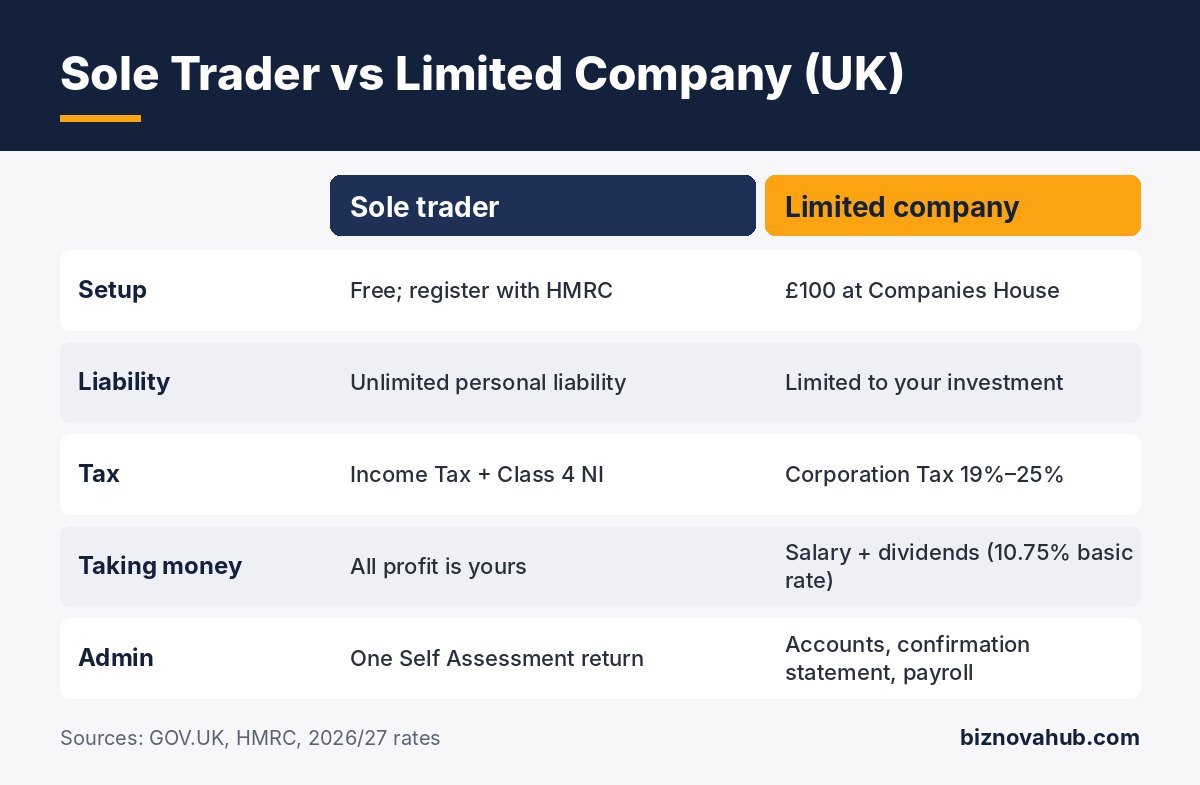
Quick answer
- Sole trader suits most people starting out: it’s free, quick and simple, and you can switch later.
- Limited company suits businesses with higher profits, real liability risk, investors or clients that prefer to work with companies, as long as you’re happy with more admin and accountancy costs.
Sole trader vs limited company: comparison table
| Sole trader | Limited company | |
|---|---|---|
| Legal status | You and the business are the same | Separate legal entity from its owners |
| Liability | Unlimited: you’re personally responsible for business debts | Limited: shareholders’ liability is generally limited to their investment |
| Setting up | Register for Self Assessment with HMRC | Register with Companies House before trading |
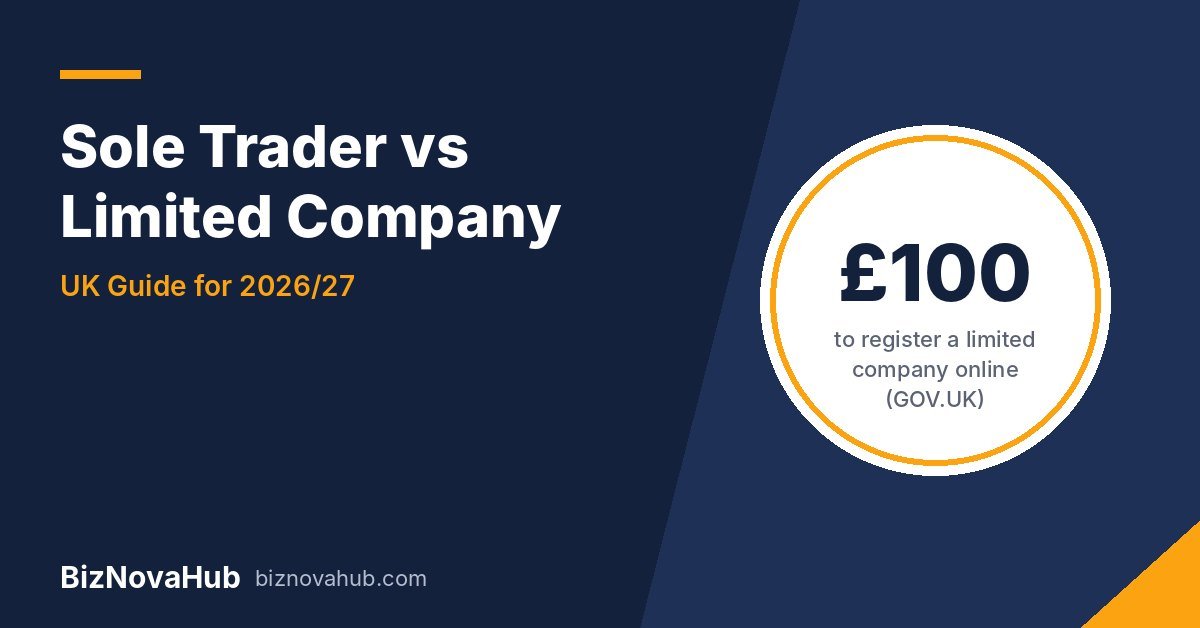
| Cost to set up | Free | £100 online Companies House fee |
| Tax on profits | Income Tax + Class 4 National Insurance | Corporation Tax (19%–25%), then tax on salary or dividends you take |
| Annual admin | Self Assessment tax return | Annual accounts, confirmation statement, Corporation Tax return, payroll if you pay a salary, plus your own tax return |
| Privacy | Details not on a public register | Company and director details are public on Companies House |
| Accountant | Optional for simple businesses | Usually recommended |
Sources: GOV.UK: Set up a business, Register your company.
How sole traders are taxed (2026/27)
As a sole trader, your business profit is added to any other income and taxed through Self Assessment.
Income Tax (England, Wales and Northern Ireland)
| Taxable income | Rate |
|---|---|
| Up to £12,570 (Personal Allowance) | 0% |
| £12,571–£50,270 | 20% |
| £50,271–£125,140 | 40% |
| Over £125,140 | 45% |
The Personal Allowance falls by £1 for every £2 of income over £100,000. Scotland has different Income Tax bands. Source: GOV.UK Income Tax rates.
National Insurance
- Class 4: 6% on profits between £12,570 and £50,270, and 2% on profits above £50,270.
- Class 2: if your profits are £7,105 or more, Class 2 contributions are treated as paid, so you get the National Insurance credit without paying. Below that, you can choose to pay voluntary contributions of £3.65 a week.
Source: GOV.UK self-employed National Insurance rates.
Example: a sole trader with £50,000 profit
Assuming no other income and the standard Personal Allowance (2026/27, England):
- Income Tax: (£50,000 − £12,570) × 20% = £7,486
- Class 4 NI: (£50,000 − £12,570) × 6% = £2,245.80
- Total: about £9,732, leaving roughly £40,268 after tax and NI
How limited companies are taxed
Corporation Tax
| Company profit | Rate |
|---|---|
| £50,000 or less | 19% (small profits rate) |
| £50,001–£250,000 | Main rate with Marginal Relief (effective rate between 19% and 25%) |
| Over £250,000 | 25% (main rate) |
Source: GOV.UK Corporation Tax rates. The thresholds are reduced if you have associated companies or a short accounting period.
Taking money out: salary and dividends
The company’s money isn’t yours until you take it out. Most owner-directors take a small salary through payroll and the rest as dividends from profits after Corporation Tax.
| Dividend tax 2026/27 | Rate |
|---|---|
| Dividend allowance | First £500 tax-free |
| Basic rate | 10.75% |
| Higher rate | 35.75% |
| Additional rate | 39.35% |
Source: GOV.UK Tax on dividends. Dividend rates rose from April 2026, which has narrowed the tax advantage of a limited company for many small businesses.
Is a limited company more tax-efficient?
Sometimes, but less often than it used to be. A company can be more tax-efficient when:
- Profits are high, especially above the higher-rate threshold
- You don’t need to take all the profit out each year (money left in the company is only subject to Corporation Tax)
- You want to pay into a pension through the company
For lower profits, the savings can be small or wiped out by accountancy fees and extra admin. Because salary, employer National Insurance, dividends and pensions interact, get an accountant to run the numbers for your situation before switching.
Liability and risk
As a sole trader, you’re personally responsible for all business debts, according to GOV.UK. A limited company keeps business debts separate, but banks often ask directors for personal guarantees on loans, and directors can still be personally liable for wrongful trading or breaches of their duties. Insurance (public liability, professional indemnity) matters with either structure.
Admin and deadlines
Sole trader
- Register for Self Assessment if your self-employed income is over £1,000 in a tax year (the trading allowance).
- Register by 5 October after the end of the tax year you started trading, or you could get a penalty (GOV.UK).
- File an online tax return and pay by 31 January.
- Making Tax Digital for Income Tax: sole traders and landlords with qualifying income over £50,000 must use it from 6 April 2026, over £30,000 from April 2027 and over £20,000 from April 2028 (GOV.UK). This means keeping digital records and sending quarterly updates.
Limited company
- Register with Companies House before trading (£100 online, usually within 24 hours). Every director needs to verify their identity and get a Companies House personal code.
- File annual accounts with Companies House and HMRC, and a Company Tax Return.
- File a confirmation statement every year.
- Run payroll if you pay salaries, including your own.
- File your personal Self Assessment return if you take dividends above your allowances.
Which should you choose?
| Choose sole trader if… | Choose limited company if… |
|---|---|
| You’re just starting or testing an idea | Your profits are consistently high |
| Your profits are modest | Your work carries real liability risk |
| You want the least admin and cost | Clients or contracts require a company |
| You value privacy | You plan to raise investment or bring in partners |
Many people start as sole traders and incorporate later once profits grow. Starting a hands-on service business? See how to start a cleaning business and how to start a lawn care business, both with UK sections. Setting up in the US instead? Read LLC vs sole proprietorship.
Expenses you can claim as a sole trader
You pay tax on profit, not turnover, so claiming allowable expenses is one of the easiest ways to reduce your bill. According to GOV.UK, these include:
- Office costs such as stationery and phone bills
- Travel costs such as fuel, parking and train fares
- Clothing such as uniforms (not everyday clothes)
- Staff and subcontractor costs
- Stock and raw materials
- Financial costs such as insurance and bank charges
- Business premises costs
- Advertising and marketing
- Professional subscriptions and business training
You can use flat-rate simplified expenses for vehicles and working from home. Or, if your costs are low, claim the £1,000 trading allowance instead of actual expenses (you can’t do both).
VAT: the same rules for both
Whether you’re a sole trader or a limited company, you must register for VAT if your taxable turnover in the last 12 months goes over £90,000, or you expect it to in the next 30 days (GOV.UK). You can register voluntarily below that, which can help if most of your customers are VAT-registered businesses.
Which is better for common business types?
| Business | Often starts as | Why |
|---|---|---|
| Cleaner, gardener, dog walker | Sole trader | Simple, low admin; insurance covers most risks |
| Freelance designer or writer | Sole trader | Low costs; switch later if profits grow |
| IT contractor | Limited company | Many agencies and clients prefer to contract with companies (IR35 rules apply) |
| Online shop with stock | Either | Company if you hold significant stock or take on debt |
| Business seeking investment | Limited company | Investors buy shares, which needs a company |
6 mistakes to avoid
- Registering late: miss the 5 October deadline and you could face a penalty.
- Not saving for tax: put aside a percentage of every payment for Income Tax and National Insurance.
- Forgetting payments on account: once your tax bill is over £1,000, HMRC usually asks for advance payments towards next year’s bill.
- Treating company money as your own: in a limited company, taking money without recording it as salary, dividends or a director’s loan can create tax problems.
- Incorporating too early for small savings that don’t cover the extra accountancy costs.
- Ignoring Making Tax Digital: check if and when you need digital records and quarterly updates.
Frequently asked questions
Do I pay less tax as a limited company?
Not always. Companies pay 19%–25% Corporation Tax, and you then pay tax on salary or dividends you take out. With dividend tax rates rising from April 2026, the savings for small profits are often modest once accountancy costs are included.
Can I switch from sole trader to limited company?
Yes. You register a company with Companies House, move the business into it, and tell HMRC you’ve stopped trading as a sole trader. Get advice on transferring assets and contracts.
How much does it cost to set up a limited company?
The Companies House online registration fee is £100. Ongoing costs usually include accountancy fees and the annual confirmation statement fee.
When do I need to register as a sole trader?
When your self-employed income is more than £1,000 in a tax year. You must tell HMRC by 5 October after the end of that tax year.
This article is general information based on GOV.UK guidance for 2026/27, not tax advice. Rules differ in Scotland. Speak to an accountant before choosing a structure.