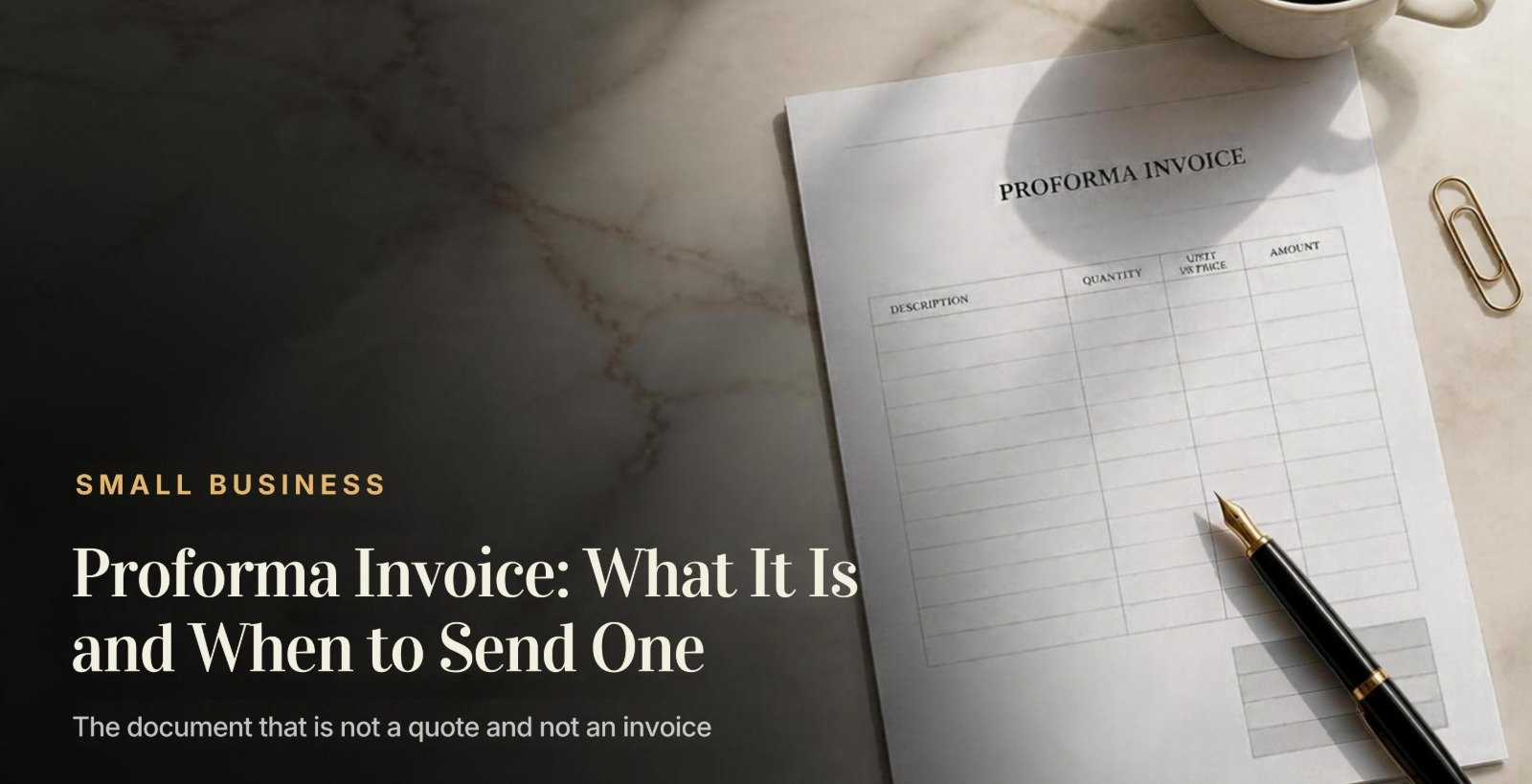
Proforma Invoice: What It Is, When to Send One and What to Put On It
A customer asks for a proforma invoice before they will raise a purchase order. A freight forwarder wants one before your goods can move. An accounts team pays against one, then asks why they cannot reclaim the VAT.
It is one of the most-requested documents in business and one of the least understood — not a quote, not an invoice, not an accounting record, but it looks like all three.
Here is what a proforma invoice actually is, what belongs on it, the tax rule that catches most people out, and when sending one is the wrong move.
What a proforma invoice actually is
A proforma invoice is a document sent before a sale is finalised, showing exactly what will be supplied and what it will cost if the buyer goes ahead.
The Latin is the clue: pro forma means “as a matter of form”. It has the form of an invoice without the legal weight of one.
HMRC’s guidance describes them as used to offer goods or services to customers the supplier does not know or who may not be creditworthy — setting out what will be supplied if payment is made, and acting as the document payment is requested against.
Three things follow from that, and they explain almost everything else:
- It creates no debt. Nobody owes you anything because you sent one.
- It is not an accounting document. It does not go in your sales ledger and it does not trigger a tax point.
- It is binding on you, not on them. The prices and terms on it are your offer; the buyer is free to walk away.
Proforma invoice vs quote vs invoice
These three documents get used interchangeably, and that is where the trouble starts. They do different jobs at different moments.
| Quote | Proforma invoice | Invoice | |
|---|---|---|---|
| When it is sent | Early, while the buyer is deciding | Once terms are agreed, before supply | After supply, or on agreed terms |
| What it says | Roughly what this would cost | Exactly what this will cost | What is now owed |
| Creates a debt | No | No | Yes |
| Goes in your accounts | No | No | Yes |
| Has an invoice number | No | Reference only | Yes, sequential |
The difference between a quote and a proforma invoice is commitment. A quote invites a conversation; a proforma says the conversation is over — this is the deal, pay this and we ship.
The difference between a proforma and an invoice is timing. One comes before anything has been supplied; the other records that it has, and that money is now due. If you are not sure which you need, our guide to writing an invoice properly covers the real thing, and purchase order vs invoice explains the document the buyer sends back.
What to put on a proforma invoice
There is no prescribed format, which is why so many are vague and get queried. Include all of this:
- The words “Proforma Invoice” at the top, unmistakably
- A unique reference — not a sequential invoice number, which you reserve for real invoices
- Issue date and a validity date — “valid for 30 days” protects you when costs move
- Your business details and the buyer’s
- A full line-by-line description with quantities, unit prices and the total
- Tax shown separately, clearly labelled as an estimate
- Shipping terms and costs, with the Incoterm if goods are crossing a border
- Payment terms and methods — and the currency, stated explicitly
- Expected delivery or lead time
Two additions do disproportionate work: the validity date stops a buyer accepting a six-month-old price, and a line saying a VAT invoice will follow on payment heads off the commonest query a proforma invoice generates.
The VAT rule that catches people out
This is the part that costs businesses real money, and it is the same across the UK and EU.
A proforma invoice cannot be used to reclaim VAT.
HMRC’s internal guidance is blunt about it: pro-forma invoices are “not, therefore, acceptable evidence” for input tax. A VAT reclaim needs a valid VAT invoice, and a proforma is not one. The same principle runs through the EU VAT system — the right to deduct attaches to a compliant invoice, and a document issued before supply is not that.
Two consequences:
If you receive one, you can pay against it, but the VAT cannot go on your return until the supplier sends a proper VAT invoice. Teams that book it and move on end up with a reclaim that will not survive inspection.
If you issue one, the obligation is yours. Once payment arrives or the supply is made, you must issue a full VAT invoice — in the UK, within 30 days. The proforma does not discharge that; it precedes it.
HMRC also says a proforma invoice “should always be clearly described as such and should preferably be endorsed ‘This is not a VAT invoice'”. That one line at the foot of the document prevents nearly every dispute this subject produces. Full guidance is in HMRC’s VAT Trader Records manual.
If you are not VAT-registered, do not show VAT on a proforma invoice at all. And where a sale sits outside the scope of VAT, leave the VAT line off and show duties separately instead.
Using a proforma invoice for customs
The second major use is international shipping, where the rules differ again.
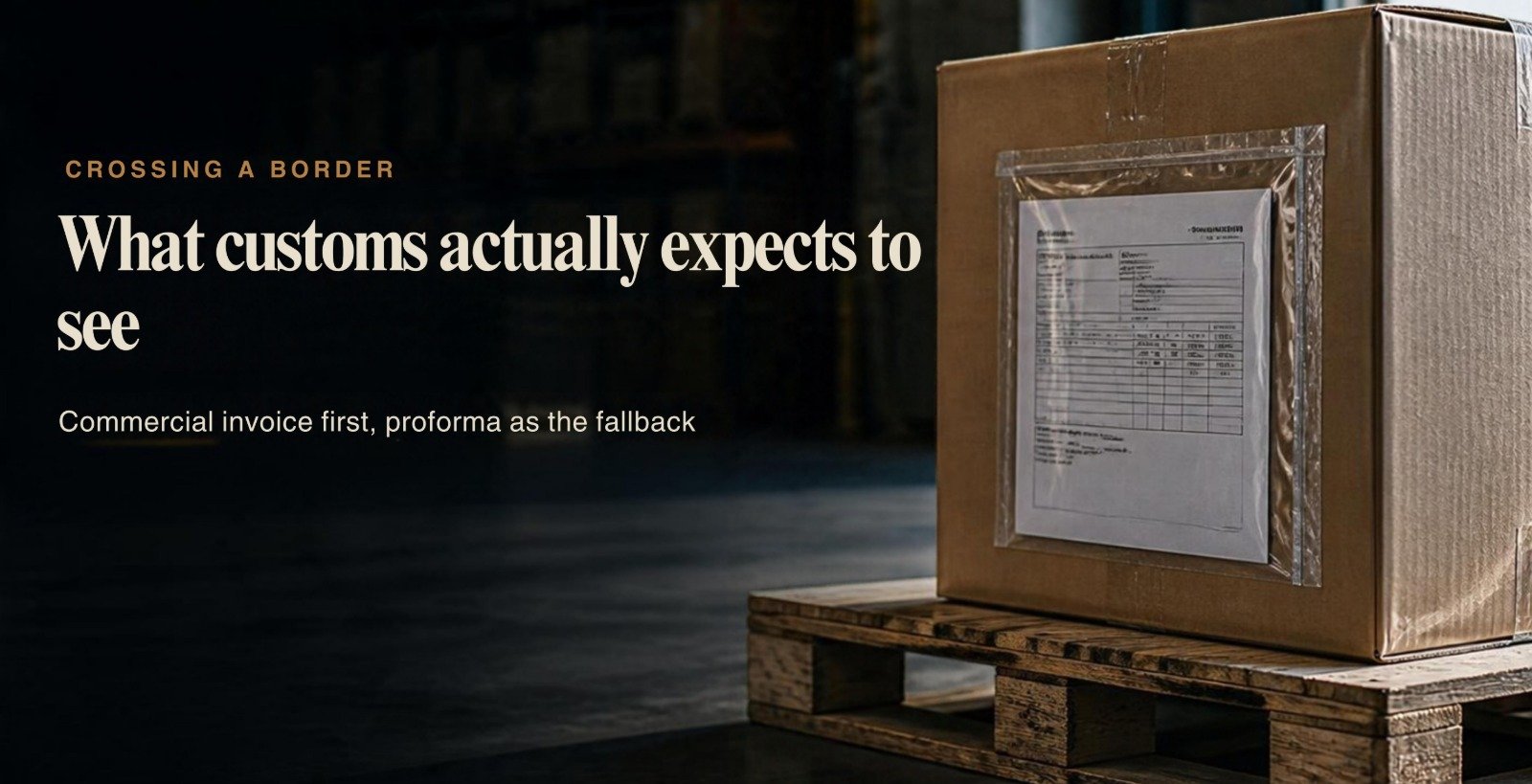
For goods entering the United States, a commercial invoice is the document US Customs and Border Protection expects. It is filed electronically through CBP’s ACE system and a copy travels with the shipment. A proforma invoice is accepted as a fallback where a commercial invoice genuinely cannot be produced — not as the standard route.
It earns its place earlier in the chain. Buyers routinely need one to:
- Apply for an import licence or permit
- Open a letter of credit with their bank
- Arrange a transfer of foreign currency
- Get a pre-shipment inspection booked
For any of those it must be specific: exact descriptions, HS codes where you have them, country of origin, gross and net weights, and the Incoterm. A vague proforma invoice is worse than none — it stalls at the bank or the border and you find out a week later.
When to send one — and when not to
Send a proforma invoice when:
- A new customer needs to pay in advance and wants a document to pay against
- The buyer’s finance process requires a figure before they can raise a purchase order
- Goods are crossing a border and the buyer needs paperwork for a licence, bank or inspection
- The order is bespoke and you want written agreement on specification before you start
Do not send one when:
- The work is already done. That is an invoice. Sending a proforma invoice at that point delays your own payment and muddies your records.
- The buyer is still deciding. That is a quote. A proforma invoice sent too early reads as pressure.
- You cannot stand behind the numbers. A proforma invoice is a firm offer. If the price might move, send a quote with the variables stated.
Three mistakes worth avoiding
Using a sequential invoice number. If a proforma invoice carries a number from your real invoice sequence, your numbering now has gaps or duplicates, and an auditor will ask about both. Use a separate prefix — PF-0012 — and keep the real sequence clean.
Treating it as a sale. A proforma invoice does not belong in your revenue figures. Recognising it early overstates income and distorts cash flow. It is a document, not a transaction.
Never converting it. The commonest failure of all: payment arrives and no VAT invoice is ever raised. Your customer cannot reclaim, your records are incomplete, and in the UK you have missed a 30-day obligation. Build the conversion into the moment payment clears, not a monthly tidy-up.
Where this fits with your other paperwork
It is one document in a short chain: quote, proforma, purchase order, invoice, payment. Each has a job, and the chain breaks when two get merged. Once the real invoice goes out, the terms on it decide when you get paid — our guides to net 30 payment terms and the late payment fee you can charge cover what happens next, and the follow-up templates are for when it goes quiet.
Frequently asked questions
Is a proforma invoice legally binding?
Not on the buyer. It is a firm offer from the seller, so the prices bind you while it is valid, but it creates no obligation to pay.
Can you pay against a proforma invoice?
Yes, and advance payment is one of the main reasons they exist. Just make sure a full invoice follows the payment.
Can I reclaim VAT on a proforma invoice?
No. You need a valid VAT invoice from the supplier. HMRC does not accept proformas as evidence for input tax.
What is the difference between a proforma invoice and a commercial invoice?
A proforma invoice is issued before the sale is final and is an estimate of terms. A commercial invoice is issued after, states what is actually owed, and is the document customs authorities expect.
The short version
A proforma invoice is a firm offer dressed as an invoice: it tells the buyer exactly what they will get and what it will cost, before anything is supplied.
It creates no debt, belongs in no ledger, and cannot be used to reclaim VAT. Mark it clearly, give it a validity date, keep it out of your invoice sequence, and convert it to a real invoice the moment payment lands.
Get those five things right and it becomes what it should be — the document that gets a cautious buyer to commit.