Follow Up Email After No Response: 7 Templates
You sent the email. You proofread it twice. And then: nothing. Three days of silence, then a week, and now you are refreshing your inbox like it owes you money.
Writing a follow up email after no response feels awkward because you are guessing. Did they see it? Are they annoyed? Is chasing going to make you look desperate?
Almost always the answer is more boring than the story you are telling yourself. The email arrived on a bad morning, got scrolled past, and is now sitting under four hundred newer ones. Nobody made a decision about you.
Here is the timing, the wording and seven copy-paste templates for every follow up email after no response that actually comes up: proposals, invoices, cold outreach, quiet clients and interviews.
Why no response usually is not rejection
Before you write a follow up email after no response, it helps to know what you are actually dealing with, because the right follow up email after no response depends on which of these it is.
It was never seen. Spam filters, promotions tabs, a crowded inbox on a Monday. Your email existed for about four seconds in someone’s peripheral vision.
It was seen but not actionable. They opened it on a phone, between meetings, while thinking about something else. Replying required a decision, a document or another person, so they left it for later. Later never arrived.
It is stuck behind someone else. Your contact needs a budget holder, a legal review or a signature. They have nothing to tell you yet, and most people would rather say nothing than say “still waiting”.
It is a soft no. This exists, but it is rarer than people assume, and it is still worth one clean follow-up so you can stop wondering.
Three of those four are fixed by a short reminder arriving at a reasonable time. You are not persuading anyone. You are bringing the message back to the top of a pile.
How long to wait before a follow up email after no response
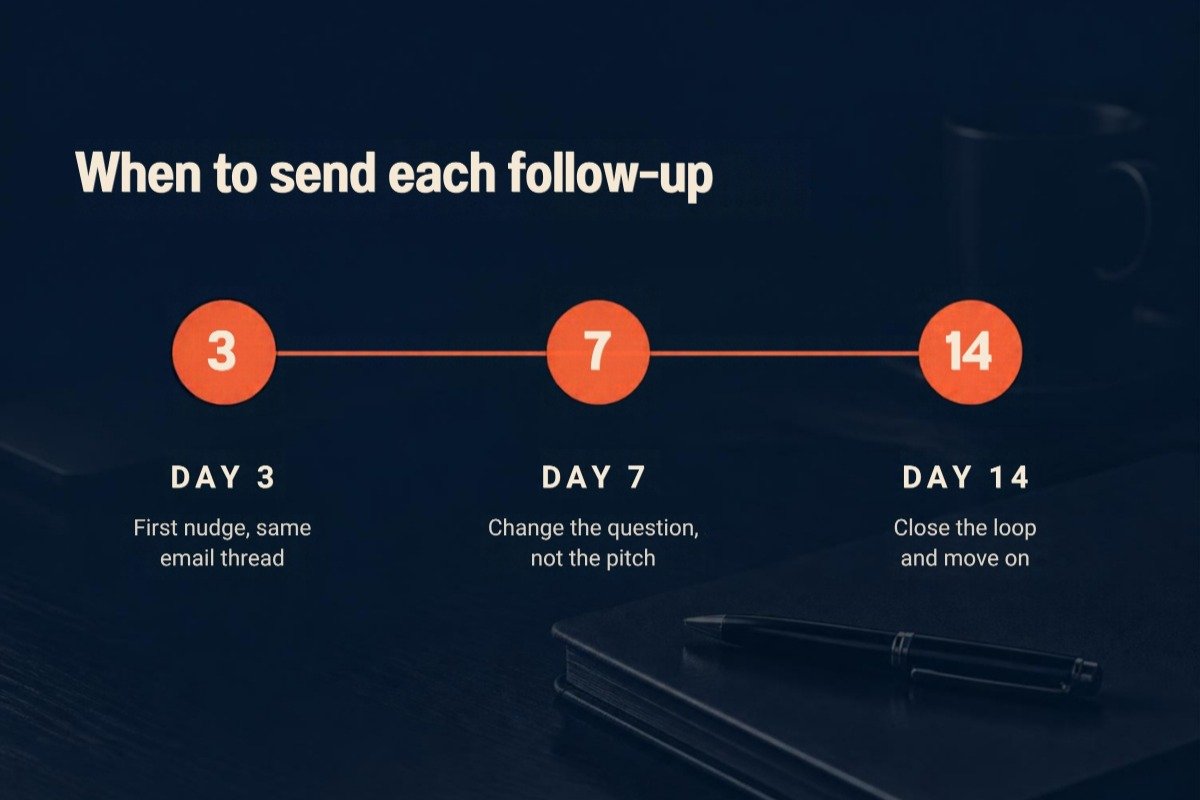
The most common mistake is not following up too often. It is waiting too long, then sending something apologetic and overlong because you feel guilty about the delay. Decide the dates for every follow up email after no response in advance instead — fixed gaps remove the decision, and a schedule never feels personal to the person receiving it.
- Cold outreach: 3 days, then 7 days, then 14 days. Three touches, then stop.
- A proposal or quote you were asked for: 3 to 4 days, then a week later.
- An unpaid invoice: the morning after the due date, then day 7, then day 14.
- A job interview: whatever date they gave you, plus one day. If they gave no date, one week.
- A client who has gone quiet mid-project: 2 days, because work is blocked and that is urgent for both of you.
Send in the morning, local time for them, on a Tuesday, Wednesday or Thursday where you can. Monday inboxes are a flood and Friday afternoon is a graveyard.
The four rules every follow up email after no response should obey
Reply in the same thread. Hit reply on the original rather than starting a new email. The original message, date and attachment travel with it, so the recipient never has to go looking for context.
Keep it under five lines. A follow-up is a nudge, not a second pitch. If your reminder is longer than the thing you are reminding them about, it gets postponed exactly like the first one did.
Give them an exit. A line like “if this has already been handled, ignore me” removes the need to explain or apologise. People reply far more often when replying does not require a confession.
Ask a question they can answer in one word. “Any update?” is a question about your anxiety. “Is this still on the agenda this quarter, yes or no?” is one they can clear in four seconds.

Subject lines that get opened
A follow up email after no response should normally keep the original subject line, because replying in-thread carries it along automatically. Change it only when the thread has gone stale or the recipient has changed. These work because they are specific and contain no pressure:
- Re: [original subject] — quick check
- Invoice [number] — [amount] — due [date]
- Still useful? [project name]
- Closing the loop on [topic]
Avoid “Just checking in”, “Touching base” and anything with “URGENT” in capitals. The first two say nothing and the third makes you sound like a scam.
7 templates for a follow up email after no response
Each follow up email after no response below is ready to use. Copy it, change the brackets, send.
1. After sending a proposal or quote
Subject: Re: Proposal — [project name]
Hi [name],
Checking you got the proposal I sent on [date]. No rush on a decision — I mostly want to know whether the scope and the number are in the right range, or whether I should rework either.
If it is helpful, I can send a shorter version with just the first phase.
[your name]
This works because it offers a smaller yes. A client hesitating over a big number will often happily answer a question about scope, and that reply restarts the conversation.
2. When an invoice has gone unpaid
Subject: Re: Invoice [number] — [amount] — due [date]
Hi [name],
Quick nudge that invoice [number] was due yesterday — attaching it again in case it got lost. If it is already in a payment run, no action needed and ignore me.
If anything is missing from it that your system needs, tell me and I will reissue today.
[your name]
Most late payments are not disputes. They are documents that failed a check and are sitting in an exception queue nobody has opened, so offering to fix the document is faster than asking for the money. If the delay is structural rather than accidental, look at what net 30 payment terms actually commit both sides to, and check the invoice itself is not the problem — our guide on how to write an invoice covers the fields that stop one being approved. If it keeps happening, note that UK businesses can charge statutory interest and debt recovery costs on late commercial payments — naming that entitlement moves an invoice up a payment run far more often than actually charging it does.
3. After cold outreach
Subject: Re: [original subject]
Hi [name],
Following up on the note below. Short version: I help [type of business] with [specific outcome], and I thought it might be relevant because [the specific thing you noticed about them].
If it is not, say “not for us” and I will leave you alone.
[your name]
The last line is doing most of the work. Giving someone explicit permission to decline gets you an answer either way, and a clean no is worth more than three more weeks of hoping.
4. After a job interview
Subject: Re: [role] interview — [your name]
Hi [name],
Thanks again for the conversation on [day]. You mentioned you would be making a decision around [date], so I wanted to check whether there is any update, and whether you need anything else from me.
Still very interested in the role.
[your name]
Reference the date they gave you. It turns the email from a nudge into a reasonable question about a timeline they set themselves.
5. When a client goes quiet mid-project
Subject: [project] — blocked on your side
Hi [name],
I am holding at [stage] until I get [the specific thing]. Without it I cannot start [next stage], which pushes the delivery date out by roughly the same number of days.
Can you tell me when I should expect it, or who else I should ask?
[your name]
This is the one follow-up where you should be direct about consequences, because the consequence lands on both of you. The second question matters too: “who else should I ask” quietly solves the case where your contact is the bottleneck. Having the deliverables and dates written down in advance makes this email almost automatic to write — one practical reason a statement of work earns its keep.
6. After a meeting with no next step
Subject: Re: [meeting] — next step
Hi [name],
Good to talk on [day]. My note from it was that the next step is [the thing], owned by [person], by [date]. Is that still right?
If something has changed, tell me and I will adjust.
[your name]
Writing the next step as a statement rather than a question makes it easy to correct and slightly uncomfortable to ignore. Both are useful.
7. The final email: closing the loop
Subject: Closing the loop on [topic]
Hi [name],
I have not heard back, so I am assuming the timing is not right and I will stop chasing this.
No hard feelings at all — if it comes back around later, you know where I am.
[your name]
This gets more replies than every email before it, and it is not a trick. It is the first message that asks for nothing, so answering costs nothing. Sometimes the answer is “sorry, yes, let’s do it”, sometimes a genuine no. Either way you get your attention back.
Mistakes that kill a follow up email after no response
Apologising for existing. “So sorry to bother you again” frames your own email as an imposition and invites the reader to agree. You sent an invoice or a proposal they asked for. That is not a bother.
Passive aggression. “I assume you must be very busy” and “as per my previous email” are read exactly as intended, and make a reply more awkward, not less.
Repeating the whole pitch. If they did not read six paragraphs the first time, eight will not help. Your follow-up should be shorter than the original.
Fake deadlines. “This price expires Friday” works once and costs you the relationship afterwards if it was not true. Real constraints are fine. Invented ones are obvious.
Chasing the wrong person. Your contact is often not the person who signs or pays. By the second follow-up it is reasonable to ask who else should be on the thread, or to copy accounts directly.
How many times should you send a follow up email after no response?
Three after the original is the sensible ceiling for anything speculative. For money you are owed, you keep going — an unpaid invoice is a debt rather than a request, and the sequence changes from reminders to a formal process.
A simple test: did this person ever ask you for something? If they did — a quote, a sample, an interview, work they received — you have standing and can follow up until you get a yes or a no. If they never asked you for anything, three touches and a polite close is the limit.
Make it a system, not a decision
The reason this is painful is that most people treat each follow up email after no response as a judgement call. Every day you wait feels like the polite choice, and you are also slightly dreading it, so you wait a bit longer — and by the time you send something you are annoyed and in a weak position.
Write a template for every follow up email after no response once, and save them wherever you keep snippets. The moment you send a proposal or issue an invoice, put the follow-up dates straight in your calendar. That moves the decision from “should I chase today” to “it is Thursday, so I send email two”.
Clients with procurement departments respect this immediately, because it is how they operate too. And a process that runs on dates rather than feelings is the easiest kind of work to hand off later — the same test in our guide to deciding what is safe to delegate: repetitive, rule-based and low-judgement.
Frequently asked questions
How long should I wait before sending a follow up email after no response?
Three days for cold outreach and proposals, one day for an overdue invoice, and two days when a client has gone quiet and work is blocked. For interviews, wait until one day past whatever date they gave you.
Should I send a follow up email in the same thread or start a new one?
Same thread, almost always. It carries the original message, date and attachment with it, so the recipient does not have to search for anything. Start a new thread only if the conversation is months old or you are writing to a different person.
What should I write in a follow up email after no response?
Four things: a one-line reminder of what you sent and when, the one piece of information they need, a question they can answer in a word, and a line that lets them off the hook if it has already been dealt with. Keep it under five lines.
Is it rude to send more than one follow up email after no response?
No. One reminder is easy to miss, which is how the message got lost in the first place. Three follow-ups spaced several days apart is normal professional practice. What reads badly is daily chasing, or a reminder longer and angrier than the original.
What do I do when nobody ever replies?
Send the closing-the-loop email, mark it closed and move on. Chasing a silent prospect for a month costs more than the deal is usually worth. If quiet or difficult clients are a pattern rather than an accident, it may be the relationship rather than the email — our guide on how to fire a client covers doing that cleanly.
What to do when the reply is “not right now”
Sometimes a follow up email after no response finally produces an answer, and the answer is a soft maybe. “Not right now.” “Let’s revisit next quarter.” “Budget is frozen until things settle.”
Most people treat that as a no and quietly delete the thread. That is a mistake, because a soft maybe is the single cheapest lead you will ever have: the person already knows who you are, already understands what you do, and has told you the objection is timing rather than fit.
Do three things instead. Ask one question — “what usually has to happen before something like this gets approved?” — because the answer tells you whether this is a real deferral or a polite exit. Agree a date out loud, so the next contact is expected rather than a surprise. Then put that date in your calendar with one line of context, so the message you send then can open with something specific rather than another generic check-in.
Deals that come back from a soft maybe close faster than cold ones, because the hard part — being taken seriously by a stranger — already happened.
The short version
A follow up email after no response is rarely a confrontation. Silence is almost never a verdict. It is an inbox problem, and inbox problems are solved by arriving again, politely, on a fixed day, with one clear question and a way out.
A follow up email after no response works best in the original thread. Keep it to five lines. Ask something answerable. Stop after three — unless they owe you money, in which case you have a much stronger conversation, and the paperwork to back it up, starting with the difference between a purchase order and an invoice.