Purchase Order vs Invoice: The Difference and When You Need Each
The first time a client asked me for a PO number I said I didn’t have one and assumed that was the end of it. Two months later I was still waiting to be paid, and when I finally rang accounts the answer was simple: no purchase order, no payment.
The confusion behind that is almost always the same one: purchase order vs invoice. They look alike, they carry similar numbers, and people use the words interchangeably. They are opposite documents, travelling in opposite directions, and mixing them up is one of the most common reasons an invoice sits unpaid.
Here is the difference between a purchase order and an invoice, what belongs on each, how the process runs on both sides, and when a small business should start issuing purchase orders of its own.
Purchase order vs invoice: the difference in one line
The single most useful thing to understand is the direction it travels.
A purchase order is issued by the buyer and sent to the seller. It says: I want these goods or services, in this quantity, at this price, delivered by this date. An invoice goes the other way — the seller issues it to the buyer to ask for payment.
Legally, the order is a proposal rather than a done deal. US federal procurement rules put it plainly: FAR 13.004 states that “a quotation is not an offer and, consequently, cannot be accepted by the Government to form a binding contract”, that “the order is an offer by the Government to the supplier to buy certain supplies or services”, and that “a contract is established when the supplier accepts the offer.”
Commercial purchasing works on the same logic. The sequence is quote, order, acceptance, delivery, invoice. Which is why “just start the work, the PO is coming” is a worse position than it sounds: until something has been accepted, there is nothing to enforce.
What goes on a purchase order
There is no single legal format, but finance systems expect roughly the same fields, and a missing one is usually why an order gets kicked back.
| Field | Why it is there |
|---|---|
| PO number | The reference everything else is matched against. Unique, never reused. |
| Date of issue | Fixes when the offer was made. |
| Buyer details | The legal entity doing the buying, plus the billing address. |
| Supplier details | Who the order is being placed with, as they are legally named. |
| Line items | One row per thing, with description, quantity, unit price and line total. |
| Delivery address and date | Where it goes and by when. Often a different address from billing. |
| Payment terms | When the buyer will pay once invoiced. |
| Total value | The ceiling. Invoicing above it usually triggers a manual review. |
| Approver | The person inside the buyer’s business who authorised the spend. |
Notice that the total is a ceiling, not an estimate. If you invoice for more than the purchase order authorises, most systems will hold the whole invoice rather than pay the approved part. That single rule causes more payment delays than anything else on this list.
Purchase order vs invoice vs quote: who issues what
Purchase order vs invoice is the comparison that matters most, but a quote belongs in the picture too. All three get used interchangeably in conversation and are completely different in a finance system.
| Quote | Purchase order | Invoice | |
|---|---|---|---|
| Who issues it | Seller | Buyer | Seller |
| What it does | Proposes a price | Offers to buy | Requests payment |
| When | Before anything is agreed | After the price is agreed | After delivery |
| Binding? | No | Once accepted, yes | Records an existing debt |
| Carries a payment due date | No | Sets the terms | States the due date |
A receipt is a fourth thing again — it confirms money has already changed hands. GOV.UK is explicit that an invoice is not the same as a receipt, and sending the wrong one is a quick way to have your request for payment rejected by a system that was looking for something else. If you are on the selling side of this, our guide to how to write an invoice covers the fields that document needs.
How the process actually runs
A complete purchase order cycle has six steps. Small businesses run all six in an afternoon; large ones take weeks.
- A need is identified. Somebody decides something has to be bought. In bigger companies this becomes a purchase requisition — an internal request, not sent to anyone outside.
- It is approved internally. Someone with spending authority signs off. This is the step the whole document exists to record.
- The purchase order is issued. It gets a number and goes to the supplier.
- The supplier accepts. A confirmation, an order acknowledgement, or simply starting work. The contract exists from here.
- Goods or services are delivered, and the buyer records what actually arrived.
- The invoice is matched and paid, against the order and the delivery record.
If you are the supplier, your job is steps three and four: get the number before you start, and confirm in writing what you are accepting. Everything that goes wrong later is traceable to skipping one of those.
The three-way match
This is the control that explains why finance departments care so much, and it is worth knowing even if you never issue a purchase order yourself. Before paying, the buyer’s accounts team lines up three documents:
- The purchase order — what was authorised.
- The delivery note or goods received record — what actually turned up.
- The invoice — what is being charged for.
If all three agree, the invoice is paid, often without a human looking at it. If any one disagrees — a quantity is different, a price has moved, the PO number is missing — it drops into an exception queue and waits for someone to investigate.
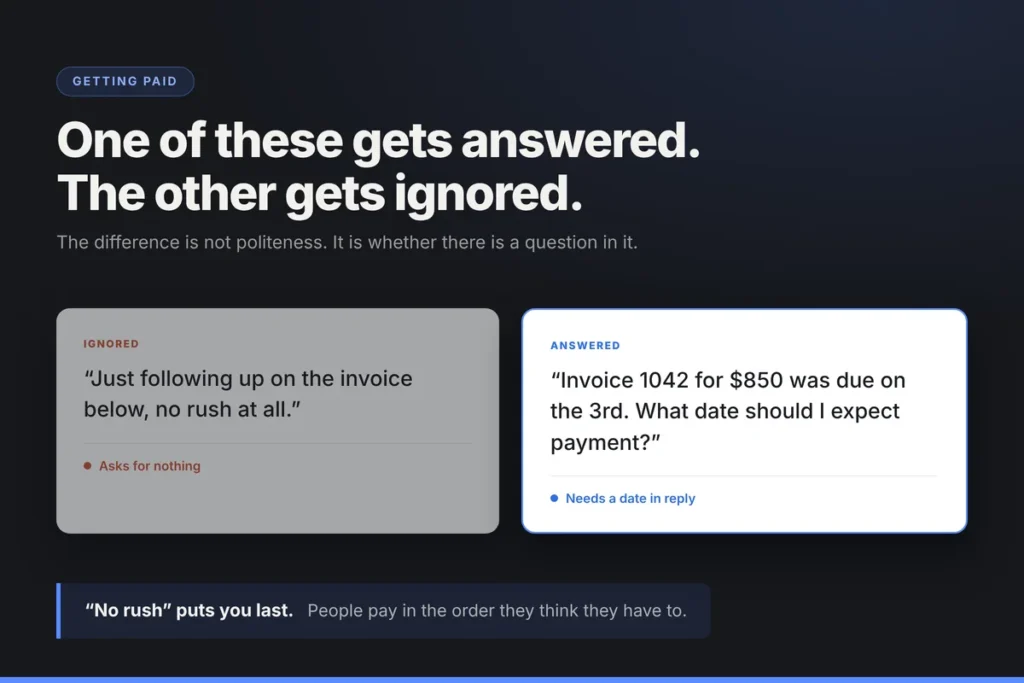
That queue is where most “they haven’t paid me” situations live — not a dispute, just a mismatch nobody has opened. It changes how you chase: “has invoice 2026-031 matched against PO 4500118?” gets a specific answer in one reply.
The four types you will meet
Most small businesses only ever need the first.
| Type | What it is | When it is used |
|---|---|---|
| Standard | One order, one delivery, everything specified. | The default. A one-off purchase. |
| Blanket | Agreed prices and terms for repeat buying over a period, up to a total value. | Ongoing supplies, retainers, recurring services. |
| Planned | Quantity and price fixed, delivery dates filled in later. | Known annual volume, staged delivery. |
| Contract | Terms agreed first, individual orders raised against it afterwards. | Long-term supplier relationships. |
A blanket purchase order is worth asking about if you do the same work for the same client every month. It replaces a monthly approval round with a single annual one, which usually means you get paid faster.
When a small business should start issuing them
You do not need a purchase order system to buy printer paper. You probably do need one once any of these is true.
More than one person can commit your money. The moment somebody other than you can agree to spend, the order becomes the record of who approved what. Without it, you find out at the end of the month.
You have been surprised by an invoice. If a supplier has ever billed you more than you expected and you had nothing in writing to point at, that is the cost of not having one.
This is also one of the first finance tasks that is safe to hand to someone else, because it is rule-based and the rules are short — the same profile we described in our guide to delegating tasks. The approval stays with you. The raising, sending and filing does not have to.
When the supplier’s terms do not match yours
You send a purchase order with your payment terms. The supplier confirms it and attaches their own terms and conditions, which say something different. Both documents now exist and they disagree.
This happens constantly and it is rarely anybody being difficult — both sides are sending standard paperwork.
Read the acknowledgement rather than filing it. If it changes the price, the delivery date or the payment terms, that is a counter-offer, not a formality. Reply in writing confirming which terms govern: “Confirming we are proceeding on the terms of PO 4500118, with payment 30 days from invoice.”
Do it before delivery. Once goods arrive and get used, arguing about whose terms applied is much harder than settling it on day one. The legal treatment of conflicting documents varies by jurisdiction, so for anything high value it is worth a lawyer’s view rather than a template.
Numbering and filing
A purchase order number is only useful if it is unique and findable. Two rules cover it.
Never reuse a number. If an order is cancelled, the number is retired with it. Reissuing a cancelled number creates a duplicate in somebody’s system, and duplicates are how both copies end up unpaid.
Keep the whole chain together. Order, acknowledgement, delivery note, invoice, filed under the same reference. That bundle is what you need if a supplier queries a payment, and it is also what a tax authority expects you to be able to produce.
The IRS states that supporting documents should “identify the payee, the amount paid, proof of payment, the date incurred”, along with a description showing the amount was for purchases, and it names invoices, canceled checks, cash register receipts, and credit card receipts and statements among the documents that do this. It also notes that a combination of documents may be needed to substantiate all elements of a purchase — which is a fair description of what an order, a delivery note and an invoice do together.
A folder of numbered PDFs and a simple log is a legitimate system. The format matters far less than being able to find the whole set in under a minute.
Mistakes that cause problems
- Starting work before the purchase order arrives. If it never comes, you have no approved spend and a weak position.
- Leaving the PO number off your invoice. In any company with a procurement process this is an automatic return, not a delay.
- Invoicing above the order value. The whole invoice holds, not just the excess. Get the order amended first.
- Vague line items. “Consulting services” cannot be matched against a delivery record by anyone who was not in the room.
- Not reading the acknowledgement. Changed terms you never noticed are still changed terms.
- Addressing it to the wrong entity. The trading name on the website is often not the company that pays.
Most of these are the same failure in different clothes: a document that cannot be matched to another document. If you are still deciding what name should appear on this paperwork at all, our comparison of sole trader versus limited company is the place to start, with a US equivalent in LLC versus sole proprietorship.
Frequently asked questions
What is the difference between a purchase order and an invoice?
The purchase order comes from the buyer and is sent before the work, offering to buy. The invoice comes from the seller and is sent after delivery, asking to be paid. Same transaction, opposite directions, different moments.
Do you need both a purchase order and an invoice?
In any business with a procurement process, yes. The order records that the spend was approved; the invoice requests the payment and is matched back against the order before anyone pays it.
Is a purchase order legally binding?
On its own it is an offer. It becomes binding when the supplier accepts it, which is the position US federal procurement rules take and how commercial purchasing generally works.
What is the difference between a purchase requisition and a purchase order?
A requisition is internal — one person asking their own organisation for permission to buy. The order is external and goes to the supplier once that permission exists.
Who creates the purchase order, the buyer or the seller?
The buyer, always. If a supplier sends you something that looks like one, it is a quote, an order confirmation or a pro forma invoice.
What if the delivery does not match the order?
Record what actually arrived rather than what was ordered. The three-way match depends on the delivery record being honest; correcting it later is far harder.
The short version
Purchase order vs invoice comes down to direction and timing. The purchase order is the buyer’s offer to buy, issued before the work, carrying a unique number, specific line items, a delivery date, payment terms and an approved total. The supplier’s acceptance turns it into a contract. The invoice is the seller’s request for payment, issued afterwards, and matched back against that order before anyone pays it.
If you sell, get the number before you start and put it on every invoice. If you buy, approve the spend before the order goes out and keep the order, the delivery record and the invoice together. That is the difference between an invoice that pays itself and one that sits in a queue.