How to Start a Lawn Care Business: 9 Steps, Costs and Pricing
Lawn care is a simple business to understand: people want tidy gardens but don’t have the time or tools to keep them that way. With a mower, a trimmer and a reliable schedule, you can build a route of regular customers who pay you every week of the growing season.
This guide explains how to start a lawn care business step by step: the equipment you need, how to price your services, the licences and insurance to sort out, and how to start a lawn care business with little or no money. It covers both the US and the UK.
In this guide
- Is lawn care a good business to start?
- How to start a lawn care business in 9 steps
- How to start a lawn care business with no money
- How to keep earning in winter
- Example: what a weekly mowing route can earn
- Lawn care seasonal calendar
- What to put in a lawn care service agreement
- 6 mistakes to avoid
- Frequently asked questions
Is lawn care a good business to start?
- Strong demand: the US Bureau of Labor Statistics expects employment of grounds maintenance workers to grow 5% from 2025 to 2035, faster than the average for all occupations, with about 1.3 million people already working in the field.
- Recurring income: most customers want weekly or fortnightly mowing, so one sale turns into many visits.
- Clear pricing: according to Angi, US homeowners pay an average of about $123 per mowing visit, with most paying between $49 and $203.
- Easy add-ons: edging, hedge trimming, leaf removal and fertilisation increase the value of each customer.
The main challenges are seasonality (less work in winter in most areas), weather delays and the physical work. Plan for winter services such as leaf clearance, snow removal (US) or hedge and garden tidy-ups.
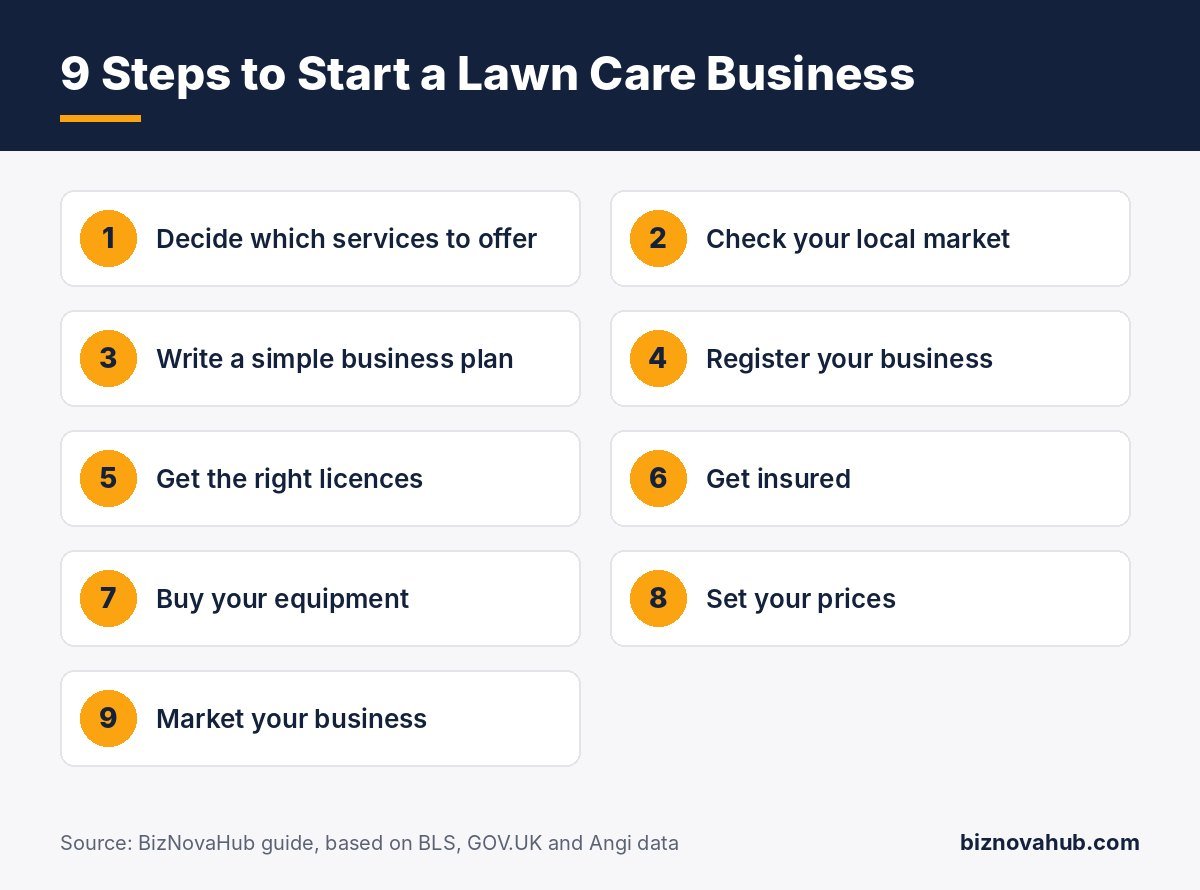
How to start a lawn care business in 9 steps
1. Decide which services you’ll offer
Start with what you can do well with basic equipment, then add services as you grow.
| Service | Equipment needed | Notes |
|---|---|---|
| Mowing | Mower | Your core recurring service |
| Edging and trimming | String trimmer, edger | Usually bundled with mowing |
| Leaf removal and garden clean-ups | Leaf blower, rake, bags | Strong demand in autumn/fall |
| Hedge trimming | Hedge trimmer | Popular add-on, especially in the UK |
| Fertilisation and weed control | Spreader, sprayer | Usually needs a pesticide licence or certificate |
| Aeration and overseeding | Aerator (can be rented) | Seasonal, higher-ticket jobs |
2. Check your local market
Search Google Maps for “lawn care near me” and “lawn mowing service” in your area. Note competitor prices, reviews and which neighbourhoods they serve. Look for gaps: areas with lots of medium-sized lawns, new housing estates, retirees or busy families.
3. Write a simple business plan
List your services, service area, prices, equipment costs and how many customers you need to cover your costs. Plan your route: customers close together save fuel and time.
4. Register your business
US: choose between a sole proprietorship and an LLC (see LLC vs sole proprietorship), register your business name if needed, and check whether your city or county requires a business licence.
UK: most gardeners start as sole traders and register for Self Assessment with HMRC once self-employed income exceeds £1,000 in a tax year. Compare structures in sole trader vs limited company.
5. Get the right licences
Mowing itself usually doesn’t need a special licence. Applying chemicals does:
- US: the BLS notes that most states require licences for workers who apply pesticides and fertilisers, usually after passing an exam on safe use and disposal. Contact your state’s department of agriculture.
- UK: anyone using professional pesticide products as part of their work needs a recognised certificate of competence (such as the PA1 and PA6 qualifications).
6. Get insured
- General liability / public liability: covers damage, for example a stone thrown by a mower that breaks a window.
- Commercial auto (US) or business-use vehicle insurance (UK): your personal car policy may not cover business use.
- Equipment insurance: protects against theft of mowers and tools.
- Employers’ liability (UK): legally required once you employ staff, with at least £5 million cover. Workers’ compensation (US): required in most states once you hire.
7. Buy your equipment
Starter kit: push or self-propelled mower, string trimmer, leaf blower, safety gear (ear and eye protection, gloves, boots), fuel cans or batteries, and a way to transport it all.
Later upgrades: commercial mower, trailer, edger, hedge trimmer, aerator. To save money, buy good-quality used equipment and rent expensive tools you’ll only use a few times a year.
8. Set your prices
| Pricing method | Typical US range (Angi) | When to use it |
|---|---|---|
| Per visit (flat rate) | $49–$203; average about $123 | Regular mowing; easiest for customers |
| Per acre | $50–$200 per acre | Large properties |
| Hourly | $25–$60 per hour | Clean-ups, irregular jobs |
| Weekly or seasonal plan | Weekly mowing around $65–$100 | Locking in customers for the season |
Measure each lawn (free satellite tools in Google Maps help), estimate the time it takes, then price so every job covers your fuel, equipment wear and a fair hourly rate for you. Offer a small discount for customers who sign up for the full season.
9. Market your business and win customers
- Create a free Google Business Profile with service areas and photos of your work.
- Knock on doors or leave flyers in streets where lawns are overgrown.
- Post before-and-after photos in local Facebook and Nextdoor groups.
- Offer a referral reward: a free cut for every new customer a client sends you.
- Ask every happy customer for a review.
How to start a lawn care business with no money
- Start with the equipment you own and take jobs close to home.
- Start as a sole proprietor or sole trader to avoid formation fees.
- Rent or borrow big equipment for one-off jobs.
- Use free marketing like your Google Business Profile, word of mouth and local groups.
- Reinvest early earnings into insurance and better equipment.
How to keep earning in winter
- Leaf removal and autumn clean-ups
- Snow removal (US) and gritting
- Hedge cutting, pruning and garden tidy-ups
- Gutter cleaning and pressure washing
- Selling pre-paid spring and summer packages
Example: what a weekly mowing route can earn
This simple example shows how recurring customers add up. Your numbers will depend on lawn sizes, local prices and travel time.
| Item | Example |
|---|---|
| Customers on weekly mowing | 30 |
| Average price per visit | $60 (small suburban lawns, below Angi’s $123 national average) |
| Weekly revenue | 30 × $60 = $1,800 |
| Season length | About 26 weeks (varies by climate) |
| Season revenue | $46,800 before costs |
From that, take off fuel, equipment maintenance and replacement, insurance, marketing, taxes and any wages. Add-ons such as edging, hedge trimming and autumn clean-ups often increase revenue per customer without adding many new stops.
Lawn care seasonal calendar
| Season | Main services | Business focus |
|---|---|---|
| Early spring | Spring clean-ups, first cuts, aeration, overseeding | Sign up customers for full-season plans |
| Late spring to summer | Weekly mowing, edging, trimming, weed control (licensed) | Keep routes tight; upsell add-ons |
| Autumn / fall | Leaf removal, final cuts, hedge trimming, overseeding | Pre-sell next year’s plans at a discount |
| Winter | Snow removal (US), gritting, garden tidy-ups, gutter cleaning | Service equipment; plan marketing for spring |
What to put in a lawn care service agreement
A short written agreement prevents most disputes. Include:
- Services included (mowing, edging, clippings removal) and what costs extra
- Visit frequency and the season’s start and end dates
- Price per visit or per month, and when invoices are due
- What happens when it rains (reschedule within a set number of days)
- Access to the garden, gates and pets
- How either side can cancel and with how much notice
6 mistakes to avoid
- Customers spread across town: travel time destroys profit. Focus on a few neighbourhoods.
- Underpricing big or overgrown lawns: always see or measure a lawn before you quote.
- Applying weed killer without a licence or certificate, which can mean fines and voided insurance.
- Neglecting equipment maintenance: sharp blades and regular servicing prevent breakdowns mid-season.
- No winter plan, which leaves you without income for months.
- Not tracking expenses: fuel, repairs and mileage are usually tax-deductible business costs.
Frequently asked questions
How much does it cost to start a lawn care business?
If you already own a mower and trimmer, you can start for the cost of fuel, insurance and basic marketing. Buying new commercial-grade equipment and a trailer costs much more, so most owners start small and upgrade from profits.
Do I need a licence to mow lawns?
Usually not for mowing alone, though your city or county may require a general business licence in the US. If you apply pesticides or weed killers, most US states require a pesticide applicator licence, and in the UK you need a recognised certificate of competence.
How many lawns can one person mow in a day?
It depends on lawn size and travel time. Grouping customers in the same neighbourhoods is the best way to fit more jobs into each day.
Is a lawn care business profitable?
It can be, especially with recurring customers on tight routes and add-on services. Profit depends on your prices, fuel and equipment costs, and how efficiently you schedule jobs.
This guide is general information, not legal or tax advice. Check licensing rules with your state or local council.