How to Ask for Payment Professionally (Without Sounding Rude)
The invoice was due eleven days ago. You have written the email four times and deleted it four times, because every version sounds either pushy or pathetic.
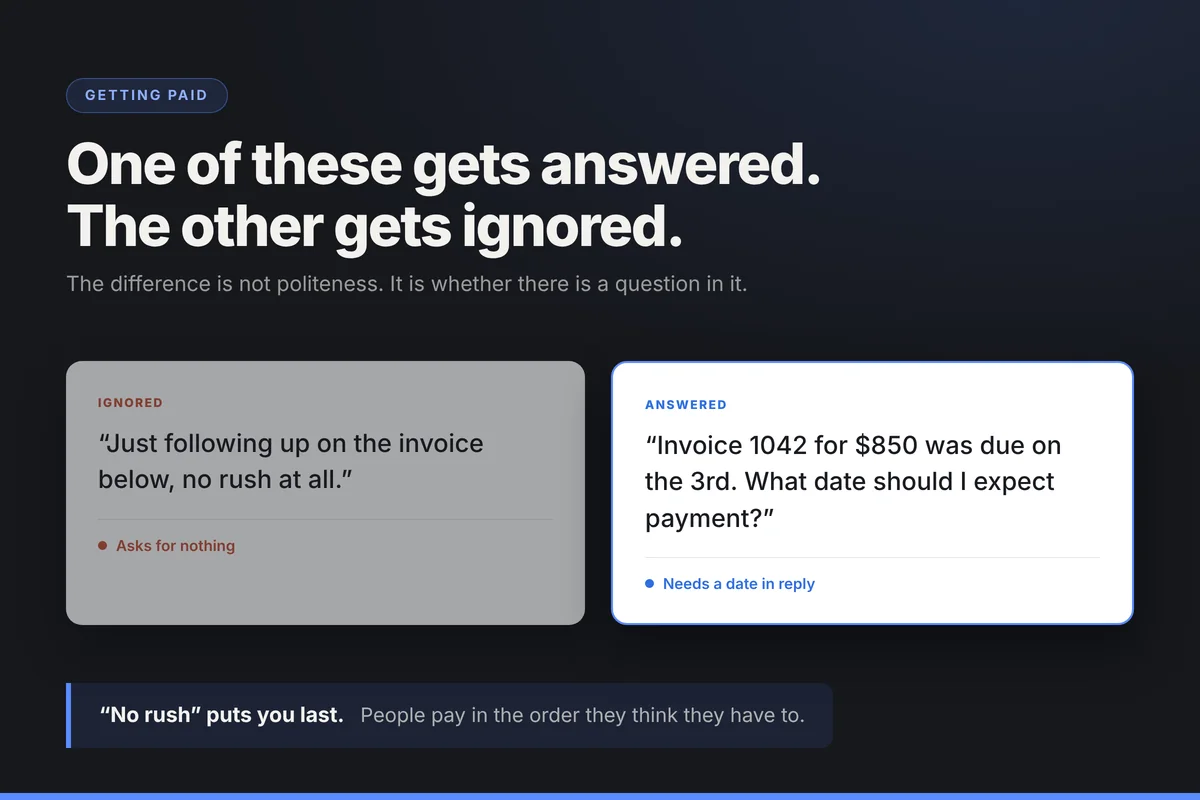
So you send the safe one. “Hi, just following up on the invoice below, no rush at all.”
And nothing happens.
Knowing how to ask for payment professionally is not about finding gentler words. It is about writing something the client cannot comfortably ignore. This guide covers why polite follow ups get skipped, the one change that gets answered, and the exact wording to use at each stage.
Why “just following up” gets ignored
Read that sentence again as the client reads it. “Just following up, no rush at all.”
There is no request in it. No amount, no date, nothing the reader has to do. It is a notification, not a question, and a notification is easy to leave in the inbox.
Worse, it signals something. Business owners who deal with late payment constantly describe the same pattern: clients pay in the order they believe they have to, and a message saying “no rush” quietly volunteers you for last place. One put it plainly: being polite is fine, but you can end up teaching a client that your invoices are optional.
That is the real cost of the soft follow up. Not rudeness avoided, but priority given away. Learning how to ask for payment professionally starts with accepting that.
The one change that works
There is one change that does most of the work. Replace the update with a question that has a date in it.
Instead of: “Just checking in on invoice 1042, let me know if you need anything.”
Write: “Invoice 1042 for $850 was due on the 3rd. What date should I expect payment?”
Three things change. There is a specific invoice and amount, so nobody has to go looking. There is a fact, the due date, which is not up for discussion. And there is a question that cannot be answered with silence or with “not yet”.
The second effect is the useful one. Once a client types a date, chasing them on that date is not rude any more. You are holding them to their own words, which is a completely different conversation from asking a favour.
Professional does not mean soft
This is where most people get stuck, and it is worth saying clearly: learning how to ask for payment professionally does not mean learning to be softer. It means being specific.
Professional means unemotional, specific and consistent. It does not mean padded. “Hi, that one was due on the 3rd, can you get it paid by Friday” is professional. It is also direct, and it contains an actual request.
Strip the apology out. You are not asking for a favour, you are asking for money that is already owed for work already delivered. The tone people worry about does not live in one message anyway. It lives in the relationship, and if the work was good, a plain question does not damage it.
How to ask for payment professionally at each stage
The best advice on how to ask for payment professionally comes from people who stopped deciding how firm to be on any given day, and set a schedule instead. Write these once and reuse them.
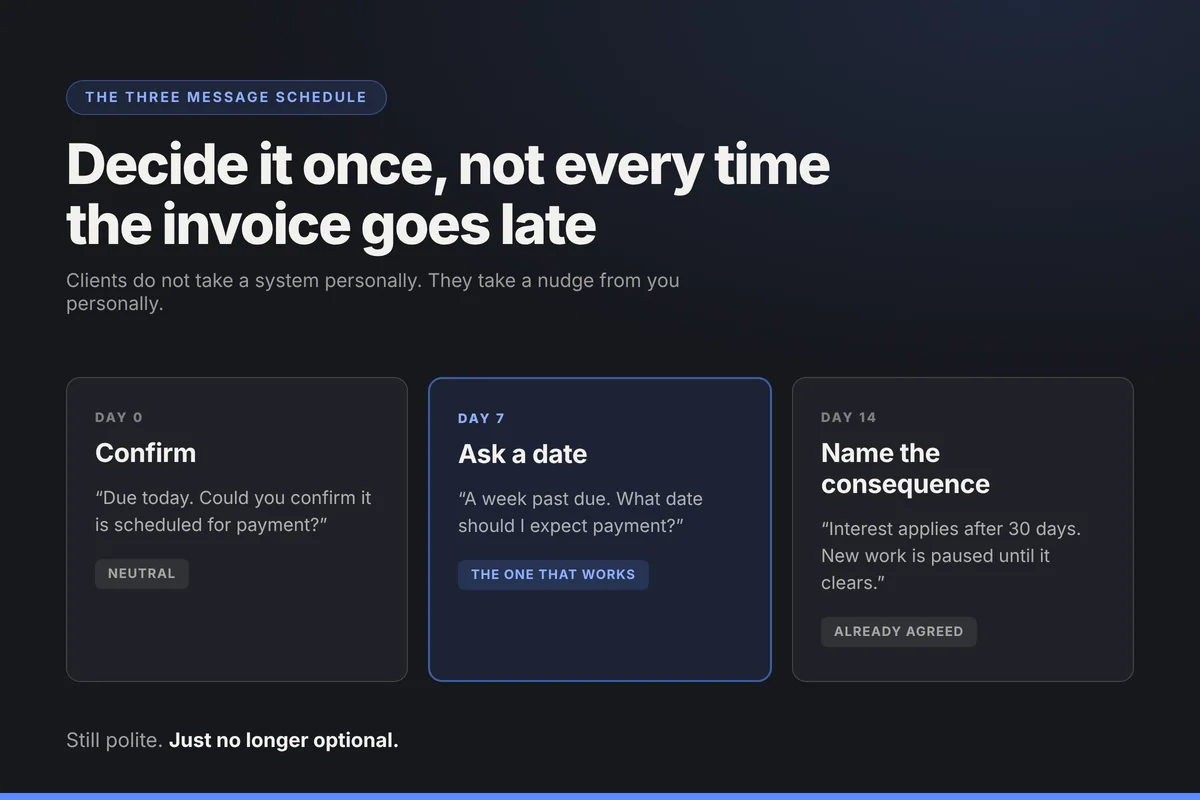
Message 1: the day it falls due
Hi [name], invoice 1042 for $850 was due today. Could you confirm it is scheduled for payment? Happy to resend the invoice if that helps.
Short, neutral, and it asks for confirmation rather than announcing a problem. This is how to ask for payment professionally before anything has gone wrong.
Message 2: one week later
Hi [name], invoice 1042 for $850 is now a week past its due date of 3 November. What date should I expect payment? If it is held up on your side, tell me what you need from me and I will send it today.
No apology, no “sorry to bother you”. The question is direct and the offer of help makes it easy to answer honestly.
Message 3: two weeks past due
Hi [name], invoice 1042 for $850 is now 14 days overdue. Our terms apply interest after 30 days, and new work is paused until the account is clear. Please confirm the payment date by Friday.
This is the one people are afraid of, and it is the one that works, because it names a consequence and a deadline. Notice it is still polite. Nothing in it is personal.
If writing these from scratch every time is the part you keep avoiding, use a saved payment reminder email template and change two fields.
Why a schedule beats a decision
There is a reason a schedule works better than deciding how to ask for payment professionally on the day itself.
Clients do not take a system personally. They take a nudge from you personally. If the reminders arrive on a known schedule, the same way every time, you are following a process rather than reacting to how annoyed you feel on a Tuesday morning.
It also removes the hardest part, which is deciding. Most accounting software, including Xero and QuickBooks, will send these on a set schedule automatically. The decision gets made once, in a calm moment, instead of twenty times in a bad mood.
Put the date and the consequence in your terms first
Knowing how to ask for payment professionally matters far less if the rules were agreed before the work started.
Write a real calendar date on the invoice, not a term. “Due 3 November” is a fact. “Net 30” is an invitation to interpret, and different accounts teams genuinely read it differently, so it is worth knowing exactly what you are agreeing to with net 30 payment terms.
Then put the consequence in the terms too: when interest applies, and when work pauses. Once that is agreed in advance, your day 14 message is not a threat. It is a reminder of something they already signed, which is why it reads as routine rather than aggressive. A stated late payment fee usually does its work as a deterrent long before you ever charge it. In the UK you can also claim statutory interest on late commercial payments, and in the United States federal agencies pay suppliers under the published Prompt Payment rule.
The fix that beats better wording
One service business owner said the thing that actually solved late payment for them was not asking better. It was asking earlier.
They moved to payment up front for bookings, and a deposit with a written cancellation policy for larger jobs. Once they stopped billing after the work was finished, the whole “day 7 or day 30” problem mostly disappeared, because there was nothing left to chase.
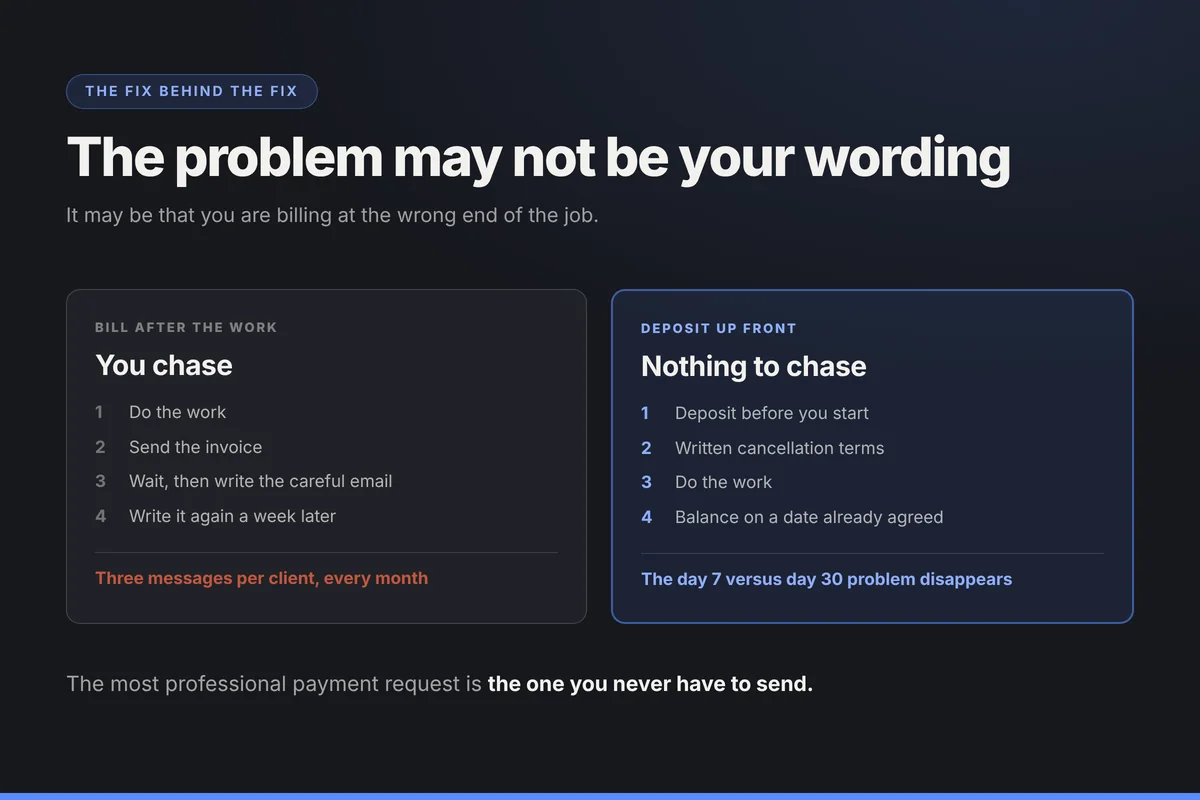
That will not fit every kind of work. But it reframes the question usefully. If you are spending real hours every month writing careful emails, the problem may not be your wording. It may be that you are billing at the wrong end of the job.
What the people who pay you actually see
Worth knowing, because knowing how to ask for payment professionally includes knowing who to ask.
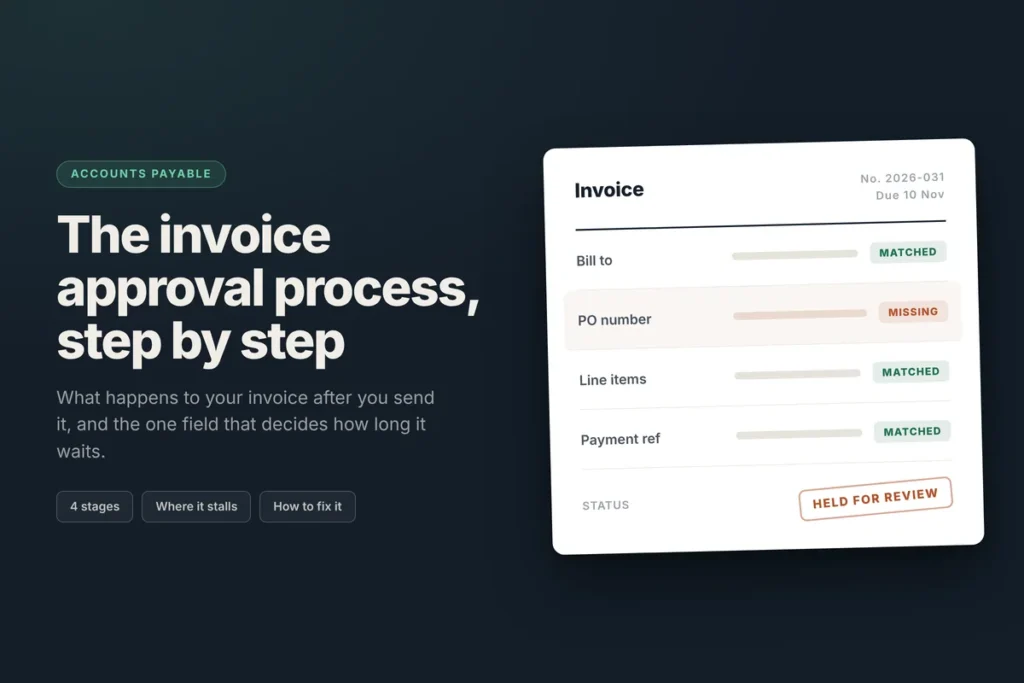
Inside a company, accounts payable processes invoices but does not approve them. The budget holder who commissioned the work does, and that approval step is where invoices sit. People who work in accounts payable say that when an invoice is stuck, the honest answer is usually that the approver has not looked at it, though what you hear back is a softer line about it moving through the approval process.
Their own recommendation: email your contact and copy accounts payable, so both sides see the same thing and neither can assume the other is handling it. If you want the full picture of what happens after you hit send, here is the accounts payable invoice approval process in detail.
Frequently asked questions
How do you ask for payment professionally without sounding desperate?
State the invoice number, the amount and the due date as facts, then ask one question: what date should you expect payment? Desperation comes from apologising and padding, not from being direct.
How long should you wait before chasing an invoice?
Send a short confirmation message on the due date itself, not a week later. Waiting signals that the date was soft. Asking for payment professionally on day one costs you nothing and sets the tone for the rest.
Should you charge a late fee?
Put one in your terms from the start. Most of its value is as a deterrent, and whether you enforce it depends on the client and the relationship. A fee that appears for the first time in an angry email is far harder to defend.
What if the client ignores all three messages?
Stop sending messages and change something. Pause the work, as stated in your terms, and phone instead of emailing. An invoice that goes unanswered through a full sequence is not a wording problem any more.
The short version
How to ask for payment professionally comes down to one idea: be specific, not soft.
Name the invoice, the amount and the date. Ask a question that needs a date in reply. Send it on a schedule you decided in advance rather than in a moment of frustration. Agree the consequence before the work starts, so the firm message is just a reminder of something already accepted.
And if you are writing these emails every month, consider taking a deposit instead. The most professional payment request is the one you never have to send.