
How to Get More Customers: 12 Proven Ways for Small Businesses
Every small business owner eventually hits the same wall: the work is good, the prices are fair, and still the phone does not ring often enough. The problem is almost never the quality of the work. It is that not enough of the right people know you exist, and the ones who do are not being given an easy reason to choose you.
This guide explains how to get more customers without a big budget. Everything below is something a one-person business can do, in order, starting this week. It covers the US, UK and Europe, and every figure is linked to its source.
In this guide
Where small business customers actually come from
Before spending anything, it helps to know which channels actually bring paying customers to a small local or service business. For most of them the order looks like this:
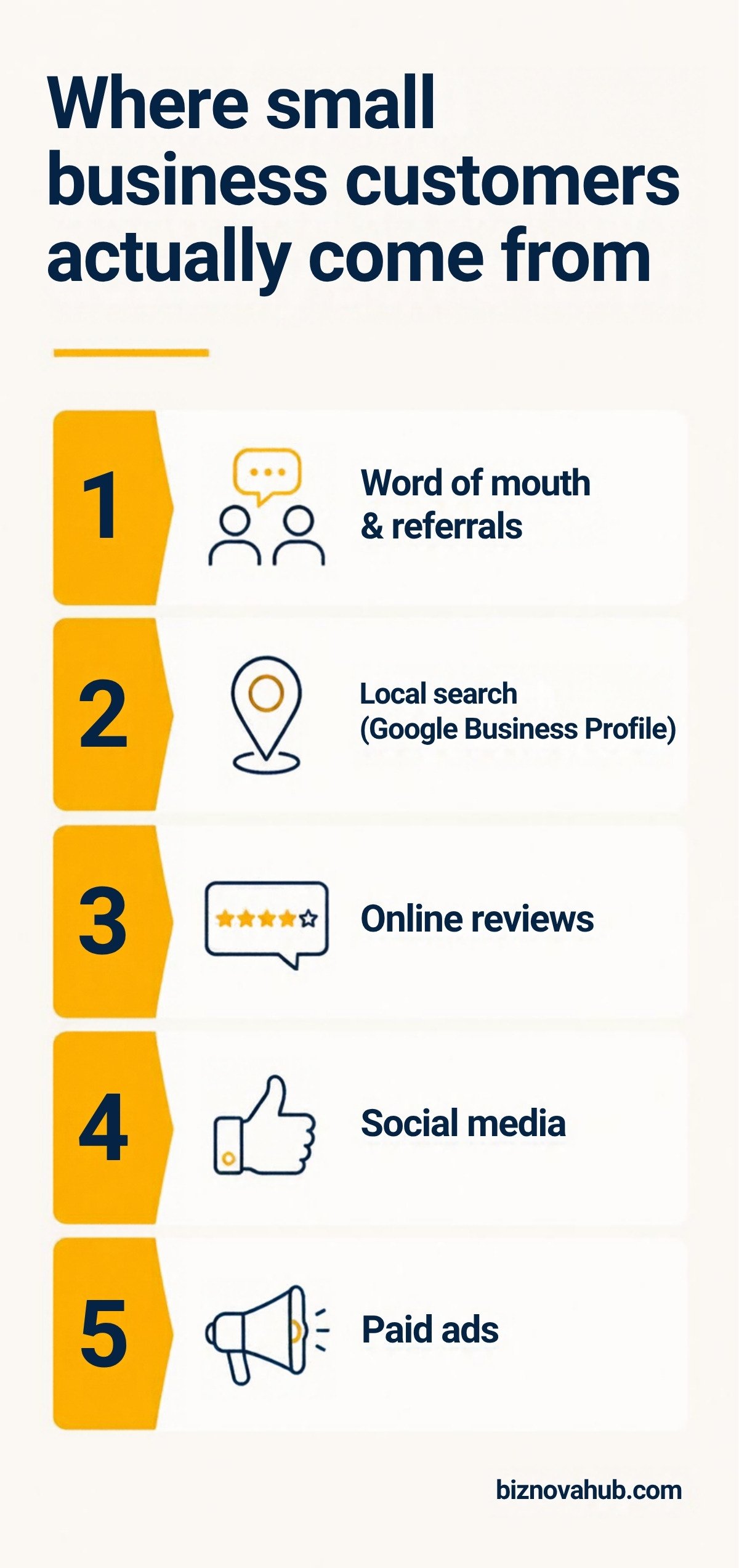
Notice what is at the top: referrals, local search and reviews. All three are free. Paid advertising sits at the bottom, not because ads do not work, but because they are the most expensive way to buy something the first three give you for nothing. Fix the free channels first and your ads will cost less per customer when you do run them.
12 ways to get more customers
1. Finish your Google Business Profile properly
For any business with a location or a service area, this is the single highest-return hour you will spend. A profile that is claimed but half-finished ranks below one that is complete. Fill in every field: categories, service area, hours, services with prices, a description, and at least ten real photos. Google’s own guidelines for representing your business set out what is and is not allowed.
Two things most owners skip: the Products or Services list, which lets you name each thing you sell in plain language, and the Q&A section, where you can post and answer the questions customers always ask.
2. Collect reviews on a schedule, not when you remember
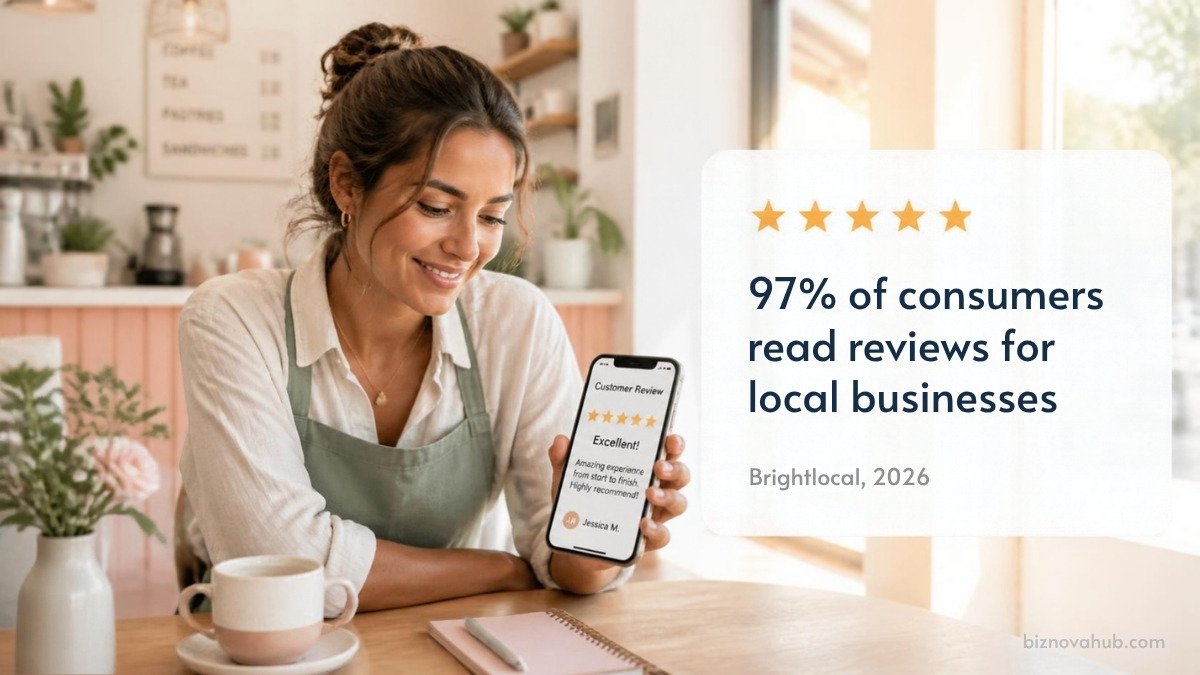
Reviews are now a filter, not a bonus. In BrightLocal’s 2026 Local Consumer Review Survey, 97% of consumers read reviews for local businesses, 31% will only use a business rated 4.5 stars or higher, and 47% will not use a business with fewer than 20 reviews. Just as important, 74% want to see reviews written in the last three months, so a wall of five-star reviews from two years ago does very little.
The fix is a habit, not a campaign. Ask every satisfied customer at the moment the job finishes, while they are pleased with you, and send a direct link to your review form. Two or three new reviews a month beats twenty in one burst.
One hard rule: never buy reviews or write them yourself. In the US the FTC’s rule banning fake reviews and testimonials carries civil penalties, and in the UK fake reviews are banned under the Digital Markets, Competition and Consumers Act 2024.
3. Ask for one referral from every happy customer
Referrals are the cheapest customers you will ever get and the most likely to buy. Most owners never ask, because it feels awkward. It stops feeling awkward when you make it specific. Instead of “let me know if you hear of anyone”, try: “If you know one neighbour who needs this, would you pass on my number?” A named, single request gets answered far more often than an open-ended one.
4. Give referrals a reason to happen
Turn the ask into a simple standing offer: a discount, a free add-on, or a credit for both sides. Keep it to one sentence that a customer can repeat from memory. If your customer has to explain a complicated scheme, they will not bother.
5. Make your website do one job
A small business website does not need to be impressive. It needs to answer three questions within a few seconds: what you do, where you do it, and how to get hold of you. Put your phone number in the header, repeat it at the bottom of every page, and make it tappable on a phone. Add the areas you cover in plain words, because that is what people type.
If you are still deciding how to set the business up before you build anything, read our comparison of an LLC versus a sole proprietorship in the US, or sole trader versus limited company in the UK.
6. Answer the questions your customers are already searching
Every trade has a short list of questions people type before they buy: how much does it cost, how long does it take, do I need it done every year. Write one honest page for each. These pages bring in people who are close to buying, and they cost nothing but your time. The US Small Business Administration’s marketing guidance makes the same point: start from what your customer is trying to decide.
7. Partner with businesses that serve the same customer
Find three businesses that sell to your customer but do not compete with you, and agree to pass work both ways. A cleaner and a handyman. A lawn care business and a garden centre. A bookkeeper and a web designer. This is the fastest way to add a steady trickle of warm leads, and it is how most established local businesses actually grew.
8. Remove every obstacle between interest and contact
Count the steps between someone deciding they are interested and reaching you. Then delete half of them. Answer the phone during working hours or use a voicemail that promises a call back by a stated time, and keep that promise. Reply to messages the same day. Offer one more way to reach you than you do now, whether that is WhatsApp, a short form or online booking.
9. Follow up on enquiries that went quiet
Most small businesses quote once and never follow up. A single short message a few days later — “Still happy to do this for you if the timing works, just let me know” — recovers a surprising share of those jobs. Keep a simple list of every enquiry and when you last contacted them.
10. Go back to the customers you already have
It is far cheaper to sell again to someone who already trusts you than to find someone new. Keep a list of past customers and contact them when it is genuinely useful: a seasonal reminder, a service that is due, a change in the rules that affects them. If you email them in the UK or EU you must have the right basis for doing so — the ICO’s guidance on electronic marketing explains the consent rules and the narrow exemption for existing customers.
11. Be visible where your customers already gather
Local community groups, neighbourhood apps, trade directories and local Facebook groups are where people ask “can anyone recommend…”. You do not need to post daily. You need to be present, helpful and easy to find when your name comes up. Answer questions properly without pitching, and the work follows.
12. Add paid ads only once the free channels work
Advertising multiplies whatever you already have. If your profile is thin, your reviews are old and your follow-up is slow, ads will simply buy you expensive leads that leak away. Once the first eleven points are in place, a small, tightly targeted local budget becomes genuinely profitable.
Which method should you start with?
If your time is limited, work down this table from the top.
| Method | Cost | Time to first results | Best for |
|---|---|---|---|
| Google Business Profile | Free | 1–4 weeks | Any local or service business |
| Review collection | Free | 2–8 weeks | Businesses with repeat jobs |
| Referral asks | Free | Days | Trades and home services |
| Partnerships | Free | 2–6 weeks | Services with a clear neighbour trade |
| Follow-up on quotes | Free | Days | Anyone who quotes before selling |
| Question-led web pages | Free (your time) | 3–6 months | Businesses with a website |
| Email to past customers | Low | Days | Seasonal and repeat services |
| Paid local ads | Ongoing spend | Days | Established basics and clear margins |
A 30-day plan to get more customers
Pick one task a week rather than trying everything at once.
- Week 1 — Be findable. Complete every field on your Google Business Profile, add ten photos, list your services with prices, and check your phone number is identical everywhere online.
- Week 2 — Be trusted. Create your review link, save it where you can send it in two taps, and ask the last ten customers you served.
- Week 3 — Be recommended. Write your one-sentence referral offer, ask five happy customers directly, and approach three non-competing businesses about passing work both ways.
- Week 4 — Be responsive. List every enquiry from the past three months that never closed, and send each one a short, friendly follow-up.
Four weeks of this will usually do more than a month of advertising, and it costs nothing. If you are still choosing which business to build this on, our guides to starting a cleaning business, starting a lawn care business and starting a vending machine business walk through the numbers for three popular options.
Mistakes that quietly cost you customers
- Different details in different places. An old phone number or address on a directory sends people to a dead end and weakens your local search ranking.
- Slow replies. Most people who contact several businesses hire one of the first to answer.
- No prices anywhere. You do not have to publish a full price list, but a starting price or a typical range stops you wasting time on people who were never going to buy.
- Ignoring negative reviews. A calm, specific reply to a bad review reassures the next reader far more than the complaint worries them.
- Chasing new customers while neglecting current ones. The people who already paid you are the cheapest source of your next job.
Frequently asked questions
How can I get customers fast with no money?
Ask past customers for referrals and follow up on enquiries that went quiet. Both are free, take an afternoon, and produce results within days because you are contacting people who already know you.
How many reviews do I need?
Aim to pass twenty, since BrightLocal’s 2026 survey found 47% of consumers will not use a business with fewer than that. After twenty, recency matters more than volume: keep a steady flow coming in rather than chasing a total.
Do I need a website to get customers?
Not at the very start. A complete Google Business Profile with photos and reviews can carry a local business on its own. A website becomes worth it once you want to rank for the questions people search before they buy.
Should I advertise on Google or Facebook?
Google tends to suit businesses people actively search for, such as repairs and emergency services. Social platforms tend to suit things people discover rather than search for. Either way, only start once your profile, reviews and follow-up are already working.
How long before I see more customers?
Referrals and follow-ups can produce work within days. Reviews and local search usually take four to eight weeks to shift. Content pages take three to six months. Run the fast and slow methods at the same time so you are not waiting on one.
This guide is general business information, not legal, tax or marketing advice. Review rules and marketing law differ by country — check the current rules with your national regulator.