Purchase Requisition vs Purchase Order: The Key Differences
Someone in your team needs a new laptop. They email you. You forward it to whoever handles the budget. Three days later nobody is sure whether it was approved, by whom, or what it was meant to cost.
That gap is exactly what a purchase requisition exists to close, and it is the document most small businesses skip entirely.
The confusion in purchase requisition vs purchase order is understandable. Both look like forms, both list items and prices, and both sit in the same part of the buying process. But they do opposite jobs. One asks permission inside your company. The other commits your company to a supplier.
Purchase requisition vs purchase order: the short answer
A purchase requisition is an internal request. An employee asks the business for permission to spend money. The supplier never sees it.
A purchase order is an external document. Once approved, your business sends it to the supplier, stating exactly what you are buying, at what price, on what terms.
That single distinction, internal versus external, explains every other difference.
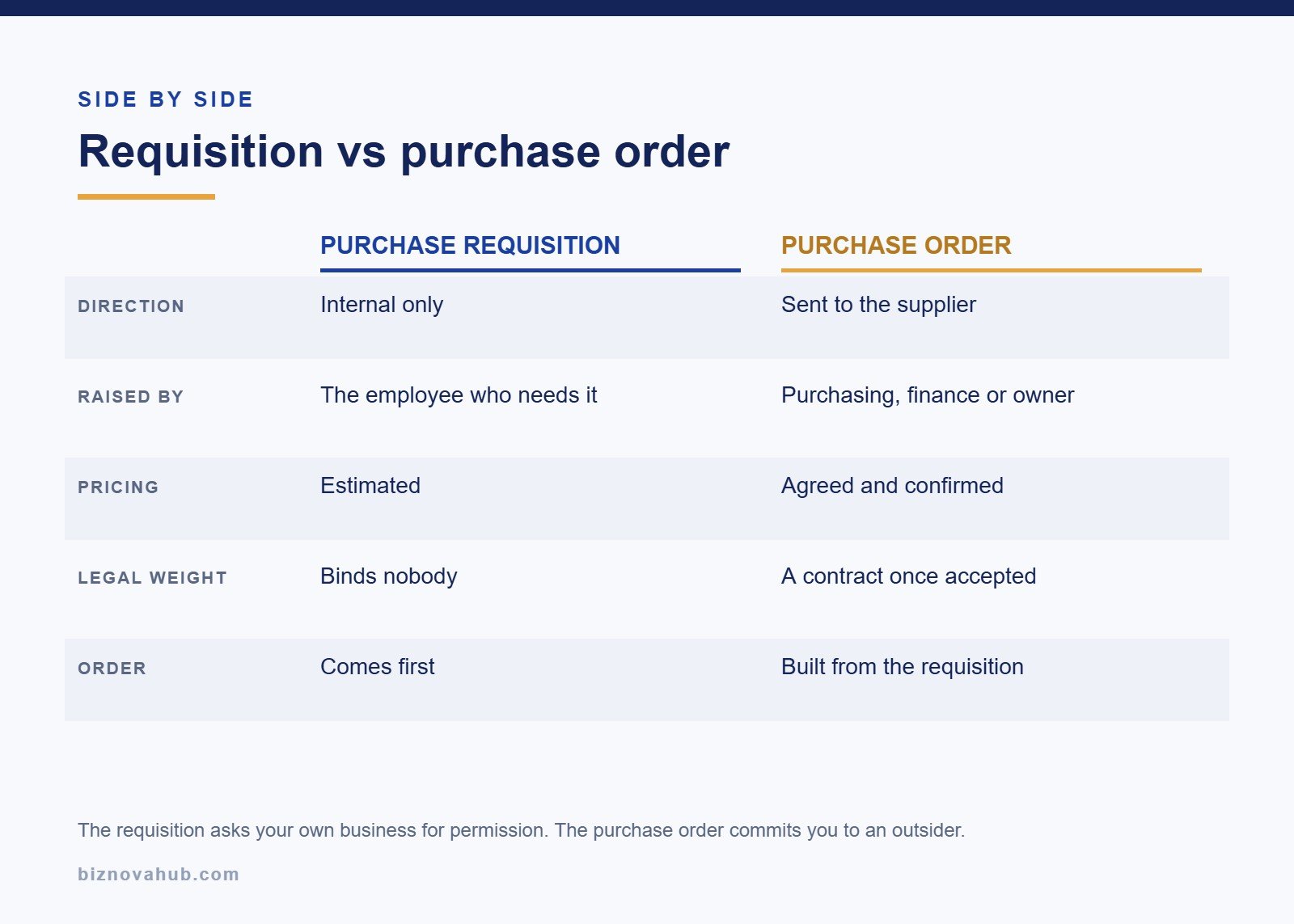
| Purchase requisition | Purchase order | |
|---|---|---|
| Direction | Internal only | Sent to the supplier |
| Raised by | The employee who needs the item | Purchasing, finance or the owner |
| Asks | May I spend this? | Please supply this |
| Pricing | Estimated | Agreed and confirmed |
| Legal weight | None. Internal authorisation | An offer that becomes a contract once the supplier accepts |
| Comes first | Yes | Created from the approved requisition |
The legal row is the one that matters most and the one people get wrong in purchase requisition vs purchase order. A requisition binds nobody. A purchase order is an offer, and the moment your supplier accepts it, you have a contract. That is why approval has to happen before the purchase order is issued, not after.
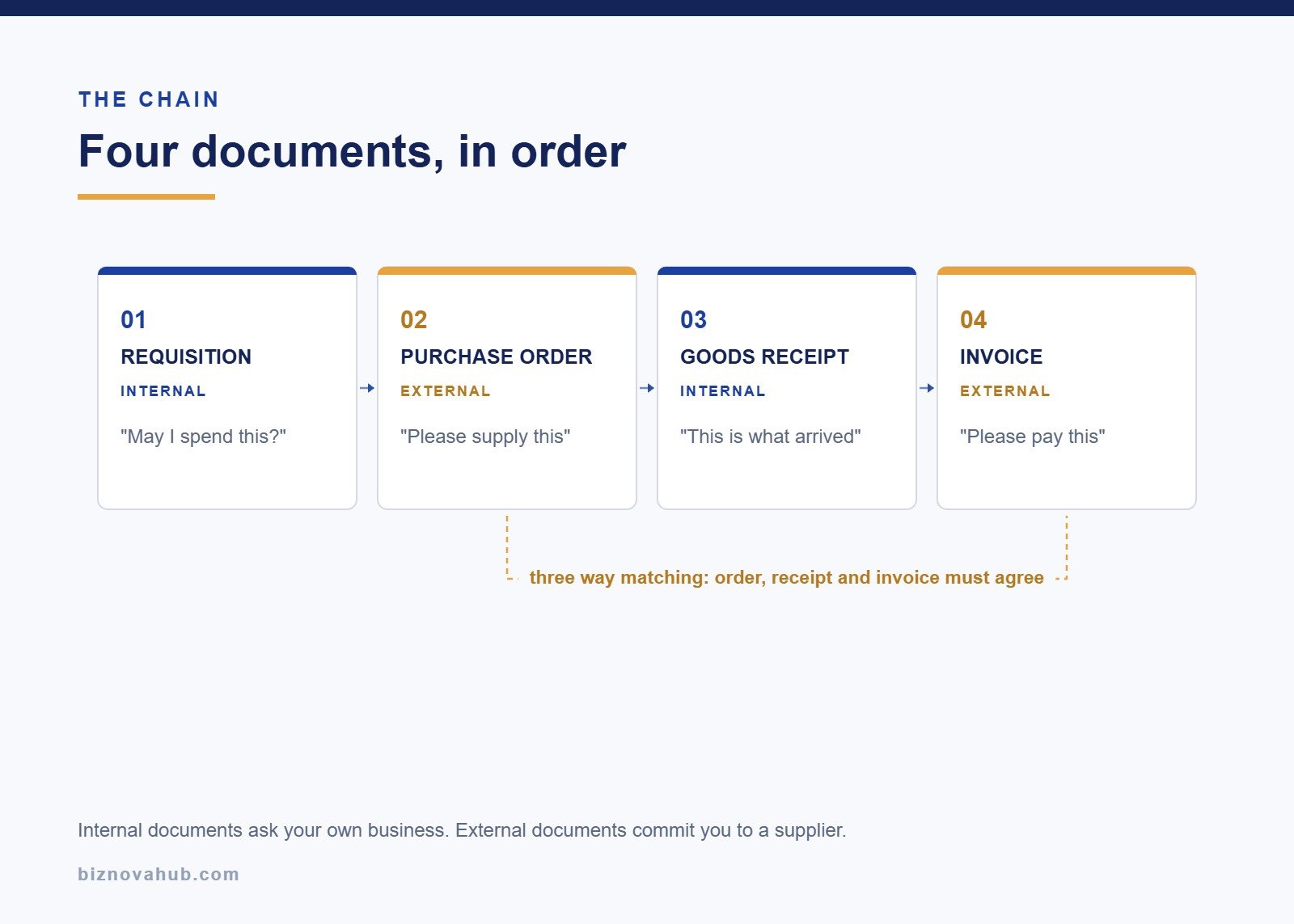
Purchase requisition vs purchase order in the buying chain
In purchase requisition vs purchase order, neither document works alone. They are two links in a four part chain, and every link exists to make the next one verifiable.
- Purchase requisition. An employee requests the purchase. Internal. Approved or rejected.
- Purchase order. Created from the approved requisition and sent to the supplier.
- Goods receipt. Someone confirms what actually arrived.
- Invoice. The supplier asks to be paid, and you check it against the two records above.
That final check has a name. Three way matching means the invoice is only paid when it agrees with both the purchase order and the goods receipt. One proves what was ordered, one proves what arrived, the third asks for money. If all three line up, pay it. If not, you have found a problem before the money left.
Most overpayments at small companies happen because this chain has a missing link. Our guide to the accounts payable invoice approval process covers the last two steps.
What goes on a purchase requisition
This is an internal document, so no supplier will ever judge it. Its only job is to let an approver decide without asking follow up questions.
- Requisition number and date
- Who is requesting it, and which department
- What is needed, described clearly, with quantities
- Estimated cost, per unit and total
- Preferred supplier, if there is one
- Date needed by
- Budget code or cost centre
- Why it is needed, in one line
That last item is the one people leave off, and it is why requisitions sit unapproved for a week. “Replacement for the laptop that failed on 14 October, user cannot work remotely” gets signed in a minute. “New laptop” gets a reply asking why.
What goes on a purchase order
A purchase order leaves your business, so the standard is higher. Anything vague here becomes a dispute later.
- Purchase order number and date
- Your legal business name and billing address
- Supplier name and address
- Item descriptions, quantities and agreed unit prices
- Delivery address and required delivery date
- Payment terms, stated explicitly
- Tax, discounts and any other agreed terms
Payment terms are the field most often left blank, and it costs businesses real money. If the purchase order does not say when payment is due, you have handed the supplier the right to decide. Our guide to net 30 payment terms covers what to put there and why.
Who approves what
A requisition process without approval thresholds is just a form that slows everyone down. Thresholds are what make it worth having.
Set them by value, write them down, and keep the list short:
| Value | Approver |
|---|---|
| Under £250 | Line manager |
| £250 to £2,500 | Department head |
| £2,500 to £10,000 | Finance |
| Over £10,000 | Owner or director |
UK public bodies work to statutory thresholds set out in the Procurement Act 2023 guidance. Private businesses set their own, but the principle is identical: the size of the spend decides who may approve it.
Those figures are a starting point. Pick numbers that match your own spending, then apply two tests. Can the approver actually see the budget they are approving against? And does approval take minutes rather than days? If either answer is no, the threshold is wrong and people will start buying without a requisition, which defeats the system.
Do you need both if you are a small business?
An honest answer to purchase requisition vs purchase order at small scale: not always.
If you are a sole trader or a team of two, a purchase requisition is paperwork for its own sake. You already know what is being bought because you are the one buying it. Issue purchase orders to suppliers and skip the requisition.
You need requisitions the moment one of these becomes true:
- Someone other than the budget holder can start a purchase
- You have more than one person buying from the same budget
- You have been surprised by an invoice for something you did not know was ordered
- You need an audit trail, for a lender, an accountant or a grant
That third one is the real trigger. The first surprise invoice is the moment a requisition process pays for itself, and most owners only introduce one after it has happened.
Four mistakes that break the process
Creating the purchase order before approval. This is the most common and the most expensive. Once the supplier accepts, you are committed, whether or not the spend was ever approved internally.
Not carrying the requisition number onto the purchase order. Without that reference, nobody can trace a purchase order back to who asked for it or who approved it, and the audit trail breaks at its most important point.
Letting the price drift silently. A requisition carries an estimate. A purchase order carries an agreed price. If the agreed price comes back far above the estimate, it should go back to the approver rather than straight to the supplier.
Approving by email. An email thread is not an approval record. When the auditor or accountant asks who approved a specific purchase, you need one document with one name on it, not a search of someone’s inbox.
How this fits with the rest of your paperwork
Purchase requisition vs purchase order is only the first half of the chain. The second half is the documents that get you paid and keep you paid. Our guide to purchase order vs invoice covers the handover point between ordering and billing, writing an invoice properly covers the document itself, and if payment then goes quiet, a dunning letter is the escalating notice that collects it. When the scope of an agreed job moves, a change order is what records it.
Frequently asked questions
Why does purchase requisition vs purchase order matter for a small business?
Because only one of them commits your money to an outsider. Confusing the two is how a business ends up contractually bound to a purchase nobody approved.
Can a purchase requisition become a purchase order automatically?
In procurement software, yes. The approved requisition data populates the purchase order so nothing is retyped. Done manually, copy the requisition number onto the purchase order so the two stay linked.
Is a purchase requisition legally binding?
No. It is an internal authorisation and carries no obligation to any supplier. Only the purchase order creates a commitment, and only once the supplier accepts it.
Who raises a purchase order?
Purchasing or procurement in a larger business. In a small one, usually finance or the owner. The key rule is that it should not be the same person who raised the requisition, because that removes the second pair of eyes.
What if goods arrive without a purchase order?
Treat it as an exception and record it as one. Create a retrospective purchase order so the invoice can still be matched, and find out who ordered it. A pattern of these means your thresholds are too strict or the process is too slow.
Do I need software for this?
Not at the start. A numbered template, a shared folder and a written threshold list will run this for a business under ten people. Software is worth it when the volume of approvals, not the value, becomes the bottleneck.
The short version
In purchase requisition vs purchase order, the requisition asks your own business for permission and the purchase order tells a supplier what you are buying. The requisition comes first, binds nobody and carries an estimate. The purchase order comes second, goes to the supplier, and becomes a contract the moment it is accepted.
Keep the requisition number on the purchase order, set thresholds you can actually meet, and never let a purchase order leave before the requisition is signed. Get those three right and the invoice at the end of the chain will match every time.