
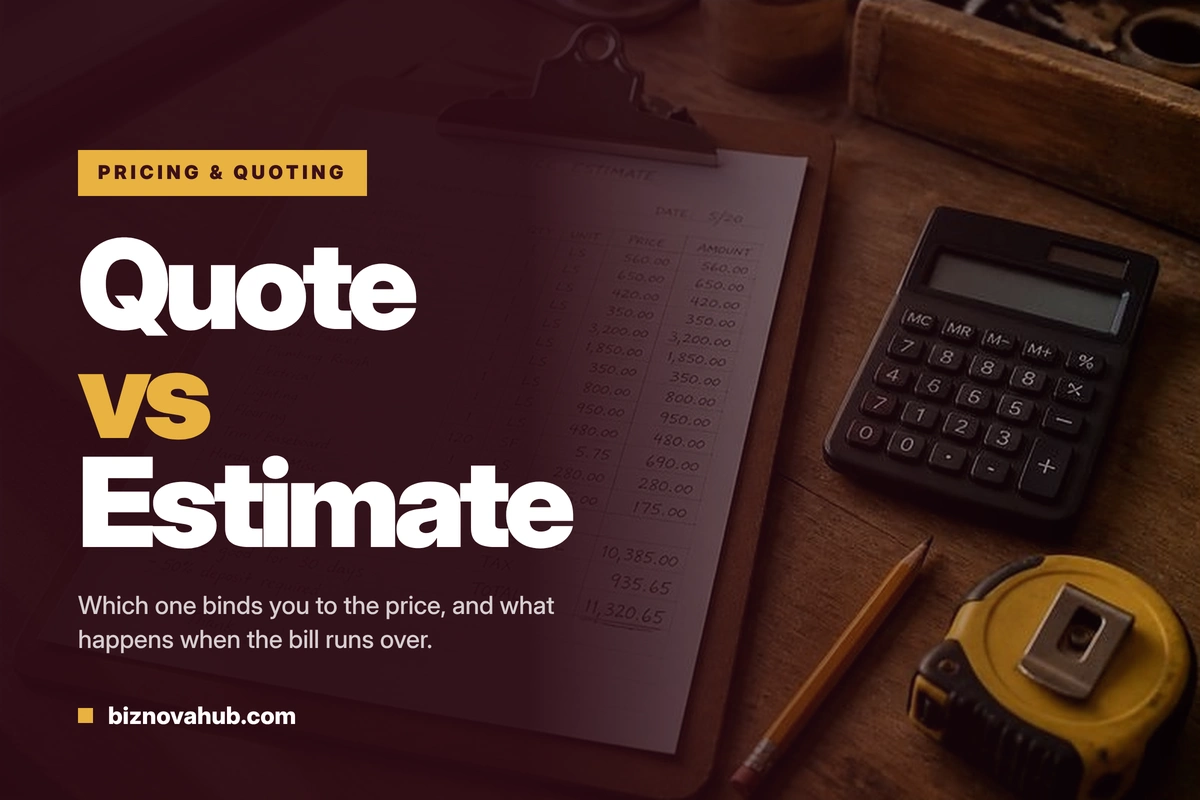
Quote vs Estimate: Which One Binds You to the Price?
A customer calls you three weeks after the job finished. The final bill is $4,180. The number you gave them at the start was $3,400. They’re not happy, and they want to know why they’re paying $780 more than they were told.
Whether you’re in the right here comes down to one thing: did you give them a quote or an estimate?
Most guides on quote vs estimate stop at “a quote is fixed, an estimate isn’t” and leave you there. That’s the easy half. The hard half is what happens when the bill lands higher than the number you first said, and that’s where this one goes.
Quick Answer
A quote is a fixed price you’re legally bound to once the customer accepts it. An estimate is an educated guess that can change as the job unfolds. Use a quote when you know exactly what the work involves. Use an estimate when you don’t, and say in writing that it’s an estimate.
Quote vs estimate: the real difference
Both are a number you give a customer before the work starts. That’s where the similarity ends.
A quote is a fixed price. Once the customer accepts it, you’ve got a contract. You can’t raise it later because the job took longer than you thought or because materials went up. That risk is yours now. You took it on when you named the number.
An estimate is your best guess at what the job will cost, given what you know so far. It isn’t binding. The final bill can land above or below it.
Here’s the part that matters: the difference isn’t the layout or whether it looks formal. It’s what you promised. If you wrote “Quote” at the top and the customer said yes, you’re held to it, even if you meant it loosely.
So the label does the work. Use it carefully.
What happens when the bill goes over the estimate
This is the question everybody actually has, and almost nobody answers it.
An estimate isn’t a blank cheque. You can’t quote $3,400, bill $9,000 and point at the word “estimate.” In the US, the general standard regulators and courts lean on is whether the final price is reasonable given the original figure, and whether you told the customer before you ran past it.
Some states write this down. California’s auto repair law says no charge can be made above the estimated price without the customer’s consent, and that consent has to come before the extra work, not after. Plenty of other trades follow the same logic even where it isn’t written into statute.
In the UK, the Consumer Rights Act 2015 says a price must be reasonable where one wasn’t fixed. Same idea, different wording.
In practice, most trades work to a rough 10% to 15% band. If the final comes in within that of the estimate, customers accept it. Past that and you’re having a conversation whether you planned to or not.
So here’s the rule worth adopting, and it has nothing to do with the law: the moment you know you’ll go past the estimate, tell them. Before you do the work, not after.
A two-line message saves the argument:
“Opened up the wall today and the pipework behind it is corroded, so it needs replacing before I can close it back up. That’s about $340 on top of the $3,400 I estimated. Happy to go ahead, or stop and talk it through first. Let me know.”
Nobody disputes a bill they agreed to in advance. They dispute surprises.
A worked example
Take the same job two ways.
As an estimate. A customer calls about replacing a bathroom floor. You haven’t seen it. From the room size they describe and jobs like it, you say roughly $3,400, and you write “Estimate, subject to inspection” on it. You lift the old floor and two joists are rotten. You message them, they approve the extra, the final bill is $4,180. That’s a clean job. The estimate did what it was supposed to.
As a quote. Same bathroom, but you visit first, lift a board, see the joists and price the whole thing at $4,180 up front. The customer accepts. Now that’s the price, and it stays the price. If you find a third rotten joist, that’s your cost, because you had the chance to look.
The difference between these two isn’t the paperwork. It’s whether you’d seen the job before you named a number.
That’s the decision rule, and it’s simpler than any list of pros and cons: have I seen enough to be held to this? If yes, quote. If no, estimate, and say so on the document.
Quote, estimate, proposal and bid
Four words, and people use them interchangeably. They aren’t the same.
Estimate is an approximate price, not binding.
Quote is a fixed price, binding once accepted.
Proposal is a quote with the sell attached. It covers the price plus your approach, timeline and why you’re the right choice. Agencies and consultants send these. A proposal usually contains a quote inside it.
Bid is a price submitted in a competitive process, often against a spec someone else wrote. Construction and government contracts work this way. A bid is normally binding like a quote.
If you’re sending a document that’s mostly about price, you want a quote or an estimate. If it’s mostly about winning the work, it’s a proposal.
What to put on each one
An estimate should carry:
- The word Estimate at the top, not “Quote”
- A date, and how long the figure holds for
- A plain description of the work as you understand it
- A line saying the price may change, and what would change it
- A note that you’ll confirm before exceeding it
A quote needs more, because it’s a contract:
- The word Quote, a reference number and a date
- Both sets of contact details and the job address
- A line by line breakdown of labour, materials and anything extra
- What’s included, and just as importantly what isn’t
- The total, with tax or VAT shown separately
- How long the quote is valid, usually 30 days
- Payment terms, including any deposit
That “what isn’t included” line is the one people skip, and it’s the one that saves you. Writing “does not include removal of existing units” costs you four seconds and settles an argument you’d otherwise lose. If you want the full structure, how to write a quote for a job walks through it, and when scope does shift mid-job a change order is how you record it properly.
Validity dates, and why 30 days
Put an expiry on both. A quote from four months ago was priced at four month old material costs, and if the customer accepts it today you’re bound by it.
Thirty days is the normal window. Go shorter when your inputs move fast. One line does it: “This quote is valid for 30 days from the date above.”
When the customer treats your estimate as a quote
This happens constantly, and it’s usually not the customer being difficult. They heard a number and that number stuck.
Head it off at the start. Say the word out loud, not just on the page: “This is an estimate, so it could move once I see behind the panel. I’ll confirm with you before anything changes.”
If it’s already happened and they’re disputing the bill, don’t lead with the paperwork. Walk them through what changed and why, show that you flagged it, and offer to split the difference on anything you genuinely should have caught earlier. A customer who feels heard pays. A customer who feels cornered stops answering your calls, and then you’re chasing money instead of working.
When the work is signed off and it’s time to bill, the quote or the approved estimate becomes the basis for the invoice, and the numbers should line up exactly.
Frequently asked questions
Is a quote legally binding?
Yes, once the customer accepts it. A quote is an offer, and acceptance forms a contract at that price. You can only change it if the customer changes the work or you find something genuinely outside what was agreed.
Can an estimate be legally binding?
Not usually, but it isn’t unlimited either. The final price has to be reasonable against the estimate, and in many places you need the customer’s agreement before going over it. Labelling a fixed price as an estimate won’t protect you if everything else says it was a quote.
How much can a final bill exceed an estimate?
There’s no single legal percentage in most places. Around 10% to 15% is what customers tend to accept without complaint. The figure matters less than whether you told them before you went over it.
Should I send a quote or an estimate?
Send a quote when you’ve seen the job and know what’s involved, because it wins more work than a vague number. Send an estimate when you haven’t, and write “Estimate” on it clearly.
Is the quote the final price?
Yes, if the customer accepted it and the work hasn’t changed. A quote is the final price unless they ask for extra work, or something genuinely outside the agreed scope turns up. Anything you simply underestimated is yours to absorb.
How do I quote an estimate?
You don’t, because they’re two different documents. Write “Estimate” at the top, give your best figure from what you know, add a line saying the price may change, and say you’ll confirm before exceeding it. Once you’ve seen the job, replace it with a quote.
The short version
A quote is fixed and binding. An estimate is a guess that can move. The label on the document decides which one you’ve given.
An estimate still has limits. Keep the final within reach of the original, and get agreement in writing before you pass it.
Decide by one question: have you seen enough of the job to be held to the number? Yes means quote. No means estimate.
And put an expiry date on both.
2 Comments
Comments are closed.