Invoice vs Receipt: What’s the Difference and When to Send Each?
A customer pays you, then asks for “the invoice.” Another pays and asks for “the receipt.” They are not asking for the same thing, and sending the wrong one makes a business look careless. The confusion around invoice vs receipt is one of the most common in small business paperwork, and it costs real time when a client is chasing a document you have already sent, just under the wrong name.
The good news is that the difference is simple once you see it, and it comes down to a single question: has the money been paid yet? Get that straight and you will never mix the two up again.
Invoice vs receipt: the one-line difference
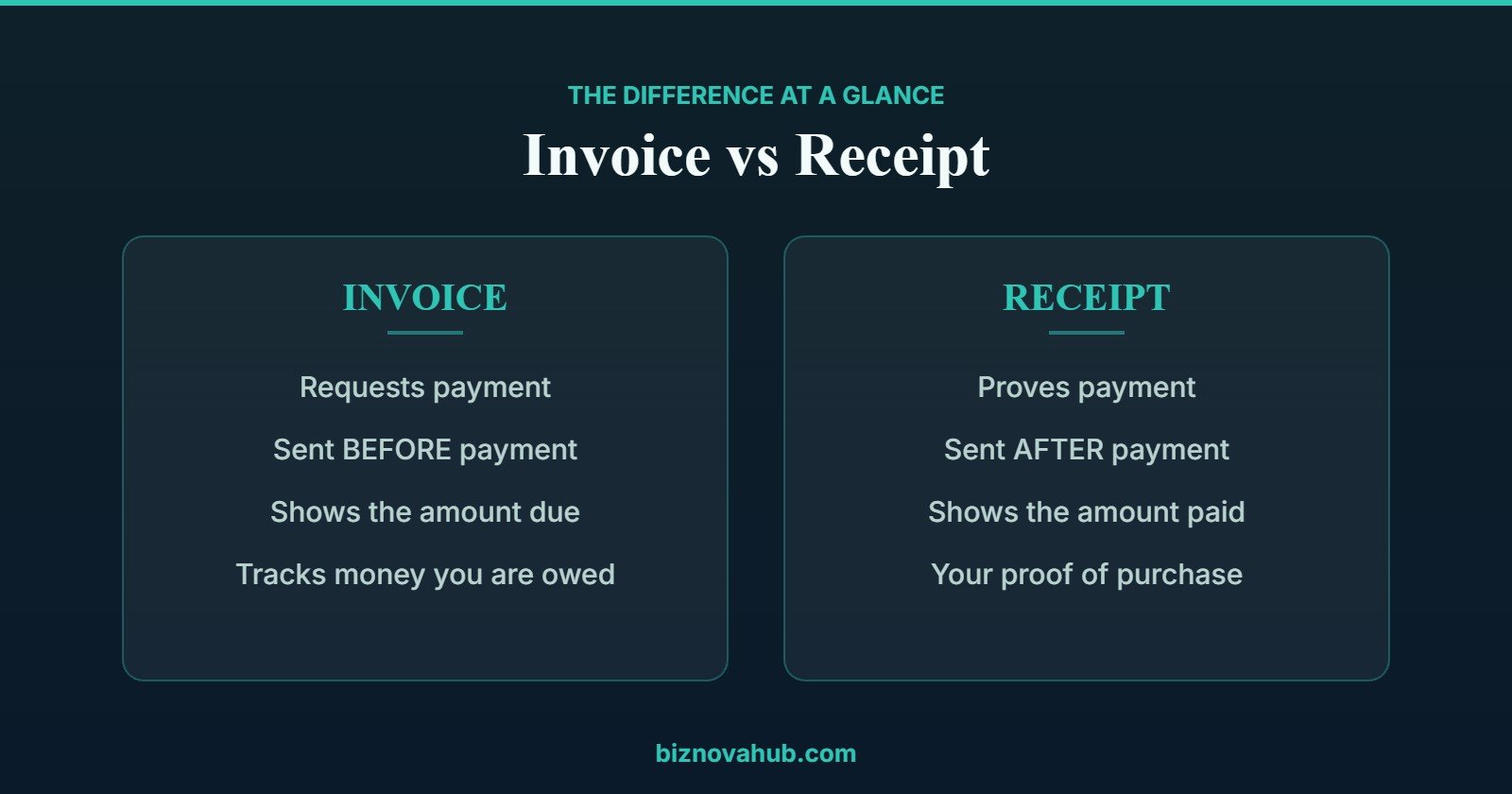
An invoice is a request for payment. You send it before you have been paid, to tell a customer what they owe and by when.
A receipt is proof of payment. You send it after the money has arrived, to confirm the transaction is complete.
That is the whole distinction. The invoice asks for money, the receipt confirms money was received. Everything else, the layout, the numbers, the legal weight, follows from that one difference in timing.
What an invoice actually is
An invoice is the document that opens the payment stage. Once the work is done or the goods are delivered, the invoice tells the customer exactly what they owe, what it was for, and the deadline to pay. It is a formal request, and in most cases it is also a legal record of a debt owed to your business.
A clear invoice usually carries the word “Invoice,” a unique invoice number, your business and the customer’s details, a description of what is being charged for, the amount due, the date, and a clear due date with payment terms. If you want the full breakdown of what to include and how to lay it out, our guide on how to write an invoice walks through every field.
The key point is that an invoice means the money is still outstanding. It is the tool you use to get paid, which is why the payment terms on it, such as net 30 payment terms, matter so much. Leave them vague and the invoice does its job slowly. State them clearly and the money tends to arrive on time.
What a receipt actually is
A receipt is the document that closes the transaction. It is issued after the customer has paid, and its only job is to confirm that payment was received. Where the invoice says “please pay this,” the receipt says “thank you, this is paid.”
A receipt typically shows the word “Receipt,” the date of payment, the amount paid, the method of payment, and a reference to what was bought or to the original invoice. It is shorter and simpler than an invoice because it is not asking for anything. It is a record.
For the customer, the receipt is the piece of paper that matters later: it is their proof of purchase for expense claims, tax records, returns and warranty claims. For your business, issuing receipts keeps your records clean and gives both sides a clear marker that the deal is settled.
Invoice vs receipt: why the timing is everything
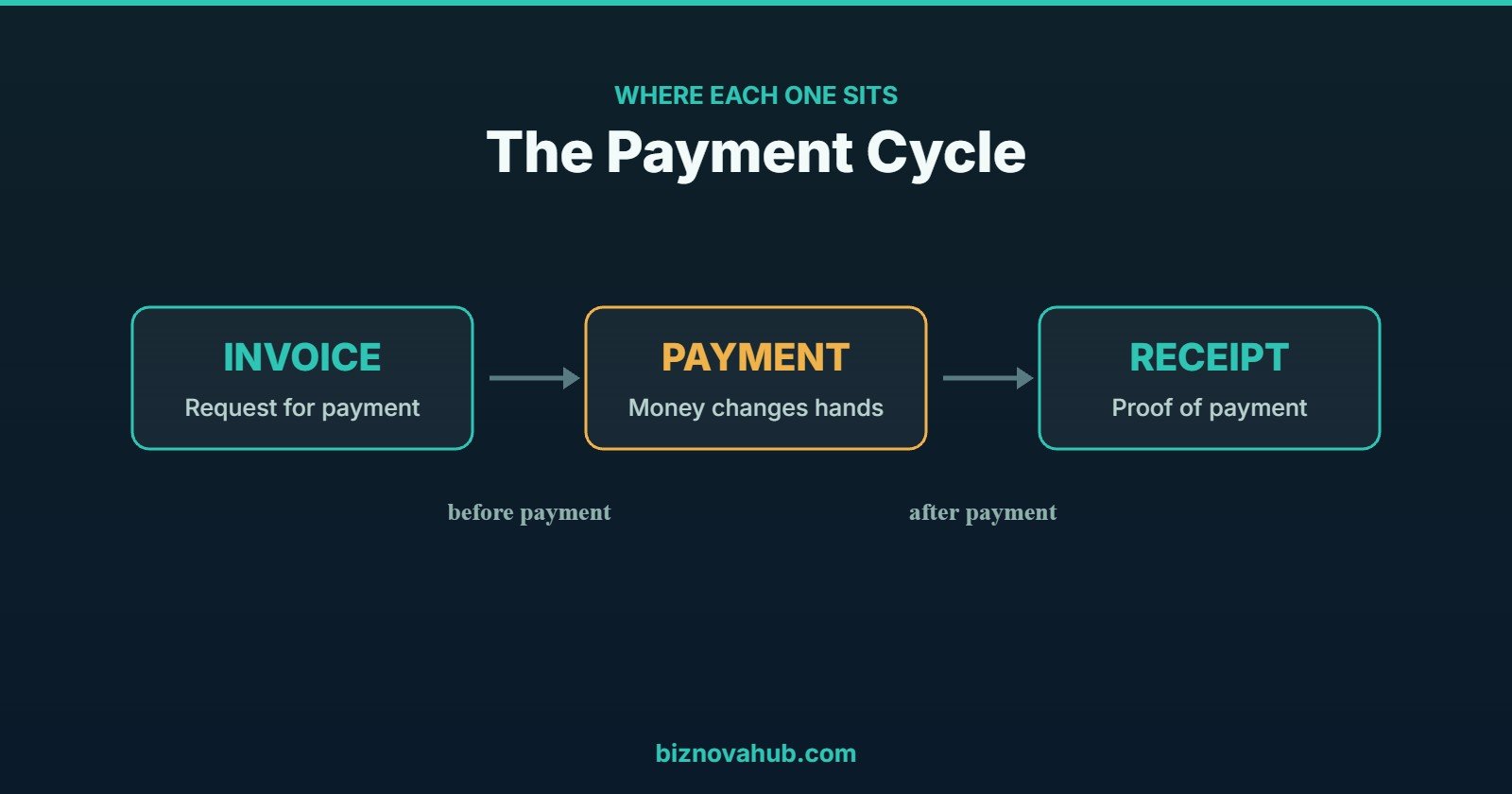
Almost every mistake with invoice vs receipt comes from ignoring the timeline. Picture a single sale from start to finish:
- You deliver the work or the goods.
- You send an invoice requesting payment by a set date.
- The customer pays.
- You send a receipt confirming the payment.
The invoice lives in the “money owed” stage. The receipt lives in the “money paid” stage. A document cannot be both at once, because a payment cannot be both pending and complete at the same moment. When someone asks which one to send, the real question is simply: has this been paid yet? If no, they need an invoice. If yes, they need a receipt.
Why the difference matters for your books
This is not just about using the right word. The two documents do different jobs in your accounting, and mixing them up creates real problems.
Invoices drive your accounts receivable, the money owed to you. They are how you track who still has to pay, follow up on late accounts, and forecast incoming cash. If you treat a receipt as an invoice, that income never gets chased, because your records think it is still a request rather than a completed sale. When an account does run late, the invoice is also what a dunning letter sequence references when you escalate.
Receipts, on the other hand, are proof for tax and audit purposes. They show money actually changed hands. Come tax time, or if a payment is ever disputed, the receipt is the evidence that the transaction was completed. An invoice alone does not prove you were paid. It only proves you asked.
Can one document be both an invoice and a receipt?
In one specific case, yes. When a customer pays immediately, at the point of sale, you can issue a single document that acts as both: it states what was bought and confirms it was paid on the spot. This is often called a “paid invoice” or simply a sales receipt, and it is common in shops and for instant online payments.
But this only works when payment and purchase happen at the same moment. The instant there is a gap, when you invoice now and expect payment in thirty days, the two documents have to separate again. You send the invoice first, and the receipt only after the money lands. So while one combined document exists, it is the exception for instant sales, not the rule for normal invoicing.
Three mistakes that cause confusion
Calling an invoice a receipt. This is the most common slip, and it worries customers, because it suggests you think you have been paid when you have not. Keep the labels exact so nobody is confused about whether money is still owed.
Never issuing receipts at all. Some small businesses send invoices but never confirm payment. The customer is left without proof of purchase, which causes problems for their records and makes your business look informal. A quick receipt closes the loop cleanly.
Letting the numbers drift apart. The receipt should reference the invoice it settles. Break that link and, when a query lands months later, nobody can match the payment to the original request. The same discipline runs through your statement of account, which lists invoices and payments side by side.
Invoice vs receipt in the wider payment cycle
Invoice and receipt are two markers in a longer chain, not the whole story. A typical flow runs from the invoice, through the customer’s payment, to the receipt, with supporting documents around the edges.
When a customer pays, they may send a remittance advice telling you which invoices the payment covers, which makes matching the receipt to the right invoice far easier. If you are chasing a slow payer before the receipt stage, a polite nudge using a payment reminder email keeps the invoice visible. Seen this way, the receipt is simply the document that ends a cycle the invoice began.
Frequently asked questions
Is an invoice the same as a receipt?
No. An invoice is a request for payment sent before you are paid. A receipt is proof of payment sent after. They describe the same sale but at opposite ends of it.
Does an invoice count as proof of payment?
No. An invoice only proves that payment was requested. It is not evidence that the money was actually received. Only a receipt proves a payment was made.
Which one does a customer need for their taxes?
Usually the receipt, because it proves the expense was actually paid. The invoice supports it by showing what the charge was for, but the receipt is the proof of payment.
Do I have to send both?
In most cases, yes, unless payment is instant. You send an invoice to request payment, then a receipt to confirm it once it arrives. For an on-the-spot sale, a single paid invoice or sales receipt can cover both.
Can I turn an invoice into a receipt?
In practice you mark the invoice as paid and issue a receipt or a paid-stamped copy once the money is in. The underlying rule still holds: the receipt only exists after payment has been received.
The short version
In invoice vs receipt, the invoice is a request for payment and the receipt is proof of payment. The invoice comes before the money and the receipt comes after, with the payment sitting between them.
Use an invoice to ask for money and track what you are owed, and use a receipt to confirm payment and give the customer proof. Keep the labels exact, link the receipt back to the invoice it settles, and the question of which to send answers itself every time: has this been paid yet or not?