What Is a Statement of Account? The Document You Should Never Pay From
Every month a supplier emails a document listing everything you owe them. Someone in accounts pays the total. Three weeks later it turns out two of those invoices had already been paid, and the supplier is now holding your money.
That is the single most common accounting mistake in small business, and it comes from not knowing what is a statement of account, and more importantly, what it is not.
Here is the full answer: what the document is, the rule that prevents duplicate payments, the two formats it comes in, and what belongs on one.
What is a statement of account?
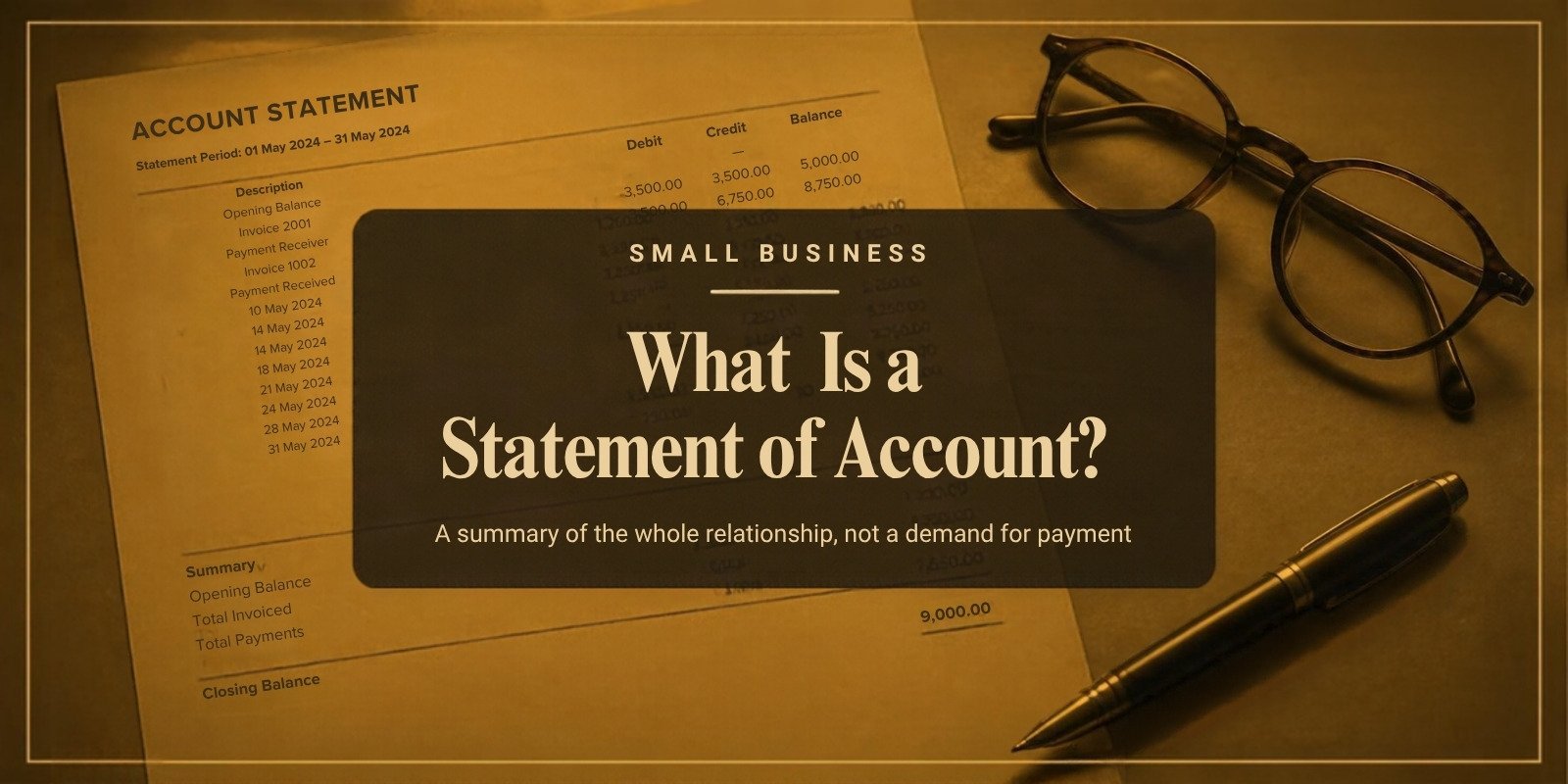
A statement of account is a summary of all transactions between a supplier and a customer over a set period, usually a month.
It shows any balance carried forward, the dates and amounts of purchases and payments in the period, and the closing balance at the statement date. One document, the whole relationship, on one page.
The key distinction, and the answer most people miss when they ask what is a statement of account, is this: it is an informational document, not a request for payment.
Statement vs invoice vs remittance advice
Three documents, three different jobs, and most duplicate payments happen because two of them get confused.
| Document | Covers | Sent | Pay from it? |
|---|---|---|---|
| Invoice | One transaction | Immediately after the purchase | Yes |
| Statement of account | A whole period | At regular intervals, usually month end | No |
| Remittance advice | One payment | With the payment, by the buyer | N/A |
An invoice is sent immediately after a purchase and covers that purchase alone. A statement provides a summary of transactions for a specific period. And a remittance advice travels the other way entirely, from buyer to supplier, explaining what a payment covers.
The rule that prevents duplicate payments
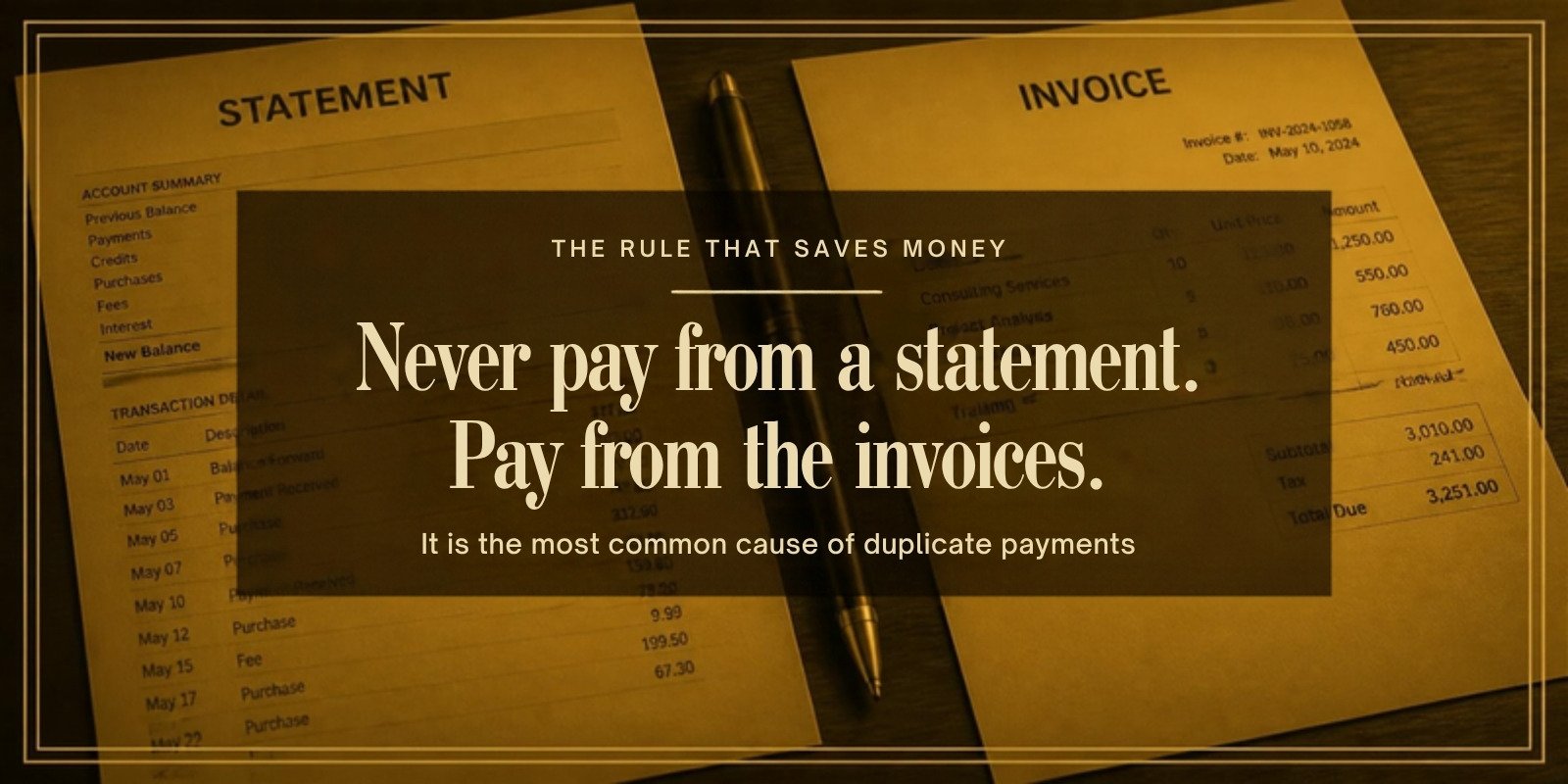
Never pay from a statement.
A statement is an informational document only. Businesses should not request payment from one, and customers should pay from invoices instead, precisely to avoid paying twice.
The reason is timing. A statement is a snapshot taken on one day. Payments made on the 29th may not appear on one generated on the 30th. Credit notes raised that week may not be reflected. Disputed invoices may still sit on it as open.
Pay the total on a statement and you are paying a number that was accurate for about an hour.
What a statement of account is good for is checking. Lay it next to your own purchase ledger and the differences tell you something useful every time: an invoice you never received, a payment they have not allocated, a credit note that never arrived.
The two formats: open-item and balance-forward
Statements come in two shapes, and the difference matters more than it sounds.
Open-item statements list every transaction that still has an open balance, regardless of when it was dated, and then show the activity for the selected period. Each line shows how much is due and how much has been paid, so you can see the status of every individual charge.
Balance-forward statements start from a single number: the amount due as at the beginning of the period. They then show that period’s activity. Older open charges are not itemised. They are rolled into that opening balance.
For B2B, open-item is almost always the right choice. Balance-forward is fine when a customer simply pays what they owe each month, but the moment a dispute, part-payment or credit note is in play, a single opening figure tells nobody anything. They cannot reconcile it, so they query it, and the query lands back with you.
If you are chasing an old balance and your statement is balance-forward, you have handed the customer a reason to delay. Switch it.
In software this is a setting, not a rewrite: most systems let you pick the statement type per customer, and Sage Intacct documents both formats clearly.
What to put on a statement of account
There is no legally prescribed format. The test is whether your customer can reconcile it without emailing you:
- Your business details and theirs, with the account number or customer reference
- The statement date and the period it covers
- The opening balance brought forward
- Every invoice in the period, with its number, date, due date and amount
- Every payment received, with the date and what it was applied to
- Every credit note, with its reference
- The closing balance, clearly totalled
- An ageing breakdown: current, 30, 60, 90+ days
- A line stating this is not a request for payment
Two of those earn their place beyond the obvious. The ageing breakdown turns a flat list into a prompt. A customer who sees £8,400 sitting in the 90+ column behaves differently from one looking at a single total. And the “not a request for payment” line is the one that stops the duplicate payment landing in the first place.
When to send one
A statement of account is typically sent at regular intervals, usually at the end of the month. That matches how most accounts payable departments work: they reconcile supplier statements monthly, and one arriving mid-month lands in nobody’s process.
Three practical rules:
Same date every month. Predictability is the value. A statement arriving on the 1st every month gets diarised; one arriving whenever gets filed.
Send to the accounts inbox, not a person. Statements sent to a named individual sit unread when that person is away. This is the same lesson as remittance advice, and it costs the same thing.
Send even when the balance is zero. A nil statement is a confirmation that you and your customer agree, and it takes thirty seconds. The month you skip it is the month a missing invoice goes unnoticed.
Statement reconciliation, from the other side
If you are the customer, a supplier’s statement of account is one of the few free audit tools you get.
The reconciliation is simple. Put their statement next to your purchase ledger and account for every difference. Each falls into a few categories:
- On their statement, not in your ledger: an invoice you never received, or one sitting unposted. Request a copy.
- In your ledger, not on their statement: usually a timing difference, occasionally an invoice raised to the wrong account.
- Payment missing from their statement: either in transit, or they have not allocated it. This is where an unallocated payment surfaces, sometimes months later.
- Amounts that differ: a credit note one side applied and the other did not, or a short payment never explained.
Doing this monthly for your ten largest suppliers takes an hour and routinely finds money. Once a year finds the same money, too late to matter.
Why this matters more than it sounds
A statement of account is the only document in the cycle that shows the relationship rather than a single transaction. Everything else, from invoices to purchase orders to remittances, is a snapshot of one moment.
That makes it where discrepancies surface. A business that sends clear monthly statements and reconciles the ones it receives finds its errors in weeks. One that does neither finds them at year end, when the trail has gone cold.
It is also, quietly, a collections tool. Not an aggressive one. A statement is not a chase letter and should never read like one. But an ageing column showing a balance drifting into 90+ days does more polite work than three emails.
Where this fits with your other paperwork
The chain runs: quote, purchase order, invoice, payment, remittance advice. The statement sits across all of it, summarising the lot.
If the documents feeding into it are weak, the statement will be too. Our guides to writing an invoice properly and purchase order vs invoice cover what goes in; net 30 payment terms explains how the due dates on your ageing column are calculated. And when a balance sits in the 90+ column with no explanation, the late payment fee you can legally charge is the next conversation.
Frequently asked questions
What is a statement of account in simple terms?
A summary of every transaction between a supplier and a customer over a period, showing the opening balance, what was invoiced and paid, and the closing balance.
Is a statement of account the same as an invoice?
No. An invoice covers one purchase and is a request for payment. A statement covers a period and is informational only.
Can I pay from a statement of account?
You should not. Pay from the individual invoices instead. Paying the statement total is the most common cause of duplicate payments.
Is a statement of account legally binding?
It is not a demand for payment and creates no new obligation. The invoices behind it are what establish the debt.
How often should statements be sent?
Monthly, on the same date each month. That matches the cycle most accounts payable teams work to.
What is the difference between open-item and balance-forward?
An open-item statement itemises every transaction still carrying an open balance. A balance-forward statement rolls older items into a single opening figure.
The short version
So, what is a statement of account? A monthly summary of everything between you and one customer: opening balance, invoices, payments, credits, closing balance.
It is informational, not a demand. Never pay from one, and put a line on yours saying so. Use open-item format, add an ageing breakdown, send it on the same date every month to a shared inbox, and send it even when the balance is nil.
Then reconcile the ones you receive. It is an hour a month, and it is the cheapest error detection available to any business.