
Net 30 Payment Terms: What They Mean and When to Offer Them
I lost about six weeks of cash once because of two words I didn’t think about. The client’s paperwork said “net 30”, I nodded, and I assumed that meant thirty days from the day I finished the job. It didn’t. It meant thirty days from when their accounts office received a correctly addressed invoice — which happened eleven days after I sent it to the wrong inbox.
That is the thing about net 30 payment terms. Everyone uses the phrase, almost nobody writes down what starts the clock, and the gap between those two facts is where small businesses lose working capital.
Here is what the term actually means, what it costs you, when it is worth offering, and how to write it so it holds up.
What net 30 actually means
Net 30 means the full amount of the invoice is due thirty calendar days after an agreed starting point — usually the invoice date.
Two parts of that sentence do most of the work.
“Net” means the whole balance, with no deductions. It is there to distinguish the full figure from a discounted figure, which matters when early payment discounts are on the table.
“30” means thirty calendar days, not working days. Thirty days from 1 March is 31 March, weekends and public holidays included. If you meant working days you have to say so, and almost nobody does.
Net 30 payment terms are not a legal category. They are a commercial convention, which means they mean exactly what the two parties wrote down and nothing more. GOV.UK’s guidance on invoicing treats the payment date as something you agree with the customer, not something the term itself settles.
Net 30 against the alternatives
These are the terms you will actually meet, roughly in order of how much they cost you.
| Term | Payment due | Typical use |
|---|---|---|
| Due on receipt | Immediately | New clients, small jobs, anything you cannot afford to finance |
| Net 7 | 7 days | Repeat clients you trust, small recurring amounts |
| Net 15 | 15 days | A reasonable middle ground for services |
| Net 30 | 30 days | The default for business-to-business work |
| Net 60 / Net 90 | 60 or 90 days | Large corporates and retailers, usually non-negotiable |
| 2/10 net 30 | 30 days, or 2% off if paid within 10 | Where you want to buy speed with margin |
| 50% upfront, net 30 on the rest | Split | Project work, new clients, anything with material costs |
That last row is the one most small businesses underuse. Asking for half upfront is far more normal than people expect, and it converts a thirty-day financing problem into a fifteen-day one.
Thirty days from when, exactly
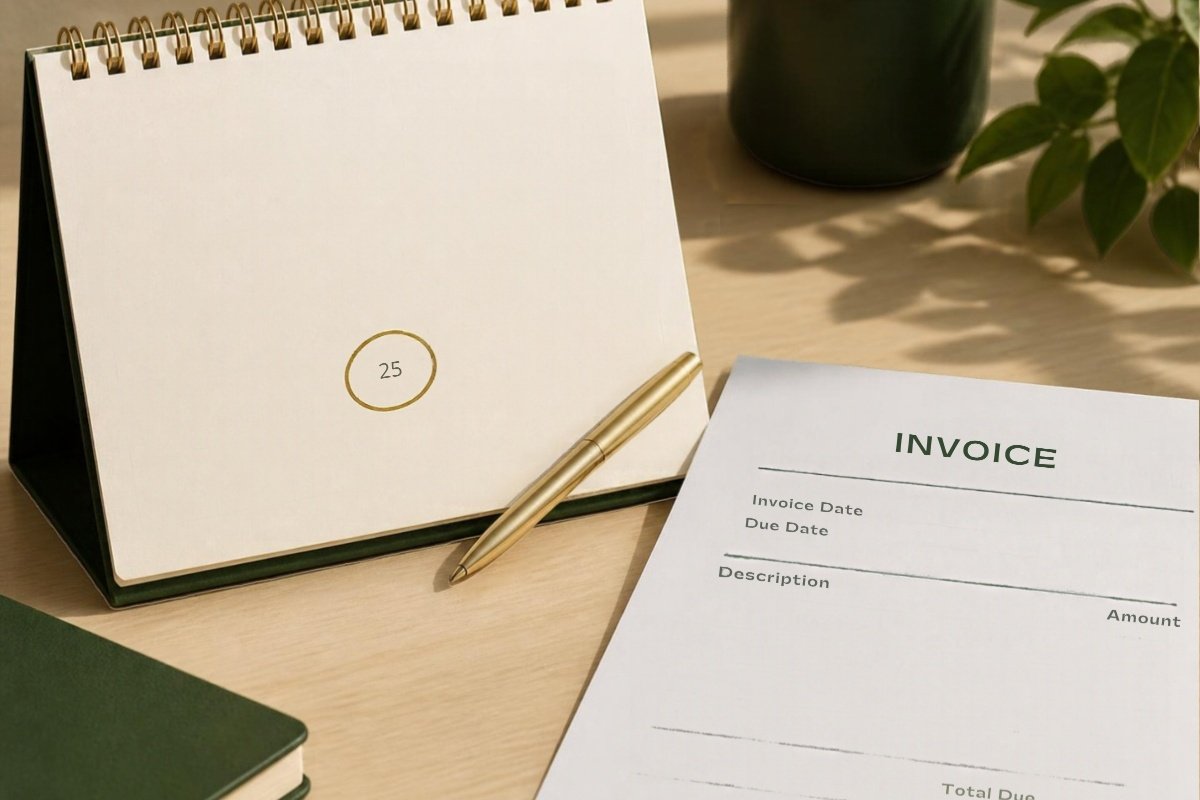
This is where the money actually goes missing, so it is worth being blunt about it.
“Net 30” on its own does not say what day zero is. In practice there are four candidates, and they can be weeks apart.
- Invoice date — the date printed on the document. This is the usual assumption and the one most favourable to you.
- Invoice receipt date — the day it landed with the right person. If it sat in the wrong inbox for a week, you lost a week.
- Delivery date — the day the goods or service were supplied, which can be before or after you invoiced.
- End of month following — some companies run “30 days end of month”, meaning everything invoiced in March is paid at the end of April. A 1 March invoice gets paid sixty days later, and that is their standard term, not a trick.
Write the due date as an actual date on the invoice — “Payment due by 11 November 2026” — rather than “net 30”. The client then has nothing to interpret. Our guide to how to write an invoice covers the other fields that decide whether a document gets paid or returned.
What the law says if you agree nothing
If the contract is silent, the law fills the gap, and it is useful to know what it fills it with.
In the UK, GOV.UK sets out that where no payment date is agreed, payment becomes late thirty days after the customer receives the invoice or after you deliver the goods or service, whichever is later. An agreed date should usually fall within sixty days for business-to-business transactions, and within thirty days when you are billing a public authority, unless a longer period is genuinely fair to both sides.
So in the UK, net 30 payment terms are roughly what you get by saying nothing at all. If you want faster, you have to ask, in writing, before the work starts.
In the US there is no general statutory default for private contracts, but federal agencies work to the Prompt Payment rule. The Treasury’s Prompt Payment guidance states that agencies must pay valid invoices on time and that “in most cases, when an agency pays a vendor late, the agency must pay interest.” The Prompt Payment interest rate for 1 July to 31 December 2026 is 4.75%.
That rate is worth knowing even if you never sell to government, because it is a published, defensible benchmark if you are deciding what late-payment interest to put in your own terms.
Why anyone offers net 30 at all
From the outside it looks like you are lending money for free. Mostly you are. There are three honest reasons to do it anyway.
It is what larger buyers expect. A company with a procurement department is not going to pay on receipt because you asked. Their payment runs are scheduled, usually weekly or fortnightly, and a request for immediate payment just gets ignored. Refusing net 30 in that market means refusing the market.
It wins work at the same price. Between two quotes that are close, the one that does not demand money upfront is easier to approve. You are effectively competing on terms rather than discounting.
It builds a payment history. Consistent, on-time payment from named clients is what lets you negotiate your own terms with suppliers later. It is also what commercial lenders look at, and what makes the case for trading as a company rather than a sole trader — a decision we compare in sole trader versus limited company.
None of those apply to a one-off client you have never worked with. That is the distinction worth holding onto.
What net 30 actually costs you

The cost is not abstract. It is the gap between when you pay for the work and when you get paid for it.
Say you invoice £6,000 a month and your costs go out roughly when the work is done. On due-on-receipt terms, you need enough cash to cover about a week of costs. On net 30, you need a month. On net 30 where the client actually pays on day 45 — which is common — you need six weeks.
That difference is working capital you have to find from somewhere: savings, an overdraft, or not taking the next job because you cannot fund it.
There is a second cost people forget. Every day an invoice is outstanding is a day it can go wrong — the contact leaves, the project gets disputed, the company runs into trouble. Debt ages badly. Thirty days is survivable. Ninety days is a different conversation.
Before you offer net 30 to anyone, do one calculation: if your largest client paid you forty-five days late, could you still pay your own bills that month? If the answer is no, you cannot afford to extend credit yet, whatever the client expects.
Early payment discounts
“2/10 net 30” means two per cent off if they pay within ten days, otherwise the full amount in thirty. It looks small. It is not.
| Discount offered | You give up | Effective annual cost to you |
|---|---|---|
| 1/10 net 30 | 1% for 20 days early | About 18% |
| 2/10 net 30 | 2% for 20 days early | About 37% |
| 3/10 net 30 | 3% for 20 days early | About 56% |
The maths is straightforward: you are paying the discount to get your money twenty days sooner, and twenty days is roughly an eighteenth of a year. Two per cent eighteen times over is a lot.
Which does not mean never offer it. If the alternative is an overdraft at 12% or turning down work you cannot fund, a 2% discount is cheap. Just price it as borrowing, because that is what it is.
When to offer net 30 — and when not to
Offer it when: the client is an established business with a procurement process, you have checked they exist and trade under the name they gave you, the amount is one you could survive being paid late, and there is a purchase order or signed agreement behind it. If they use purchase orders, get the number before you start — no number usually means no payment, however good your terms are.
Do not offer it when: it is a brand new client with no history, the amount would hurt if it vanished, you are funding materials or subcontractors out of your own pocket, or the client has already paid you late once. A client who paid late last time will pay late this time.
The middle option is the one to reach for first: 50% upfront, balance net 30. It is standard practice in most service industries, and it halves your exposure without making you look difficult.
How to write the terms so they hold
Four lines, agreed before the work starts, not discovered afterwards.
- Name the term and the date. “Net 30 from invoice date. Payment due by 11 November 2026.”
- Say what starts the clock. “The thirty-day period runs from the date of the invoice, not from receipt or approval.”
- State the interest position. In the UK you are entitled to statutory interest and reasonable debt recovery costs on late commercial payments. Say so in the terms. Whether you ever charge it is a separate decision.
- Say where the invoice goes. “Invoices will be sent to [accounts email]. Please confirm any PO number required.” Most of the delay in the story at the top of this article came from not asking this one question.
Put these in the proposal and the invoice, not only in terms and conditions nobody opens. A term the client has read is worth more than a term you can prove you sent.
When a net 30 invoice goes past thirty days
Run the same sequence every time so it never feels personal.
- Day 31: short, friendly email. Assume it was missed, because usually it was. Reattach the invoice.
- Day 37: contact the accounts team, not the person who hired you, and ask one specific question — is this invoice in the next payment run.
- Day 45: formal written reminder stating the invoice number, amount, original due date, and that interest may be applied.
- Day 60: stop new work, in writing, and set out what happens next.
Most late payment is administrative rather than deliberate — a mismatch in a system, a missing reference, an approver on holiday. Asking a precise question gets a precise answer far faster than chasing in general terms. If lateness has become the pattern rather than the exception, the problem is the relationship, not the terms, and we covered that in our guide to ending a client relationship professionally.
Frequently asked questions
Does net 30 mean 30 business days?
No. Calendar days, including weekends and public holidays, unless the contract says otherwise.
Is net 30 the same as 30 days end of month?
No, and the difference can be thirty extra days. “30 days EOM” means payment at the end of the month after the invoice month.
Can I charge interest if a net 30 invoice is late?
In the UK you are entitled to statutory interest and recovery costs on late commercial payments. Elsewhere it depends on your contract, so put the interest term in writing before the work starts.
Should a new small business offer net 30 payment terms?
Usually not at first. Start with payment on receipt or a deposit, and offer net 30 once you have a history with the client and enough cash to absorb a late payment.
What if a client asks for net 60 or net 90?
Treat it as a pricing question. Longer terms cost you money, so either price them in, ask for a deposit, or decline. In the UK, terms beyond sixty days between businesses have to be genuinely fair to both sides.
The short version
Net 30 payment terms mean the full invoice is due thirty calendar days from an agreed date. The term itself is not the risk — leaving the starting point undefined is.
Write the due date as a date, say what starts the clock, agree it before the work begins, and only extend credit you could survive losing. Offer net 30 to businesses that have earned it, and a deposit to everyone else.