Accounts Payable Invoice Approval Process: The 4 Stages
You sent the invoice three weeks ago. The work was signed off. Nobody has said anything is wrong, and nobody has paid you.
Between the moment your invoice arrives and the moment money leaves the client’s bank account, it passes through a chain of checks and approvals that nobody ever explains to suppliers. That chain is the accounts payable invoice approval process, and once you know how it works, a lot of unexplained silence starts to make sense.
This guide walks through all four stages, shows where invoices get stuck, and lists what to put on the document to stop it happening.
What the accounts payable invoice approval process is
The accounts payable invoice approval process is the sequence a company follows to verify a supplier invoice and authorise payment. It confirms three things: that the goods or services were genuinely ordered, that they were genuinely received, and that the amount billed matches what was agreed.
Every company runs some version of it. A small business might do it in ten seconds over a desk. A large employer runs it through software with routing rules. The steps are the same either way.
The important thing for a supplier: approval is not one decision by one person. It is several checks, and your invoice has to clear all of them.
The four stages of the accounts payable invoice approval process
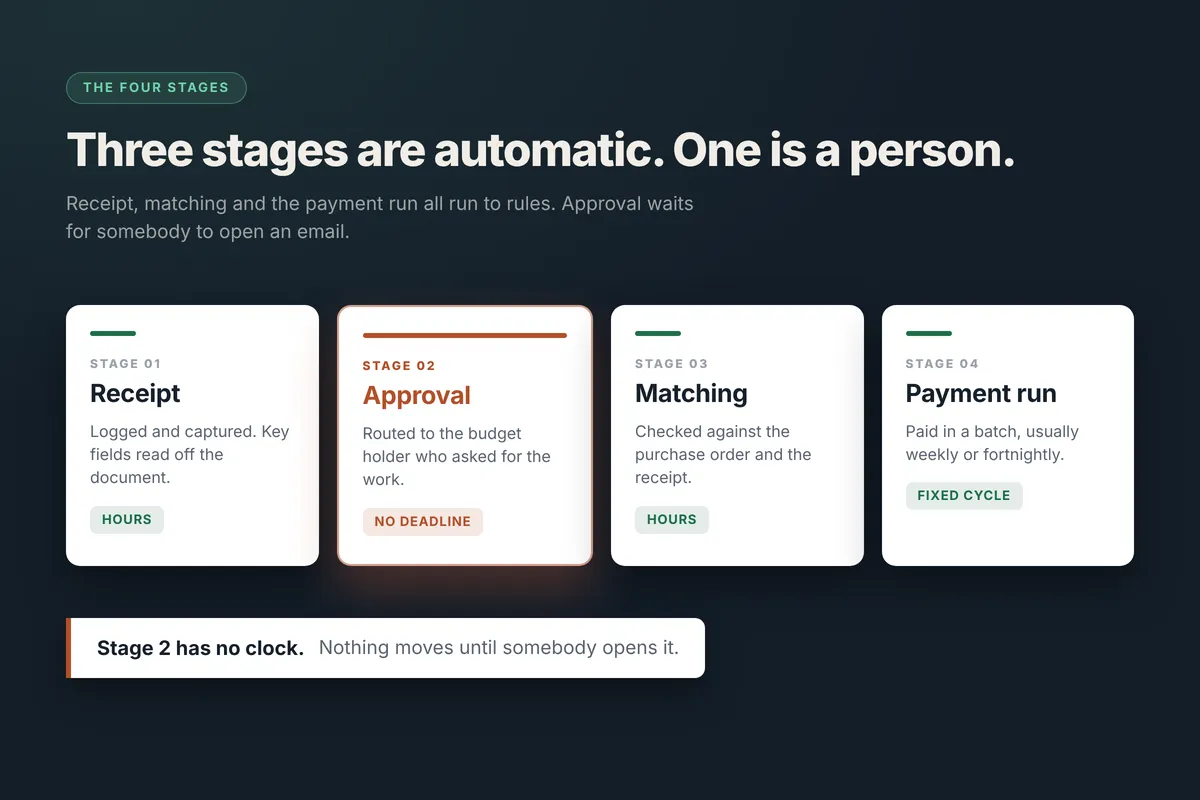
Stage 1: Receipt and capture
The invoice arrives, usually by email, and is logged into the system. Key details are pulled off the document: supplier name, invoice number, date, amount, tax, and any purchase order reference.
Two things go wrong here, and both are silent. If your invoice went to your day to day contact instead of the accounts payable inbox, it never entered the system. And if the capture step cannot read a field it needs, the invoice is flagged before a human looks at it.
Stage 2: Approval routing
The invoice is routed to whoever can approve that cost: usually the manager who requested the work, sometimes a department head, sometimes two people if the amount crosses a threshold.
This is the stage with a person in it, and it is the stage with no deadline attached. The other three steps are checks that either pass or fail within hours. This one waits for somebody to open an email.
Stage 3: Matching
Here the invoice is compared against the company’s own records. There are two common versions:
- Two way matching: the invoice is checked against the purchase order. Do the amounts, quantities and prices agree?
- Three way matching: the invoice is checked against the purchase order and a goods received note or delivery confirmation, proving the work actually arrived.
A mismatch at this stage does not usually mean rejection. It means the invoice drops into an exception queue for somebody to investigate, which brings us back to waiting for a human.
Stage 4: Payment run
Approved invoices join a payment run. Very few companies pay invoices one at a time. They batch them, typically weekly or fortnightly, sometimes monthly. Public bodies often work to a published standard instead: in the United States, federal agencies follow the Prompt Payment rule, which sets a 30 day clock.
An invoice approved on a Thursday, where payment runs happen on Wednesdays, waits another six days. That delay has nothing to do with anything you did.
Where the process actually stalls
Ask people who work in accounts payable where the accounts payable invoice approval process breaks down, and the answer is consistent: it is almost never the software. It is stage two.
The approver is busy, or on holiday, or meant to look on Tuesday. There is no alert, no escalation and no deadline, because an unapproved invoice creates a problem for nobody inside the company. It only creates one for you.
There is a second, less obvious issue. When an invoice fails a check and lands in the exception queue, nobody is necessarily watching that queue. In many companies it gets cleared at month end, so an invoice that lands there on the 2nd and one that lands on the 26th are both found in the same sweep.
So “it is in the system” and “somebody is working on it” are not the same sentence, even when they are said in the same breath.
The fields that trigger an automatic hold
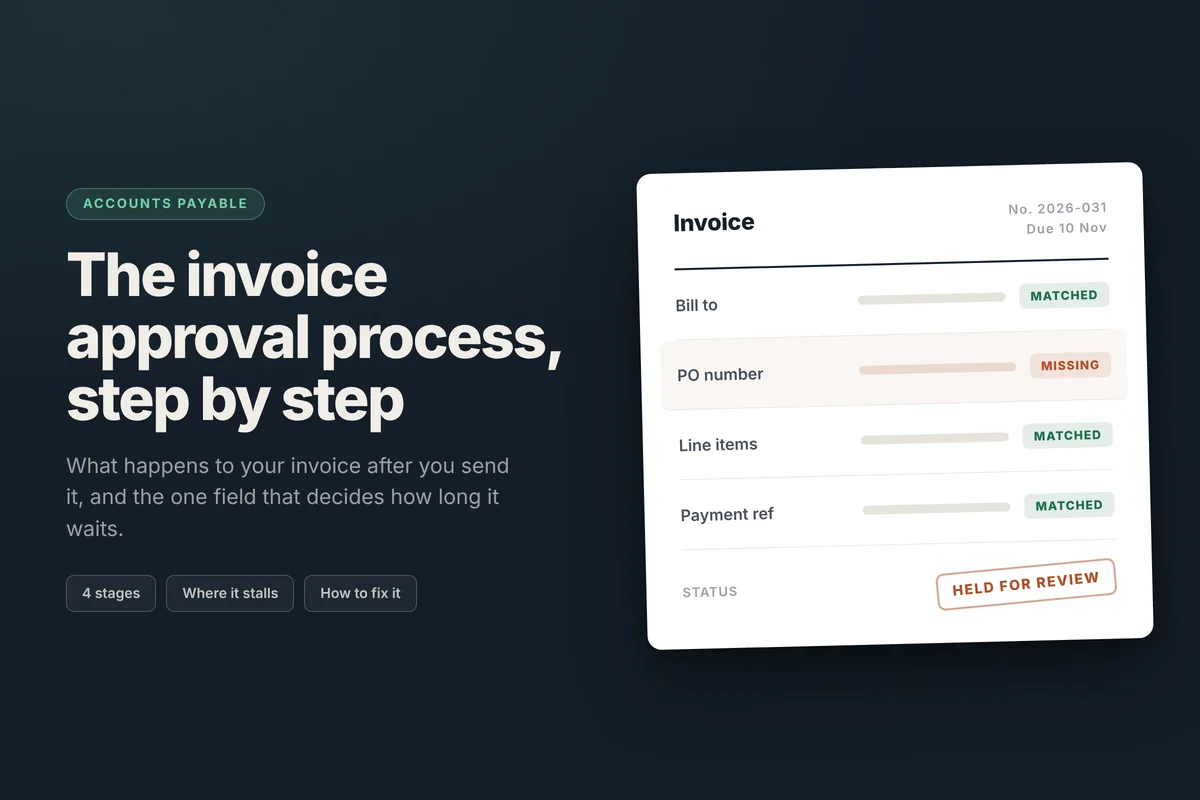
Before a human ever sees your invoice, a handful of fields decide whether it clears the accounts payable invoice approval process or stops dead.
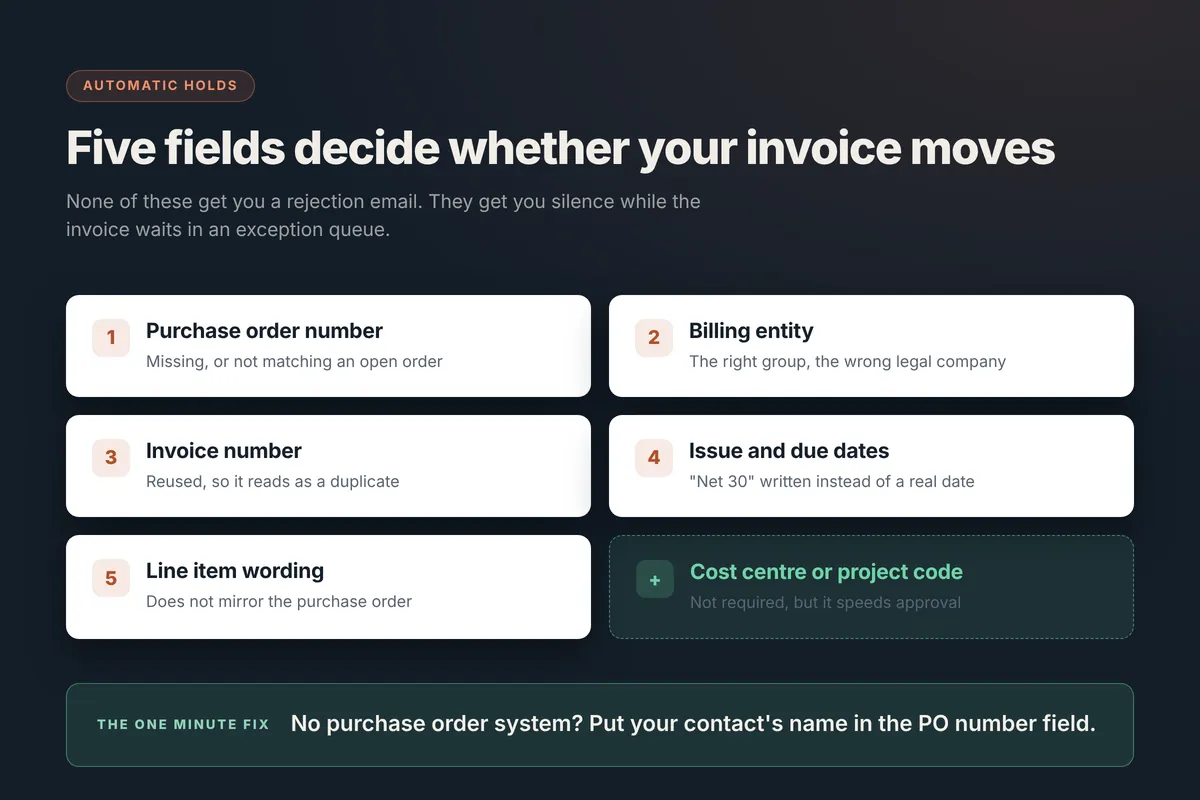
The purchase order number. Many companies will not process an invoice without one, and will not process one where the number does not match an open order. Ask on the day the work is agreed, not the day you invoice. If you are unclear on how the two documents relate, the difference between a purchase order and an invoice is worth ten minutes of reading.
The billing entity. You worked with Acme. The company that pays might be Acme Holdings Ltd or Acme Services Inc. Bill the wrong one and their system sees an invoice addressed to a company that owes you nothing.
The invoice number. Yours has to be unique and sequential. Reusing a number because you reissued a document looks like a duplicate, and duplicate detection is exactly the sort of automated check that quietly holds payment.
The dates. An invoice needs an issue date and a due date written as actual dates. “Net 30” is a term, not a date, and different accounts teams read it differently. If you have never looked closely at what you are agreeing to, net 30 payment terms are worth understanding properly.
Line item wording. If the purchase order says “website copy, 4 pages” and your invoice says “content consulting”, somebody has to decide whether those are the same thing. Accounts payable does not make that call. It sends the invoice back.
What you can do about it
You cannot change a client’s accounts payable invoice approval process. You can change how easy your invoice is to move through it.
Send it to accounts payable directly, from the very first invoice. Not later as an escalation, which reads as distrust. As the default, with your contact copied. This single habit removes the most common failure point, which is an invoice sitting in one person’s inbox.
Ask for the PO number before the work starts. Ten seconds of asking saves three weeks of waiting.
If the client has no purchase order system, put your contact’s name in the PO number field. An empty field tells the person opening it nothing. A name gives them somebody to ask, and your invoice stops being anonymous.
Ask for the cost centre or project code. These tell finance which budget a cost belongs to. An invoice that answers that in advance is easier to approve than one that creates work.
Put a contact line on the invoice itself. A name, an email and a phone number for questions about this invoice. It turns a silent hold into a quick question, and getting the structure right costs nothing.
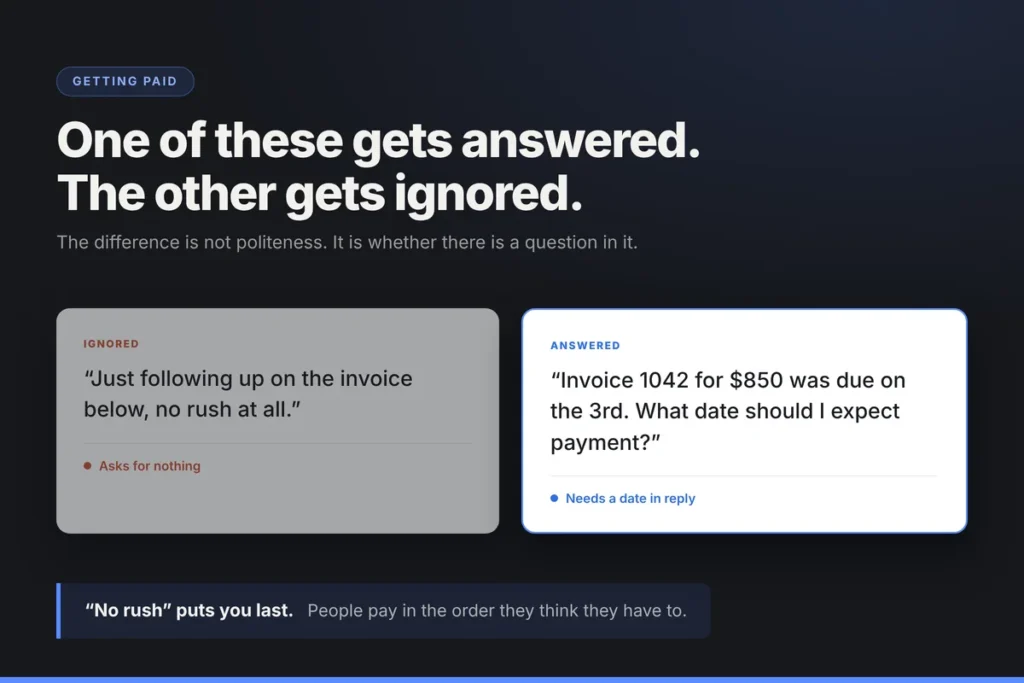
Ask which payment run you are in. When you chase, avoid “any update?”, which can be honestly answered with “not yet”. Ask a question with a factual answer. A fixed, polite schedule works better than chasing when you feel annoyed, which is why a standard payment reminder email beats improvising every time.
How long should the whole process take?
Where the accounts payable invoice approval process is working normally and nothing on the invoice is wrong, expect a few days to two weeks before it joins a payment run. Add the payment terms on top of that.
Beyond three weeks with no explanation, the invoice is almost certainly waiting on a person rather than a process. That tells you who to contact and what to ask.
Frequently asked questions
Who approves invoices in accounts payable?
Accounts payable runs the checks, but approval itself comes from the budget holder who requested the work. Accounts payable cannot approve a cost that is not theirs, which is why chasing them alone rarely speeds anything up.
What is three way matching?
Three way matching compares the invoice, the purchase order and proof that the goods or services were received. All three must agree before payment is authorised. Two way matching skips the receipt check.
Why is my invoice in an exception queue?
Because one check did not pass, most often a missing or mismatched purchase order number, a wrong billing entity, or a duplicate invoice number. The invoice is not rejected. It is waiting for somebody to look, and nobody is required to tell you.
Can I charge interest if the approval process is slow?
In many countries you can, and in some you have a statutory right to. In the UK you can claim statutory interest on late commercial payments. Whether it is wise depends on the relationship. A late payment fee usually works better as a deterrent written into your terms than as something you enforce.
The short version
The accounts payable invoice approval process has four stages, and three of them are fast. The one that is slow is the one with a person in it, and that person has no deadline.
Everything useful you can do comes down to the same idea: make the invoice easy to match, send it where it can be seen, and give it a name attached to it. You are not speeding up a system. You are making sure somebody owns the document.