LLC vs Sole Proprietorship: Taxes, Liability and Costs Compared
When you start a business in the US, one of the first decisions is whether to stay a sole proprietor or form a limited liability company (LLC). Both let you keep things simple and pay tax through your personal return, but they differ in one big way: whether your personal assets are protected if the business is sued or runs into debt.
This guide compares LLC vs sole proprietorship side by side, covering liability, taxes, costs and paperwork, so you can decide which suits your business.
In this guide
- Quick answer
- LLC vs sole proprietorship: comparison table
- What is a sole proprietorship?
- What is an LLC?
- Liability: the biggest difference
- LLC vs sole proprietorship taxes
- Single-member LLC vs sole proprietorship: when to switch
- How to form an LLC
- Running a cleaning, lawn care or vending business?
- Three real-world scenarios
- LLC costs checklist
- Common myths about LLCs
- How to switch from sole proprietorship to LLC
- Frequently asked questions
Quick answer
- Choose a sole proprietorship if you’re testing an idea, your work carries little risk and you want zero setup cost.
- Choose an LLC if you have clients, employees, property, inventory or any real chance of being sued, or if you want a more professional structure and the option of S corp tax savings later.
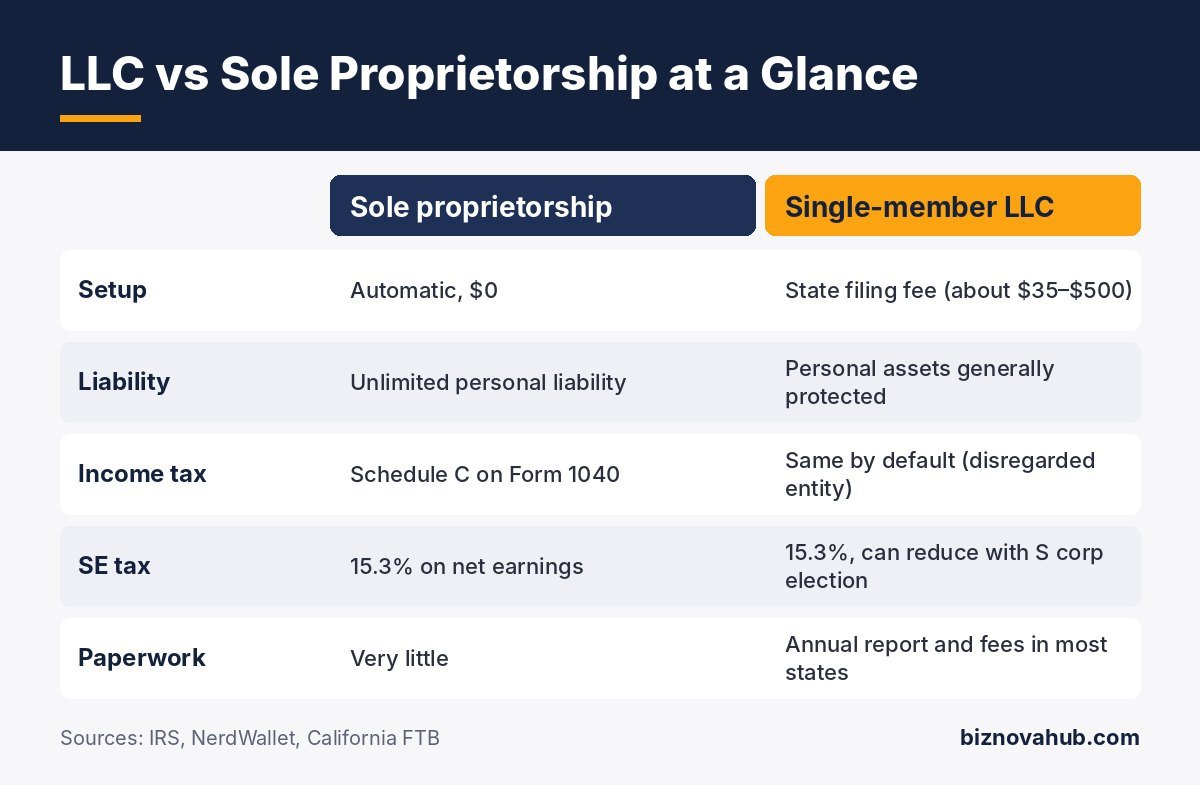
LLC vs sole proprietorship: comparison table
| Sole proprietorship | Single-member LLC | |
|---|---|---|
| How you create it | Automatic when you start trading | File articles of organization with your state |
| Setup cost | $0 (plus any local licences or DBA name) | State filing fee, generally about $35–$500 |
| Personal liability | Unlimited: your personal assets are at risk | Limited: personal assets are generally protected from business debts and lawsuits |
| Federal income tax (default) | Schedule C on your Form 1040 | Same: treated as a “disregarded entity” |
| Self-employment tax | 15.3% on net earnings | 15.3% by default; can be reduced with an S corp election |
| Ongoing paperwork | Very little | Annual report and fees in most states; separate bank account |
| Credibility with clients and banks | Lower | Higher |
| Tax flexibility | None | Can elect C corp or S corp taxation |
Filing fee range: NerdWallet. Tax treatment: IRS.
What is a sole proprietorship?
A sole proprietorship is a business owned and run by one person with no legal separation between the owner and the business. If you start freelancing or selling and haven’t registered anything, you’re already a sole proprietor.
Pros: free and instant to start; minimal paperwork; all profit is yours; simple taxes.
Cons: you are personally liable for business debts and lawsuits; it can look less established to clients and lenders; no option to be taxed as a corporation.
What is an LLC?
An LLC is a legal entity created under state law. It separates the business from its owner (called a “member”), so the business’s debts and liabilities generally belong to the LLC, not to you personally.
Pros: liability protection; professional image; flexible tax options; easier to add partners later.
Cons: formation and annual fees; more admin; you must keep business and personal finances separate to keep your protection.
Liability: the biggest difference
As a sole proprietor, if a customer sues your business or you can’t pay a supplier, creditors can go after your personal savings, car or home. With an LLC, they can generally only reach the business’s assets.
That protection has limits:
- It doesn’t cover your own negligence. If you personally cause harm, you can still be liable.
- If you mix personal and business money, ignore formalities or personally guarantee a loan, courts can “pierce the corporate veil” and hold you personally liable.
- It’s not a substitute for insurance. Most LLC owners still carry general liability or professional liability cover.
LLC vs sole proprietorship taxes
Income tax: the same by default
The IRS treats a single-member LLC as a disregarded entity by default. Its income and expenses go on your personal return (usually Schedule C), exactly like a sole proprietorship. So forming an LLC doesn’t change your federal income tax unless you elect a different tax status.
Self-employment tax
Both sole proprietors and default single-member LLC owners pay self-employment tax of 15.3% (12.4% Social Security plus 2.9% Medicare) once net earnings reach $400. The Social Security part applies up to the annual wage base, which is $184,500 for 2026.
The S corp option (LLCs only)
An LLC can elect to be taxed as an S corporation (Form 2553). You then pay yourself a reasonable salary through payroll and can take remaining profit as distributions, which aren’t subject to self-employment tax. This can save money once profits are well above a reasonable salary, but it adds payroll costs and accounting work. Talk to an accountant before electing.
State taxes and fees
Some states charge LLCs extra. For example, every LLC organized or doing business in California owes an $800 annual tax, plus an additional fee once California income passes $250,000 (California FTB). Check your state’s annual report fees before you form.
Single-member LLC vs sole proprietorship: when to switch
Consider forming an LLC when:
- You work in clients’ homes or premises (cleaning, lawn care, trades, repairs)
- You hire employees or contractors
- You sign leases, take on debt or hold stock and equipment
- You sell physical products that could cause injury
- Your profits are high enough that an S corp election could reduce tax
- Bigger clients or platforms ask you to work through a business entity
Staying a sole proprietor can make sense when you’re testing an idea with low risk, such as writing, design or tutoring with good insurance.
How to form an LLC
- Choose a name that meets your state’s rules (usually ending in “LLC”).
- Appoint a registered agent with an address in the state.
- File articles of organization with your Secretary of State and pay the fee.
- Create an operating agreement, even for a single-member LLC.
- Get an EIN from the IRS. It’s free, and banks usually ask for one.
- Open a business bank account and keep all business money in it.
- Get local licences and mark annual report deadlines in your calendar.
Beneficial ownership reporting: in March 2025, FinCEN issued an interim final rule exempting US-created companies and US persons from Corporate Transparency Act beneficial ownership reporting. Check for updates and any state-level disclosure rules when you form.
Running a cleaning, lawn care or vending business?
Hands-on service businesses carry real liability risk, which is why many owners form an LLC early. See our step-by-step guides on how to start a cleaning business, how to start a lawn care business and how to start a vending machine business. Starting in the UK instead? Read sole trader vs limited company.
Three real-world scenarios
Scenario 1: freelance writer earning $25,000 a year
Low liability risk, no employees, no premises. A sole proprietorship with professional liability insurance is often enough. An LLC adds cost without much tax benefit at this level, though some freelancers still form one for a more professional image.
Scenario 2: house cleaner working in clients’ homes
Accidental damage or injury claims are a real risk, and the business may hire staff. An LLC plus general liability insurance and a bond is the usual choice. See our cleaning business guide.
Scenario 3: consultant earning $150,000 in profit
Here the tax angle matters. An LLC taxed as an S corporation could reduce self-employment tax by splitting income into a reasonable salary and distributions. Run the numbers with an accountant, including payroll costs and state fees.
LLC costs checklist
| Cost | When | Notes |
|---|---|---|
| State filing fee | Once, at formation | Generally about $35–$500 depending on the state |
| Registered agent | Yearly (optional) | Free if you act as your own agent with an in-state address |
| Annual report / franchise tax | Yearly in most states | California charges an $800 annual tax |
| EIN | Once | Free from the IRS |
| Business licences | Varies | City, county or state, depending on your work |
| Accounting | Yearly | Higher if you elect S corp status and run payroll |
Common myths about LLCs
- “An LLC lowers my taxes automatically.” Not by default. A single-member LLC is taxed like a sole proprietorship unless you make an election.
- “An LLC protects me from everything.” It doesn’t cover your own negligence, personal guarantees or mixing personal and business funds.
- “I must form my LLC in Delaware or Wyoming.” Most small businesses should form in the state where they operate. Forming elsewhere usually means registering as a foreign LLC at home too, paying two sets of fees.
- “Sole proprietors can’t have a business name.” They can, by registering a DBA (“doing business as”) name where required.
How to switch from sole proprietorship to LLC
- Form the LLC with your state and create an operating agreement.
- Get a new EIN for the LLC (and keep your old records).
- Open an LLC bank account and move business money into it.
- Transfer contracts, licences, domain names and equipment into the LLC’s name.
- Update your invoices, website, insurance and payment processors.
- Tell clients and suppliers about the change.
Frequently asked questions
Is an LLC better than a sole proprietorship?
For most businesses with clients, assets or employees, yes, because of liability protection. For a very low-risk side business, a sole proprietorship can be enough to start.
Do LLCs pay more tax than sole proprietors?
Not by default. A single-member LLC is taxed like a sole proprietorship at the federal level. You may pay extra state fees, and you can sometimes pay less self-employment tax by electing S corp status.
Can I change from a sole proprietorship to an LLC later?
Yes. You form the LLC, move business assets, contracts and bank accounts into it, and update licences and your EIN details as needed.
Does a single-member LLC need an EIN?
According to the IRS, a single-member LLC with no employees and no excise tax obligations can use the owner’s Social Security number for income tax. In practice, most owners get a free EIN because banks and clients ask for one.
This article is general information, not legal or tax advice. Rules vary by state; speak to an attorney or accountant about your situation.