How to Start an AI Automation Agency in 2026 (Real Costs and Pricing)
What this guide covers
- What an AI automation agency actually sells
- Why the model works in 2026
- What it really costs to start
- Step 1: Pick one process, not “AI”
- Step 2: Choose your stack
- Step 3: Price it so it survives
- Step 4: Get the first paying client
- Step 5: Register the business properly
- Step 6: The compliance part nobody mentions
- Mistakes that kill these agencies
- FAQ
Search “AI automation agency” and you will find a lot of people selling the dream and very few explaining the work. The pitch is always the same: no code, no staff, recurring revenue, six figures by month six.
The underlying business is real. Companies genuinely will pay someone to connect their tools together and put a language model in the middle. What almost nobody explains is what you actually sell, what it costs to run, what to charge, and which legal obligations land on you the moment you touch a client’s data.
This guide covers that, with real 2026 prices and the rules that apply in the US, the UK and the EU.
What an AI automation agency actually sells
Strip away the branding and the product is simple: you remove a repetitive task from a business and keep it removed.
The work looks like this. A client has a process that eats hours — sorting inbound enquiries, chasing invoices, writing listing descriptions, routing support tickets, summarising calls into the CRM. You build a workflow that does it automatically, test it against real cases, and then maintain it when something breaks.
The “AI” part is usually one step inside a larger plumbing job. A model reads the email and decides what it is about. Everything around that step — the trigger, the data lookups, the formatting, the error handling, the record that gets written — is ordinary automation, and it is where most of your time actually goes.
This matters for how you sell. Nobody buys “AI”. They buy “you will never manually sort another enquiry”.
Why the model works in 2026
Three things changed at once, and the combination is what makes this viable for a solo operator.
The models got cheap enough to put in a loop. Running a language model over every inbound email used to be a line item worth arguing about. At current API prices it is often cents per day for a small business’s volume.
The connectors caught up. The automation platforms now ship native AI nodes, so you are configuring a step rather than writing and hosting code.
Demand moved down-market. Small firms have watched larger competitors automate and now assume they are behind. They do not have an internal person who can build this. That gap is the business.
There is a fourth factor that works against you, and you should know it before you start: the barrier to entry is low, so the market is crowded with people who have watched the same videos you have. The ones who last are the ones who can point at a finished system and say what it saved. That is a delivery problem, not a marketing one.
What it really costs to start
Much less than an agency in any other field, and more than “free”.
| Item | Realistic cost | Notes |
|---|---|---|
| Automation platform | $0–$50/month | Make’s Free plan gives 1,000 credits/month; Core is $9/month for 10k credits. Zapier is free for 100 tasks/month, Professional from $19.99/month. n8n Starter is $20/month billed annually for 2,500 executions, Pro $50/month for 10k. |
| Model API credit | $5–$40/month | Pay-as-you-go. For one or two small clients this stays low; it scales with volume, not with headcount. |
| Business registration | $0–$500 one-off | Varies by state and country. See the legal section below. |
| Domain and email | ~$15/year + ~$6/month | Use a real domain. A Gmail address on a proposal costs you deals. |
| Professional indemnity insurance | $30–$90/month | Optional at first, expected once you handle anyone’s customer data. |
| Contract templates | $0–$300 one-off | A service agreement and a data processing addendum. Do not skip the second one. |
A sane starting budget is $100–$200 in the first month, most of it one-off. The real cost is the fifty to eighty hours you will spend building things nobody pays you for while you learn the platforms.
Step 1: Pick one process, not “AI”
The single biggest mistake is positioning as “we do AI automation for businesses”. It describes a capability, not a problem, so nobody can tell whether they need you.
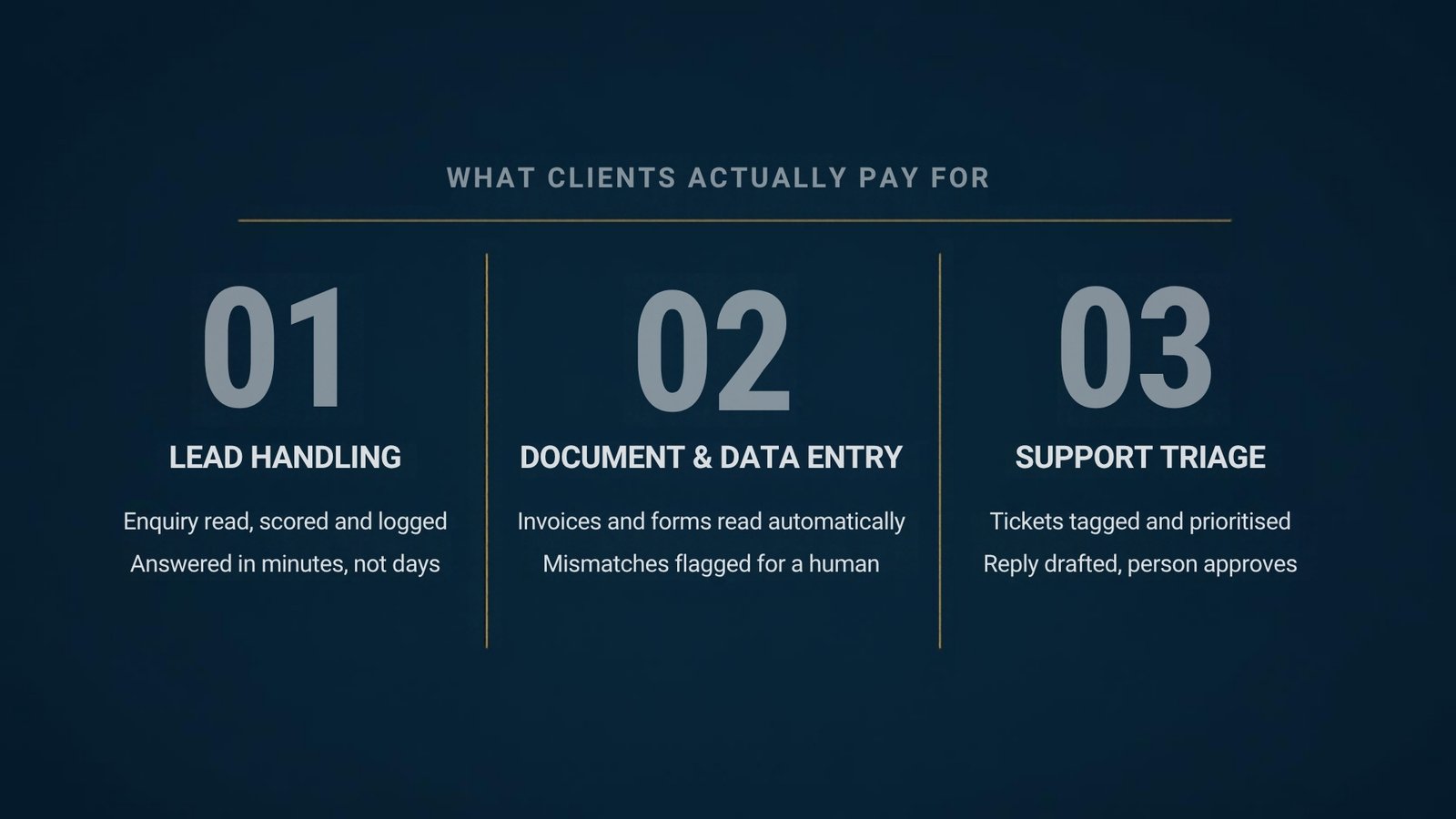
Pick one process that exists in thousands of businesses and that you can describe in a sentence a client would say out loud. Three that reliably sell:
Lead handling. An enquiry arrives by form, email or call. It gets read, categorised, scored, logged in the CRM, and answered within minutes with something relevant. Businesses that pay for leads feel this one immediately, because a slow reply is money they already spent and lost.
Document and data entry. Invoices, purchase orders, delivery notes, timesheets. Something extracts the fields, checks them against existing records, flags the ones that do not match, and writes the rest into the accounting system. The value is measured in hours and in errors avoided.
Support triage. Incoming tickets get read, tagged, prioritised, and either answered from an existing knowledge base or routed to a person with a draft already written. Note the word “draft” — the version where a human still approves is both easier to sell and much safer legally.
Pick one. Build it three times for three different businesses in the same industry. By the third build you will be fast, you will know the edge cases, and you will have a demo that is specific enough to close.
Step 2: Choose your stack
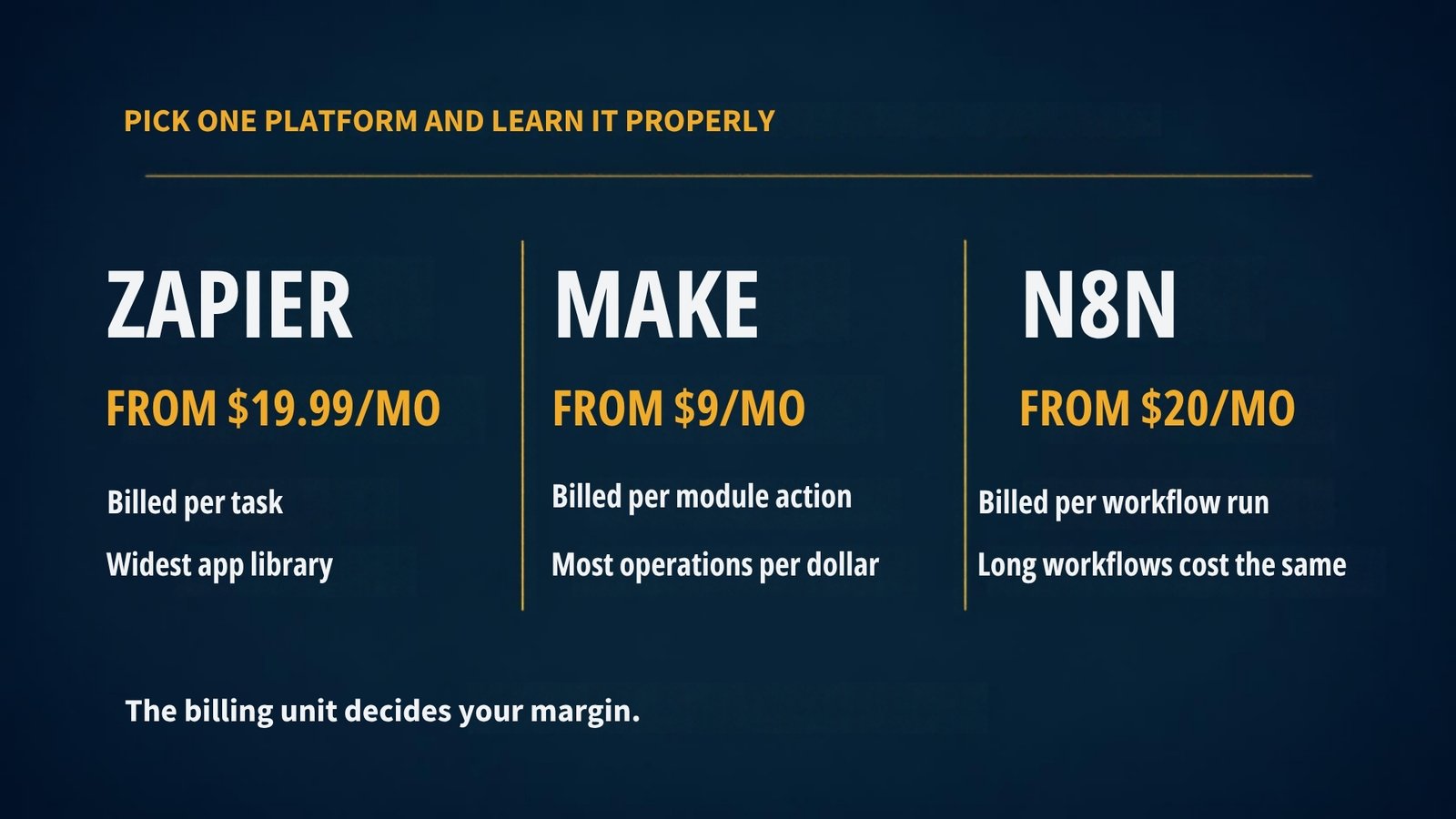
You need one automation platform you know deeply, not three you know badly. Here is how the main options actually differ in 2026.
| Platform | Entry price | Billing unit | Suits you if |
|---|---|---|---|
| Zapier | Free (100 tasks/month), Professional from $19.99/month | Per task | You want the widest app library and the shortest learning curve. Costs climb fastest at volume. |
| Make | Free (1,000 credits/month), Core $9/month for 10k credits | Per module action | You think visually and want far more operations per dollar than Zapier. |
| n8n | Starter $20/month billed annually (2,500 executions), Pro $50/month (10k) | Per workflow execution, regardless of steps | Your workflows are long. A 40-step run costs the same as a 3-step run, which changes the maths completely. Can also be self-hosted. |
The billing unit is the part people miss. On a per-task platform, a workflow with thirty steps bills thirty times. On n8n the same run bills once. If your automations are long — and real client automations are long — that difference compounds into your margin every month.
Beyond the platform you need one model provider, one place to store client credentials securely, and a simple way to monitor failures. That is the whole stack. Resist adding more.
Step 3: Price it so it survives
Hourly pricing is the trap. The entire value of what you build is that it takes less time than doing it manually, so billing by the hour means you are paid less the better you get.
The model that works is a setup fee plus a monthly retainer. The setup fee covers the build. The retainer covers monitoring, fixes when an API changes, and small adjustments. Both parts are necessary: setup-only work leaves you rebuilding your income from zero every month, and retainer-only pricing means you fund the expensive part yourself.
Published 2026 benchmarks put agency engagements in a wide band — roughly $500 to $20,000+ per month depending on client size. Broken down by tier:
| Client type | Typical monthly retainer | What they expect |
|---|---|---|
| Small business | $500–$1,500 | One or two workflows, straightforward tools, you on email when it breaks |
| Mid-market | $1,500–$4,000 | Several connected processes, their own systems, documentation, response times in writing |
| Enterprise | $3,000–$8,000+ | Security review, data processing agreements, named contacts, formal change control |
A workable first-client structure: a setup fee of $1,500–$3,000 and a retainer of $500–$900 a month, with the retainer explicitly covering a fixed number of hours of changes.
Two rules that will save you later. First, price against what the process costs the client now, not against what it costs you to build. Twelve hours a month of someone’s time is a number they can verify, and it makes your fee look small. Second, put a usage ceiling in the contract. If their volume triples, your platform and model bills triple too, and without a clause you absorb that.
Step 4: Get the first paying client
Cold outreach with no proof is the slowest possible route. What works at the start is narrow and unglamorous.
Build it before you pitch it. Choose a specific industry, build the automation for an imaginary company in it, record a four-minute screen walkthrough. You are now showing a working thing instead of describing a service. This single asset outperforms any amount of cold copy.
Go where the process is visibly broken. Businesses that take days to answer an enquiry, agencies drowning in onboarding forms, clinics with manual appointment admin. You can often see the problem from the outside, which makes the first message specific.
Offer a paid pilot, not a free trial. A small fixed-fee build — one workflow, two weeks, a few hundred dollars — converts far better than a free audit and filters out people who were never going to pay. It also gives you a real case study.
Work your existing network first. Your first client is usually someone who already knows you, or one referral away. The broader playbook for this is in our guide on how to get more customers.
Keep every result. Hours saved, response time before and after, error rate. Three sentences of numbers from a real client is worth more than a website.
Step 5: Register the business properly
You can start as a sole trader or sole proprietor, and many people do. The reason to form a company earlier than feels necessary in this particular business is that you are touching other companies’ customer data, and personal liability is a bad default.
United States. An LLC separates your personal assets from the business and costs between roughly $50 and $500 to form depending on the state, plus an annual fee. Our comparison of LLC vs sole proprietorship covers which makes sense when.
United Kingdom. Registering a limited company with Companies House is inexpensive and fast, and gives you the same liability separation. We compared the options in sole trader vs limited company.
European Union. The equivalent structures vary by member state, but the principle is identical: a limited-liability entity before you hold anyone else’s data.
Whatever you choose, get three documents in place before the first client: a service agreement that defines what “maintenance” includes, a data processing agreement, and clear written terms on who owns the workflows if the relationship ends.
Step 6: The compliance part nobody mentions
This is the section missing from almost every guide on this topic, and it is the one that can end an agency rather than merely slow it down.
When you build an AI workflow that processes a client’s customer data, you are a processor handling personal data on their behalf, and in EU terms you are often also a deployer of an AI system. Both carry obligations.
If you or your client operate in the EU
The EU AI Act applies on a staggered timetable. Its prohibitions and the AI literacy duty have applied since February 2025, obligations for general-purpose AI models since August 2025, and a further set of obligations — including the transparency rules most small deployments actually touch — applies from 2 August 2026.
For the kind of systems an automation agency builds, the practical requirements are modest but real:
- Tell people when they are talking to an AI. A chatbot or voice agent that handles customers must make clear it is a machine, unless that is obvious from the context.
- Label synthetic content. AI-generated or AI-manipulated images, audio and video need to be marked as such.
- AI literacy. The people operating the system need to understand enough about it to use it responsibly. In practice this means you document what the automation does, what it cannot do, and when a human must intervene.
The penalties sit with the business deploying the system, not with you — which is exactly why clients will start asking you to put this in writing. Being the supplier who already has it documented is a sales advantage, not a burden.
If you operate in the UK or US
There is no single equivalent statute, but the direction is the same. UK GDPR obligations around automated processing apply as they always have, and a growing number of US states have introduced disclosure rules for AI used in customer interactions, particularly voice agents and chatbots. If you build voice automations, check the rules in the state your client operates in before you launch, not after.
The three things to do regardless
One: sign a data processing agreement with every client, naming the sub-processors you use — which includes your automation platform and your model provider.
Two: do not send more personal data to a model than the task requires. Strip what you do not need before the API call. This is good practice everywhere and mandatory in the EU.
Three: keep a human approval step on anything that is sent to a customer, makes a financial decision, or cannot be undone. It reduces your risk, and clients find it easier to approve a system they can supervise.
Mistakes that kill these agencies
Selling the technology instead of the outcome. “We use multi-agent AI workflows” means nothing to a plumbing company. “You stop losing enquiries that arrive after 6pm” does.
No maintenance in the contract. APIs change, clients rename fields, models get deprecated. If maintenance is not a paid line, every break is unpaid work and every client becomes a loss.
Taking every industry. Each new sector means new tools, new vocabulary and a build from scratch. Three clients in one industry is a business. Three clients in three industries is three jobs.
Ignoring the volume clause. Your platform and model costs scale with the client’s activity. Without a ceiling in writing, a client’s good quarter becomes your bad one.
No handover documentation. If only you understand the workflow, you cannot take a holiday and you cannot ever hire. Document from the first build.
Automating something nobody minded doing. Before building, ask how long the task takes and who does it. If the answer is “ten minutes a week, the owner’s nephew”, there is no deal there regardless of how good the demo looks.
FAQ
Do I need to know how to code?
No, to start. The platforms are visual, and a competent non-developer can build genuinely useful automations. You will hit a ceiling eventually — error handling, custom API calls, anything with unusual authentication — and basic scripting will take you past it. Treat it as a second-year skill, not a prerequisite.
How long before the first client?
Realistically one to three months if you build a demo first and target one industry. Faster if you already have a network in a specific sector. The people claiming thirty days are usually counting from a warm contact they already had.
Is the market already saturated?
The low end is. There are many people offering generic “AI automation” with no proof. The segment that is not saturated is narrow specialisation — someone who has built the same workflow twenty times for dental practices is not competing with those people at all.
What if a client asks for something unsafe or non-compliant?
Decline it in writing and offer the supervised version instead. Fully automated decisions about people — hiring, credit, pricing by individual — carry obligations that a one-person agency should not take on.
Can I run this alongside a job?
Yes, and most people should at first. The build work is asynchronous. What is not asynchronous is client support when something breaks mid-morning, so set response times you can actually meet before you sign.
Do I need my own website?
A single clear page and a real domain, yes. A large website, no. The recorded demo does more selling than any amount of copy. If you want the no-inventory version of a similar idea, we covered starting an online store without inventory separately.
The short version
Pick one process. Build it three times in one industry. Price it as a setup fee plus a retainer with a volume ceiling. Register a limited-liability entity before you touch anyone’s customer data. Put the compliance basics in writing early, because your clients are about to start asking.
The hype around this model is mostly noise. The business underneath it is ordinary, unglamorous and genuinely workable — which is exactly why most of the people chasing it will not still be doing it in a year.
Sources: platform pricing taken from Zapier, Make and n8n, checked October 2026. Agency pricing bands from published 2026 industry guides. EU AI Act timetable per the Regulation’s staggered application dates, with the further obligations applying from 2 August 2026. This article is general information, not legal advice — confirm your own obligations with a qualified adviser in your jurisdiction.