How to Write an Invoice: What to Include and When to Send It
The first invoice I ever sent came back with one line: “Can you resend this with your address on it?”
It cost four days. The client wasn’t being difficult — their accounts system genuinely could not pay a document that didn’t have a billing address on it, and nobody had told me that was a rule.
That is most of what goes wrong when people write an invoice. Not fraud, not bad clients, just a document missing one field that somebody’s payment process requires, sitting in a queue while you wonder why the money hasn’t arrived.
So this is the practical version of how to write an invoice: the fields that are actually required, what changes depending on how your business is registered, and the handful of choices that decide whether you get paid in two weeks or two months.
An invoice is a demand for payment, not a receipt
Before you write an invoice at all, it is worth separating these, because people use the words interchangeably and the distinction matters legally.
An invoice is issued before payment. It states what is owed, by whom, and by when. A receipt is issued after payment and confirms money changed hands. GOV.UK states this plainly: an invoice is not the same as a receipt.
A quote is different again — it is an offer, not a demand, and it creates no obligation to pay until the work is accepted and delivered.
If you send a document headed “Receipt” to request payment, some finance teams will reject it on the spot, because their system expects to match an invoice to a purchase order.
The nine things every invoice must include
When you write an invoice in the UK, this is the statutory list, and it is a good baseline everywhere because it covers what any finance department needs to process a payment.
| Field | What to actually write |
|---|---|
| Unique identification number | A reference distinct to this invoice. Never reused. |
| Your business name, address and contact details | The address matters — this is the field that held up my first invoice. |
| The customer’s name and address | The legal entity being billed, not the person who hired you. |
| A clear description of what you are charging for | Specific enough that someone who wasn’t in the meeting understands it. |
| The date the goods or service were supplied | The supply date, which is often not the invoice date. |
| The date of the invoice | Usually the date payment terms start running from. |
| The amount being charged | Per line, not just a lump sum. |
| VAT amount if applicable | Shown separately, never folded into the total. |
| The total amount owed | The single number the client pays. |
If you are missing one of these, you do not have an invoice problem — you have a payment delay you have not noticed yet.
What changes depending on how your business is registered
This is where generic invoice templates quietly fail you, because the requirements differ by entity type.
| If you are | You must also include |
|---|---|
| A UK sole trader | Your own name, plus any business name you trade under. If you use a business name, an address where legal documents can be delivered to you. |
| A UK limited company | The full company name exactly as it appears on the certificate of incorporation. If you name any directors on your invoices, you must name all of them. |
| VAT registered, billing a VAT-registered customer | A full VAT invoice, which carries more information than a standard one. |
| A US sole proprietor or LLC | No federal invoice format is mandated, but your records must clearly show the income. More on that below. |
That “all directors or none” rule catches people out constantly. If you want to put your own name on the invoice as a company director, you have to list every director. Most small companies simply name nobody.
If you are still deciding which structure to trade under, the invoice requirements are a small part of a much bigger decision — our comparison of sole trader versus limited company covers the tax and liability side, and there is a US equivalent in LLC versus sole proprietorship.
Step 1: Number it so it can never repeat
The requirement is a unique identification number. GOV.UK does not prescribe a format, which means the format is your problem to get right.
Two approaches work.
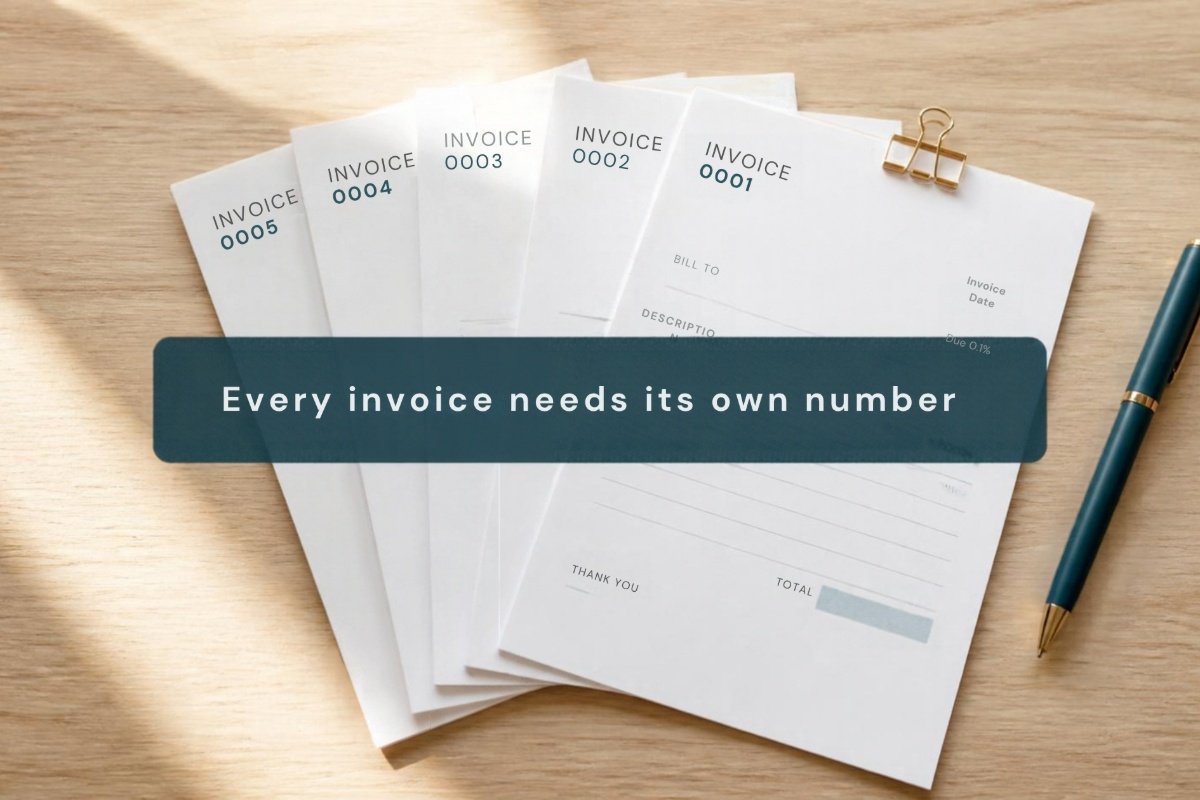
Sequential: 0001, 0002, 0003. Simple, obviously unique, and the gaps tell you immediately if one went missing. The downside is that invoice 0003 tells a client you have had three customers ever, which is information you may not want to volunteer.
Dated: 2026-10-014, or ACME-2026-03. Harder to read at a glance, but it sorts chronologically and reveals nothing about your volume.
Pick one and never change it mid-year. The one rule that is not negotiable: never reuse a number, even for a corrected invoice. If you need to fix an invoice you have already sent, issue a credit note against the original and raise a new invoice with a new number. Overwriting invoice 0014 with a different invoice 0014 is how audits turn into arguments.
Step 2: Describe the work so it cannot be argued with
“Consulting — October” is a line item that invites a conversation. “Website migration: content audit, staging build, DNS cutover and two weeks of post-launch monitoring, 12–28 October” is a line item that gets paid.
Three rules that have never let me down:
- One line per deliverable, not one line per invoice. If the client queries part of the work, they can approve the rest and pay it while you discuss the remainder.
- Quantity and rate, even on fixed-price work. “Project fee: $2,400” is harder to defend than “Design phase, 16 hours at $150”.
- Reference their paperwork. If they issued a purchase order number, put it on the invoice. In larger companies, an invoice without a PO number does not get paid — it gets returned. Our guide to purchase order vs invoice explains how the two documents are matched.
Step 3: Set payment terms before you send
This is the field that most determines when money actually lands, and most people leave it to default.
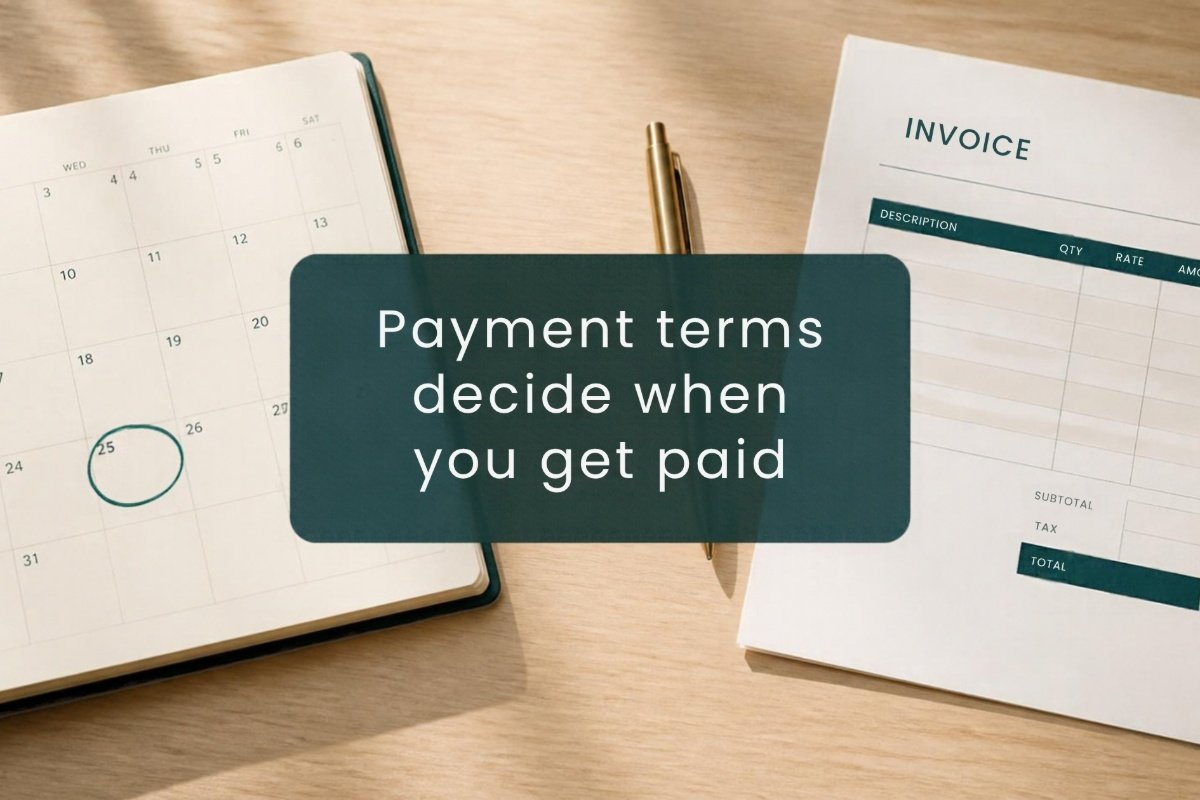
In the UK, if you agree no payment date, the law fills the gap for you: payment becomes late 30 days after the customer receives the invoice or after you deliver the goods or service, whichever is later. An agreed date should usually fall within 60 days for business-to-business transactions, and 30 days when you are billing a public authority. Longer is possible only if it is genuinely fair to both sides.
So “30 days” is not a neutral choice — it is roughly what you get by saying nothing. If you want faster, you have to ask for it, in writing, before the work starts.
Write the terms as a date, not a duration. “Payment due by 10 November 2026” is unambiguous. “Net 30” requires the client to work out which day that is, and they will work it out generously.
Step 4: Send it to a person, and to the system
An invoice emailed to the person who hired you often stops there, because that person is not the one who pays it.
Before you send the first invoice to a new client, ask three questions: who should the invoice be addressed to, is there an accounts email or portal it needs to go to, and do you need a purchase order number. Thirty seconds of asking saves weeks of chasing.
Send PDF, not a word processor file or a spreadsheet. A PDF looks the same on their screen as yours, cannot be accidentally edited, and is what accounting systems expect to archive.
Put the invoice number and the amount in the email subject line. When somebody later searches their inbox for “why haven’t we paid this”, you want to be findable.
Step 5: Keep the record
Your invoices are your proof of income, and the standard is lower-tech than people expect.
The IRS says you may use any recordkeeping system suited to your business that clearly shows income and expenses — in most cases no special kind of record is required. What it does say is that the burden of proof is on you to substantiate what you put on a return, and that you must keep records as long as they are needed to prove the income or deductions, with employment tax records kept at least four years.
Translated: a folder of numbered PDFs and a simple log is a legitimate system. An inbox is not, because you cannot prove what you did not keep.
Keep every invoice you issue, including the cancelled ones. A gap in a sequence with no explanation looks like a missing sale.
VAT and sales tax: the part that trips people up
Two different problems that people often confuse.
VAT (UK and EU). If you are VAT registered and your customer is too, you must issue a full VAT invoice, which requires more detail than the standard list above. If you are not VAT registered, you must not charge VAT or show a VAT line at all — adding it because the template had a box is a real and common error.
Sales tax (US). Generally charged on goods and some services, varies by state and often by city, and is driven by where the customer is rather than where you are. If you sell services across state lines, check your own state’s rules rather than assuming the invoice needs a tax line.
In both cases, the rule is the same: show tax as its own line, never bundled into the price. A client who cannot see what the tax portion is cannot reclaim it, and will ask you to reissue.
A worked example
Here is how to write an invoice in full, in plain text. Everything required, nothing decorative.
| Section | Content |
|---|---|
| Header | INVOICE — number 2026-014 |
| From | Your legal name / company name, full address, email, phone |
| To | Client’s legal entity name, billing address, accounts contact, PO number if they use one |
| Dates | Invoice date: 11 October 2026 · Supplied: 22 September – 8 October 2026 |
| Line 1 | Content audit of 48 existing pages — 12 hours at £75 — £900 |
| Line 2 | Staging build and DNS cutover — fixed fee — £1,200 |
| Line 3 | Post-launch monitoring, two weeks — fixed fee — £300 |
| Subtotal | £2,400 |
| VAT | VAT at 20% — £480 (omit this line entirely if you are not VAT registered) |
| Total due | £2,880 |
| Payment terms | Payment due by 25 October 2026 |
| How to pay | Bank name, account name, sort code or routing number, account number, reference: 2026-014 |
Note the reference on the payment line. If the client’s payment arrives with no reference, you will spend an afternoon matching a bank line to an invoice.
What to do when it is not paid
Have a sequence, and run it the same way every time so it never feels personal.
- Day after due date: a short, friendly email. Assume it was missed, because usually it was. Reattach the PDF.
- Day seven: phone or message the accounts contact, not the person who hired you. Ask one question: is this in the payment run, and which one.
- Day fourteen: a formal reminder in writing stating the invoice number, the amount, the original due date, and that interest may be applied.
- Day thirty: stop new work, in writing, and set out what happens next.
In the UK you can claim statutory interest and debt recovery costs on late commercial payments. Mentioning that you are entitled to it is usually more effective than actually charging it — most delays are administrative, and a polite reminder that the clock has legal weight moves an invoice up a payment run.
If late payment has become a pattern rather than an accident, the problem is the relationship rather than the invoice, and that is a different decision — we covered it in our guide to ending a client relationship professionally.
Mistakes that delay payment
- No address on your own invoice. The one that cost me four days. Many accounts systems will not process a supplier without one.
- Billing the wrong entity. The trading name on the website is often not the legal entity that pays. Ask.
- Missing PO number. In any company with a procurement process, this is an automatic return.
- Reusing an invoice number. Creates a duplicate in their system, which usually means neither gets paid.
- Vague descriptions. “Services rendered” gives an approver no basis to approve.
- Sending it late. An invoice raised three weeks after delivery starts its payment clock three weeks late, and signals that the money does not matter much to you.
- Charging VAT when you are not registered. Not a delay, a problem.
- No payment instructions. Surprisingly common, and completely fatal to getting paid quickly.
Once your invoicing is this predictable, it becomes one of the first tasks worth handing to someone else — it is repetitive, rule-based and low-judgement, which is exactly the profile we described in our guide to delegating tasks.
Frequently asked questions
Do I legally have to send an invoice?
In the UK, if you and your customer are both VAT registered, you must issue a VAT invoice. Outside that, an invoice is how you evidence the sale and request payment, and you will struggle to chase a debt without one.
What number should I start at when I write an invoice?
Anything, as long as it is unique and consistent. Many people start at a number other than 1 so the first client cannot tell they are the first. The format matters less than never repeating a number.
Can I invoice without a company?
Yes. A sole trader invoices under their own name, plus any trading name, with an address where legal documents can be delivered.
What payment terms should I use?
Decide before the work starts and write it as a date. If you agree nothing in the UK, payment becomes late 30 days after the customer receives the invoice or you deliver, whichever is later.
Should I charge a late fee?
In the UK you are entitled to statutory interest and recovery costs on late commercial payments. Say so in your terms. Whether you actually apply it is a commercial decision each time.
How long do I keep invoices?
The IRS position is that you keep records as long as they are needed to prove the income or deductions on a return, with employment tax records kept at least four years. Keep cancelled invoices too.
PDF or a document file?
PDF. It cannot be edited by accident, renders identically everywhere, and is what accounting systems expect.
The short version
Write an invoice this way every time. Give it a unique number you will never reuse. Put your address on it. Bill the legal entity, not the person. Describe the work in lines a stranger could approve. Write the due date as a date. Send it as a PDF to the accounts contact with the number in the subject. Keep every copy.
None of it is clever. It is just the difference between money arriving in two weeks and money arriving whenever somebody gets round to asking you for your address.