How to Write a Quote for a Job That Wins Without Haggling
You spent an hour measuring, pricing and writing it up. You sent it. Three days later the reply came back: “Can you do it any cheaper?”
That is not a pricing problem. It is a quote problem.
Learning how to write a quote for a job is less about the number at the bottom and more about everything around it. A good quote answers the questions a client would otherwise ask, removes the things they would otherwise negotiate, and makes saying yes the easiest option on the page.
Qualify the job before you write anything
The most expensive quotes are the ones you write for people who were never going to book you.
Experienced tradespeople almost all do the same thing first. Before writing a quote for a job, they give a rough range on the phone: “this kind of work usually starts around X.” It ends the conversation early with anyone whose budget is nowhere near yours.
Ask what the budget is. Not at the start of the call, where it sounds like you are sizing them up, but once you understand what they actually want. A lot of people simply tell you, and then you are pricing a job that exists.
Pitch that ballpark slightly high. This is price anchoring. If the written quote lands under the figure already in their head, it reads as good news. Anchor low and every conversation afterwards is you defending an increase.
Then collect the same five things every time, into a note on your phone: name, address, contact number, email, scope in their words. Add photos. Half the battle, as one contractor put it, is hearing somebody clearly enough to write their email down correctly while standing in the middle of a job.
And do not price work you have not seen. Contractors describe losing money on access that never showed up in the photos, parking that had to be paid for, and loading restrictions nobody mentioned.
What to include in a quote for a job
A quote that wins contains more than a price:
- What the client said they want. One or two lines, close to their own words. It proves you listened, and it fixes the scope in writing.
- What you will actually do. The real detail: where, what, which materials, which finish.
- What is not included. The most useful section on the page, and the one almost everybody leaves out.
- The price.
- Timeline and next step. When you can start, how long it takes, and exactly what they do to accept.
The scope detail is where the value sits. A homeowner reading “finish bathroom floor, $400” has no idea what they are buying, and that uncertainty is what turns into haggling. The same job written as three specific lines about preparation, materials and finish reads as somebody who has done this before.
The “not included” section does quiet work too. Every item in it is an argument you are not having in week three.
Should you itemise, or give one number?
Both sides of this argument are right about different things.
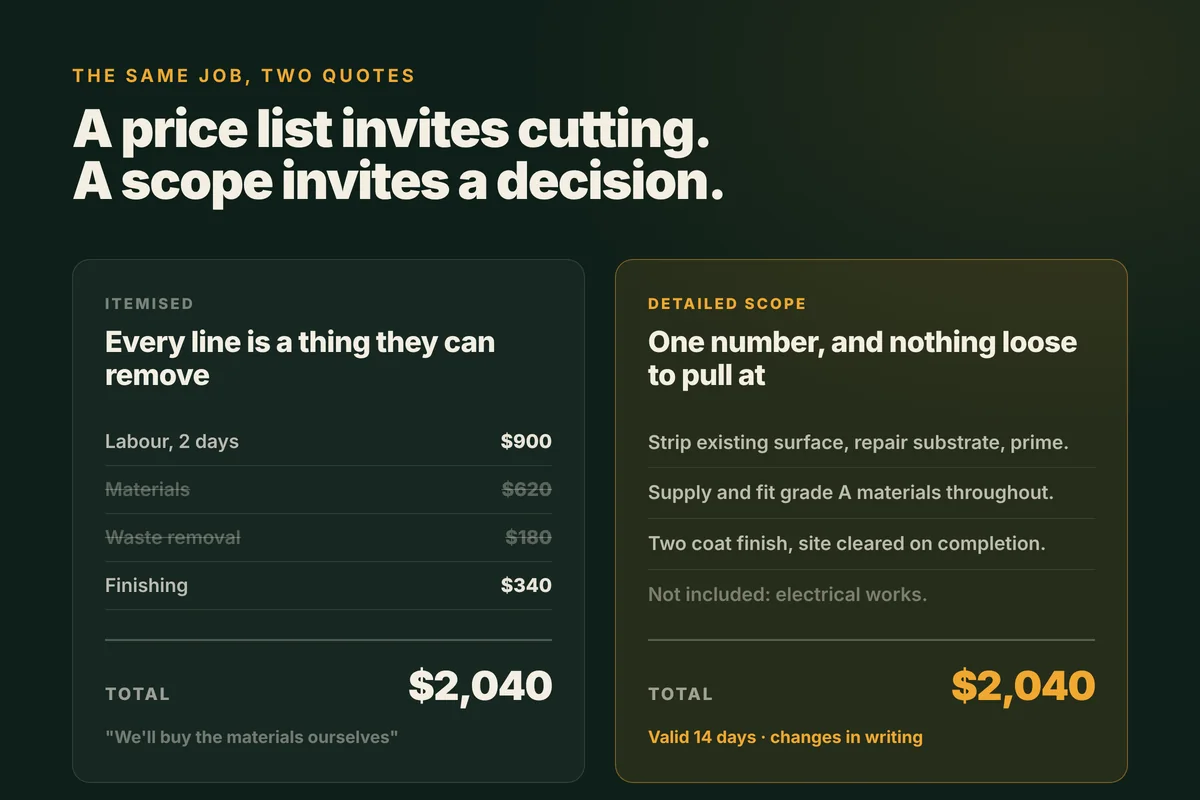
The case against itemising is sharper than most expect. Once a client can see individual prices, the quote becomes a menu, and a menu invites cutting. Contractors name three specific problems:
- Clients take your material line and buy the parts themselves, usually cheaper, and with no warranty from you on what they installed.
- When somebody asks for a discount, your own itemised figure becomes the amount they expect to come off.
- A breakdown invites a line by line negotiation instead of one decision.
The case for detail is just as real. A vague quote makes people suspicious, and a client who cannot tell what they are buying assumes the worst.
That is the trade off: itemising invites cutting, vagueness invites doubt.
Most experienced people land on the same compromise: detailed scope, single price. Describe the work thoroughly, name the materials and the standard, split genuinely separate parts of the job into their own lines with their own totals. What you do not publish is your cost per component.
If somebody pushes anyway, a flat answer beats an argument. “That is the price for the work as described” is a complete sentence.
Give three options instead of one price
If you change one thing about how to write a quote for a job, make it this.
Instead of a single number the client can only accept or refuse, give three:
- Fix it today. The minimum that solves the immediate problem.
- Fix it properly. What you would actually recommend, and why.
- The full version. Everything, done to the standard you would want in your own house.
The question changes from “yes or no” to “which one”, and clients often take the middle option without negotiating at all, because they are busy choosing rather than deciding whether to buy.
It protects your price too. A single figure has nothing to compare against except a competitor’s.
The two lines that protect you later
A valid until date. Material prices move and your calendar fills up. Common windows are 7 to 14 days for most residential work, 5 to 7 days on larger jobs with more material exposure, and 21 to 30 days for a repeat customer or a small service call. Put the reason beside the date, something like “valid for 14 days, as supplier pricing and scheduling availability change”. With a reason attached it reads as a fact rather than pressure.
A change order line. One sentence: work beyond the scope described above requires a written change order, with a signature line under it. This decides who pays when the job turns out bigger than it looked, and without it, that is you.
When do you actually write the quotes?
This is the part nobody explains, and it is where most self employed people lose their evenings.
The answer from almost everyone who has solved it: batch them. Take the details on site in thirty seconds, then write every quote in one fixed block, an hour before leaving in the morning or one day a week. It goes faster because you are in the same headspace for all of them instead of restarting six times a day.
The fear is that a next day quote loses the job. People who work this way report nobody complaining, and one made the sharper point that a job too urgent to wait until morning was usually a job he did not want.
Which settles the on site question. Quoting in person catches people while they still care, but pricing out loud is how you miss something, and whatever number leaves your mouth is the one they remember. Give the range verbally, send the written quote next morning.
One more habit worth stealing: spend the first part of that block following up on quotes already sent, not writing new ones. Quotes do not close themselves.
Pricing it without years of numbers
Writing the document is quick once you know your prices. For most people the hard part is the pricing.
Build a list of priced blocks. Write down every task you can imagine doing and what you charge for it. Every quote then becomes assembly rather than invention, and the number stops depending on what mood you were in.
Move to flat rate where you can. Hourly work creates a second problem: customers watching the clock resent seeing you do anything that is not the job, including quoting. Priced work removes that entirely.
Then the habit that actually builds your pricing: record what each job really cost you and correct the block afterwards. Within a couple of months you are quoting from real numbers instead of guesses.
Your quote then becomes the basis for the invoice, so it helps to know what a client’s purchase order does that your quote does not, and how to carry the agreed scope through to a properly built invoice. Settle the terms now: what you are offering with net 30 payment terms, and whether to state a late payment fee up front.
Frequently asked questions
What is the difference between a quote and an estimate?
A quote is a fixed price offer for a defined scope. An estimate is a considered projection expected to move. In several countries a quote becomes binding once the client accepts it, so use the word deliberately and say which one you are sending.
How long should a quote stay valid?
Seven to fourteen days suits most residential work. Shorten it for larger jobs where material prices carry more risk, and extend it to around a month for repeat clients or small service calls.
What do you say when a client says it is too expensive?
Do not cut the price. Cut the scope. Go back to your three options and move down one, so the reduction comes with less work attached rather than the same work for less money. Discounting the same job teaches the client that your first number was never real.
The short version
How to write a quote for a job, in one paragraph: qualify it on the phone first, take the same five details every time, describe the scope fully but keep your component costs to yourself, give three options instead of one price, and put a valid until date and a change order line on every one. Then write them all in one block tomorrow morning rather than six times today.
A quote is not a price list. It is the last chance to decide what the job is before somebody else decides for you.