What Is a Packing Slip? What Goes On It and How to Use It
A customer messages you to say two items are missing from their order.
You open the order in your system and everything looks right. The question you can’t answer is what actually went into the box, and that’s the moment a packing slip stops being paperwork and starts being the only record you’ve got.
Most guides answer what is a packing slip in a paragraph and then stop. So here’s the rest of it: what belongs on one, how it differs from the two documents people confuse it with, and what to do on the day the contents don’t match the list.
Quick Answer
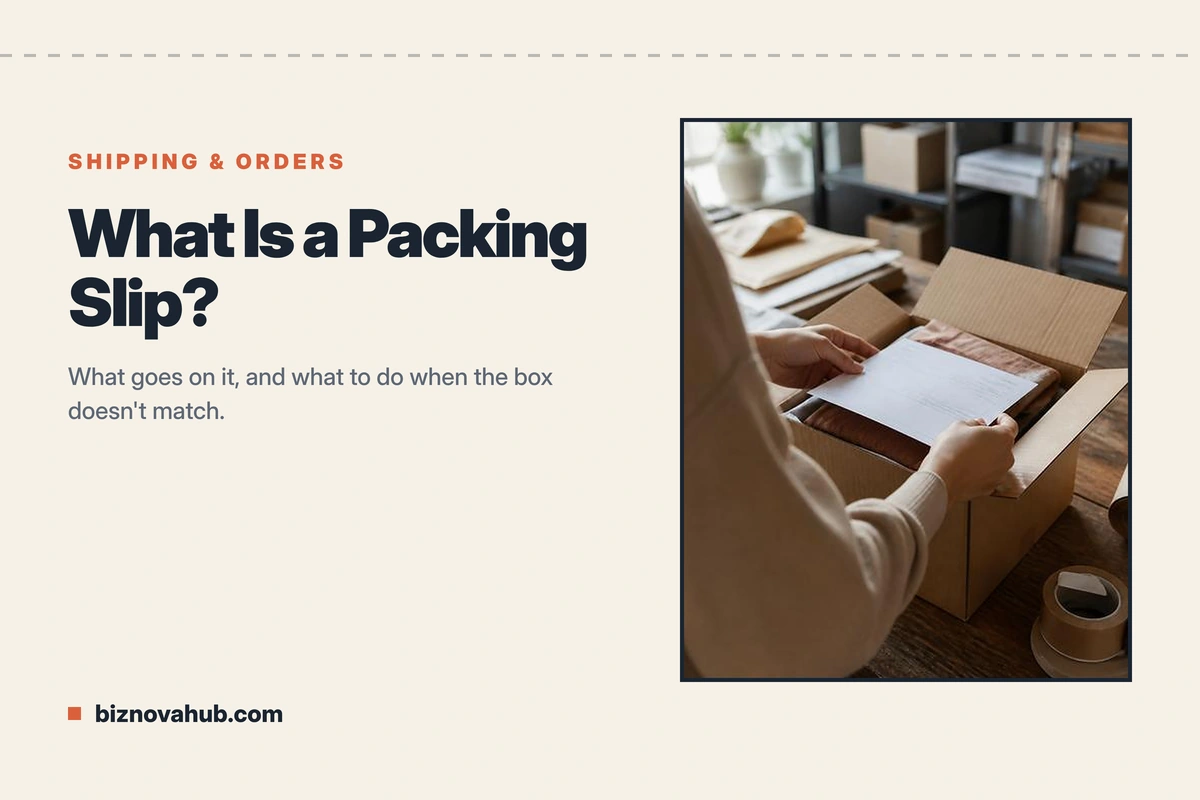
A packing slip is the itemised list that travels inside or on the parcel, showing exactly what was packed and in what quantity. It carries no prices and asks for no payment. Its job is to let whoever opens the box check the contents against the order in under a minute.
What is a packing slip, and what is it for?
It’s the itemised list that travels with the goods, and it’s got one job: so the person opening the box can check it without calling you.
That sounds small until something goes wrong. Then it’s the only document that says what left your warehouse, and without it you’re arguing from memory against a customer who’s holding the box and counting.
It gets used three times, and most people only think about the first.
Your packer uses it to check the box before it’s sealed. Your customer uses it to check the box on arrival. And when there’s a dispute weeks later, both of you use it as the record of what was sent. That’s three chances to catch a problem, and you’re paying for the document either way.
That third use is why the copy you keep matters as much as the copy you ship.
What goes on a packing slip
Here’s the full layout. Anything beyond this is clutter.
Top section. Your business name and address. The customer’s shipping address, which is where the goods went, not where the bill goes. The order number. The packing slip number. The date it was packed.
The item list. One line per product, with SKU or product code, description, quantity ordered, and quantity shipped.
Those last two are separate columns and they need to stay separate. Merging them is the single most common mistake, and it’s the one that causes arguments, because a box that’s short two units looks identical to a box that was only ever meant to hold what’s in it.
Bottom section. Total number of items, total number of parcels in the shipment (“box 1 of 3”), and a short note line for backorders or substitutions.
Here’s what one looks like filled in.
PACKING SLIP PS-20418
Order 10592 Packed 14 March Box 1 of 2Ship to: J. Mensah, 14 Hill Road, Leeds LS6 2AB
SKU 4471 Oak shelf bracket, 200mm Ordered 6 Shipped 6
SKU 4490 Wall plug pack, 50pc Ordered 2 Shipped 2
SKU 4502 Oak shelf, 1200mm Ordered 3 Shipped 1Items in this box: 9
Note: 2 x SKU 4502 on backorder, shipping separately by 21 March.
Look at that last line. The customer opens the box, counts one shelf instead of three, reads the note, and doesn’t message you. That one sentence is worth more than the rest of the document.
No prices. Here’s why
A packing slip doesn’t carry unit prices, totals, tax or payment terms.
Two reasons. Gift orders are the obvious one, where the person opening the box isn’t the person who paid. The less obvious one is that a priced document inside a parcel invites a conversation about money at the exact moment you want a conversation about contents.
If somebody genuinely needs the figures, they want a proper invoice, and that’s a separate document sent separately.
Packing slip vs invoice vs delivery note
These three get mixed up constantly, and the difference is simpler than most explanations make it.
Ask what the document is asking the reader to do.
A packing slip says: check this. It lists contents, carries no prices, travels with the goods, and nobody signs it.
An invoice says: pay this. It carries prices, tax and payment terms, and it usually goes by email rather than in the box.
A delivery note says: confirm you received this. It travels with the goods like a packing slip, but it’s built to be signed and handed back, which makes it proof of delivery rather than a packing checklist. If you’re shipping on account or to trade customers, that signature is the thing you’ll want later, and a delivery note is the document that gets it.
Plenty of businesses need both. The packing slip goes in the box, the delivery note gets signed at the door, and the invoice follows by email.
And if you only ship to consumers, you probably need just the packing slip. Don’t make a driver chase signatures for a parcel left in a porch.
One exception worth knowing. On international shipments the packing list becomes a customs document. The US International Trade Administration lists it among the common export documents, notes that customs officials may use it to inspect cargo, and says your commercial invoice should match it. So if you ship abroad, the two need to agree line for line.
When the contents don’t match the slip
This is the part every other guide leaves out, and it’s the part you’ll actually use.
Three things can happen, and they need different answers.
Short shipment. Fewer items arrived than the slip lists. Check your own copy first, because about half the time the slip is right and the picker got it wrong, which means the stock is still on your shelf. Ship the missing items with a new packing slip referencing the original order number. Don’t issue anything financial yet, because nothing has been refunded.
Over shipment. More arrived than the slip lists. Say so before the customer does. Either invoice for the extra or arrange collection, and if you’ve already invoiced the original quantity, a credit note is how you correct the paperwork cleanly.
Wrong item. The SKU in the box isn’t the SKU on the slip. This one is a picking failure, not a counting failure, and it tends to come in pairs. If customer A got customer B’s item, customer B is about to message you too. Check the orders packed either side of it before you go looking.
In all three, the first move is the same. Pull your filed copy of the slip and compare it with what the customer describes, before you promise anything. A refund issued in the first five minutes to keep somebody happy is a refund you can’t take back when the stock turns up in the wrong box two days later.
Packing slips in practice
Most order systems generate these automatically, which is good, and almost all of them default to a layout that nobody checked, which isn’t.
So print one and look at it properly, because three things go wrong by default and you won’t spot them on a screen.
Prices appear because the template was copied from the invoice. Quantity ordered and quantity shipped are merged into one column. And the type is set small enough that a packer scanning twenty boxes an hour will misread it.
Put the slip inside the box, in a document pouch on the outside, or both. Inside is standard for consumer orders. Outside helps where goods get checked in at a loading bay without being opened.
Keep your copy for as long as you keep order records, and make it searchable by order number rather than by date. When a dispute lands, you’ll have the order number and nothing else. If you’re reconciling a run of these across a month, the order and invoice trail is what ties it together.
Frequently asked questions
Is a packing slip the same as a receipt?
No. A receipt proves payment and a packing slip proves contents. A customer can hold a packing slip for goods they haven’t paid for yet, and a receipt for goods that haven’t shipped.
Does a packing slip need to be signed?
No. If you need a signature, you want a delivery note, which is designed to be signed and returned. A packing slip is a checklist, not a receipt of handover.
Can a packing slip be sent by email?
It can, but it mostly defeats the point. The value is that it’s physically with the goods when somebody opens the box. Emailing one as well is fine for trade customers who check paperwork before the pallet arrives.
Do you need a packing slip for every box?
For multi-box shipments, put one in every box and mark each “box 1 of 3”, listing only what’s in that box. One slip in box one listing everything leaves the person who opens box three with no idea what should be in it.
The short version
A packing slip lists what’s in the box so somebody can check it without calling you. No prices, no payment terms.
Keep quantity ordered and quantity shipped in separate columns, and use the note line for backorders. That one habit prevents most of the messages you’d otherwise get.
Packing slip for contents, delivery note for a signature, invoice for money.
And when a box doesn’t match its slip, check your filed copy before you promise anybody anything.