Sales Order vs Purchase Order: The Key Differences
Two businesses agree on a deal. The buyer sends a document confirming what they want. The seller sends one confirming they can supply it. Same deal, two pieces of paper, mirror images.
That is the whole idea behind sales order vs purchase order. Once you see which side of the table each sits on, the confusion disappears. Most explanations bury the one fact that matters: in sales order vs purchase order, you are looking at the same transaction from opposite ends.
Quick Answer
In sales order vs purchase order, the difference is who raises the document. A purchase order comes from the buyer and requests goods at an agreed price. A sales order comes from the seller and confirms the order so fulfilment can start. Each one sits in a different company’s system.
Sales order vs purchase order: the one line that explains it
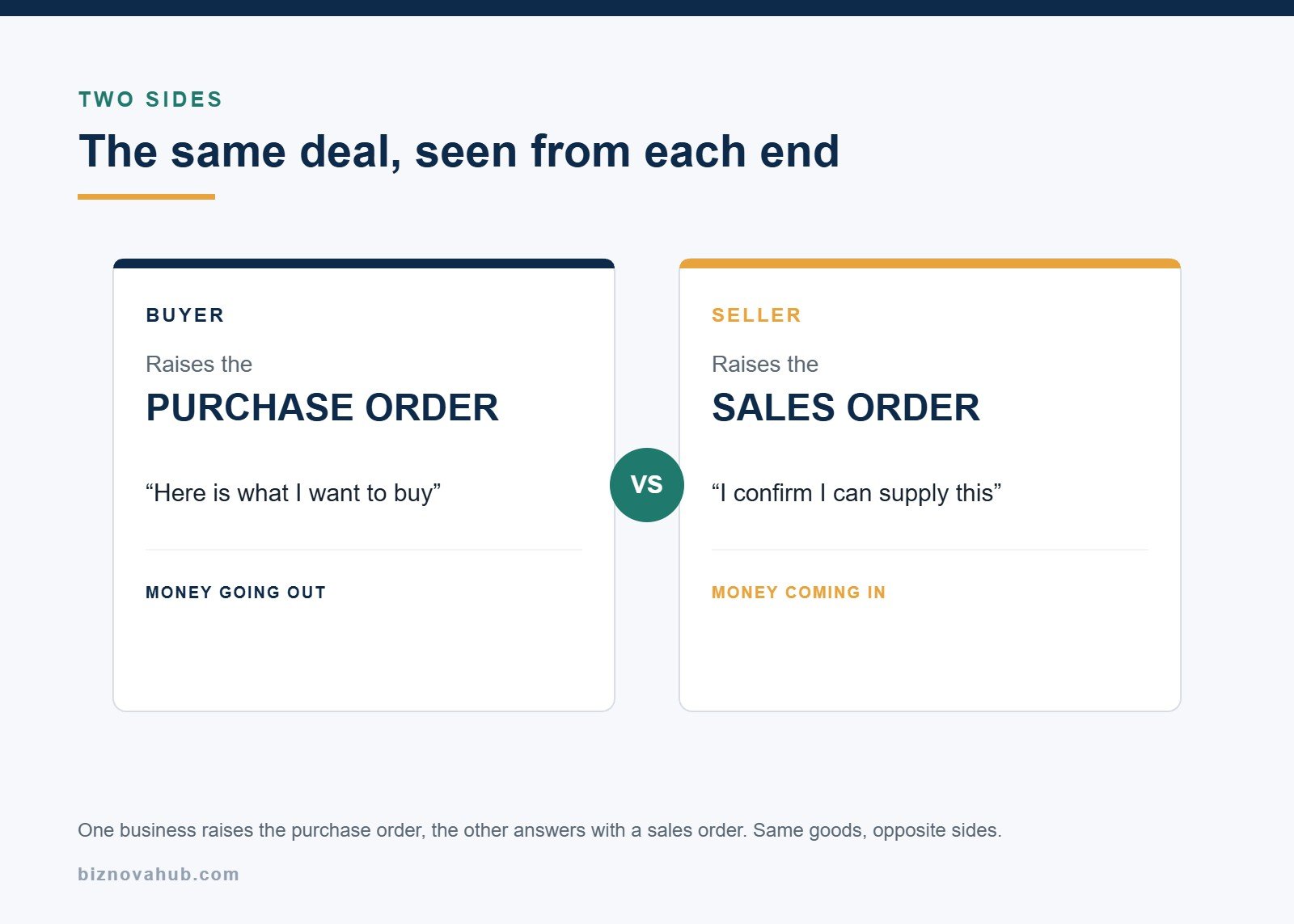
A purchase order is created by the buyer and sent to the seller. It says: here is what I want to buy.
A sales order is created by the seller in response. It says: I have your request and I confirm I can fulfil it.
So if you spend the money, you raise purchase orders. If you take the money and ship the goods, you raise sales orders. The same order is a purchase order to one company and a sales order to the other, at the same moment. That is the key to the whole thing.
| Purchase order | Sales order | |
|---|---|---|
| Created by | The buyer | The seller |
| Sent to | The seller | The buyer, as confirmation |
| Says | I want to buy this | I confirm I can supply this |
| Comes first | Yes | No, it answers the purchase order |
| Price shown | The offered price | The confirmed net selling price |
| Main job | Request and commit to a purchase | Confirm the sale and trigger fulfilment |
If your business only ever buys, you never raise a sales order. If it only sells, you never raise a purchase order. Most growing businesses do both, which is why the terms get tangled.
Walking through a single order
Picture a print shop buying paper from a supplier. Follow the paperwork and sales order vs purchase order stops being abstract.
- The print shop needs twenty boxes of card stock. Internally, someone raises a request to spend the money. That is a purchase requisition, the step before anything leaves the building.
- Once approved, the print shop creates a purchase order and emails it to the supplier. The buyer is committing.
- The supplier checks the stock and sees it can fulfil the order.
- The supplier creates a sales order and sends a confirmation back. The seller is committing.
- The paper ships with a delivery note, and an invoice follows.
Both describe the identical twenty boxes, in different systems and for different owners: one tracks money going out, the other money coming in.
Our guide to purchase requisition vs purchase order covers the internal approval before the purchase order is sent.
Which one creates the contract?
This is where people get nervous, and the answer is simple.
The purchase order is an offer. On its own it binds nobody. The moment the seller accepts it, by confirming it or creating the sales order against it, a contract exists between the two businesses. The official rules on invoicing and taking payment set out what follows once that agreement is in place. Acceptance is the trigger, and the sales order is usually the proof it happened.
So the sales order is not a second, competing contract. It is the seller’s record that it agreed to the offer. Treating them as two separate agreements is a common and expensive mistake.
What goes on each one
In sales order vs purchase order, the two documents carry different fields because they serve different owners, and the gaps tell you what each side cares about.
A purchase order is built around the buyer’s need to track and control a spend:
- Purchase order number, and the requisition number it came from
- Supplier name and address
- Item descriptions and quantities
- The agreed price per unit
- Delivery address and the date wanted
- The buyer’s approval or signature
A sales order is built around the seller’s need to fulfil and get paid:
- Sales order number
- The customer and the purchase order it answers
- Items, quantities and the confirmed net selling price
- Payment terms and method
- Shipping terms, costs and any discount given
- Confirmed delivery date
Notice what the sales order adds: payment terms, shipping costs, discounts. These are the seller’s commercial details, which the buyer’s purchase order does not dictate. If you sell, this is where you state when you expect to be paid. Leaving it vague is how a clean sale turns into a chasing exercise, which is why net 30 payment terms belong in writing rather than by assumption.
Where each one sits in the full cycle
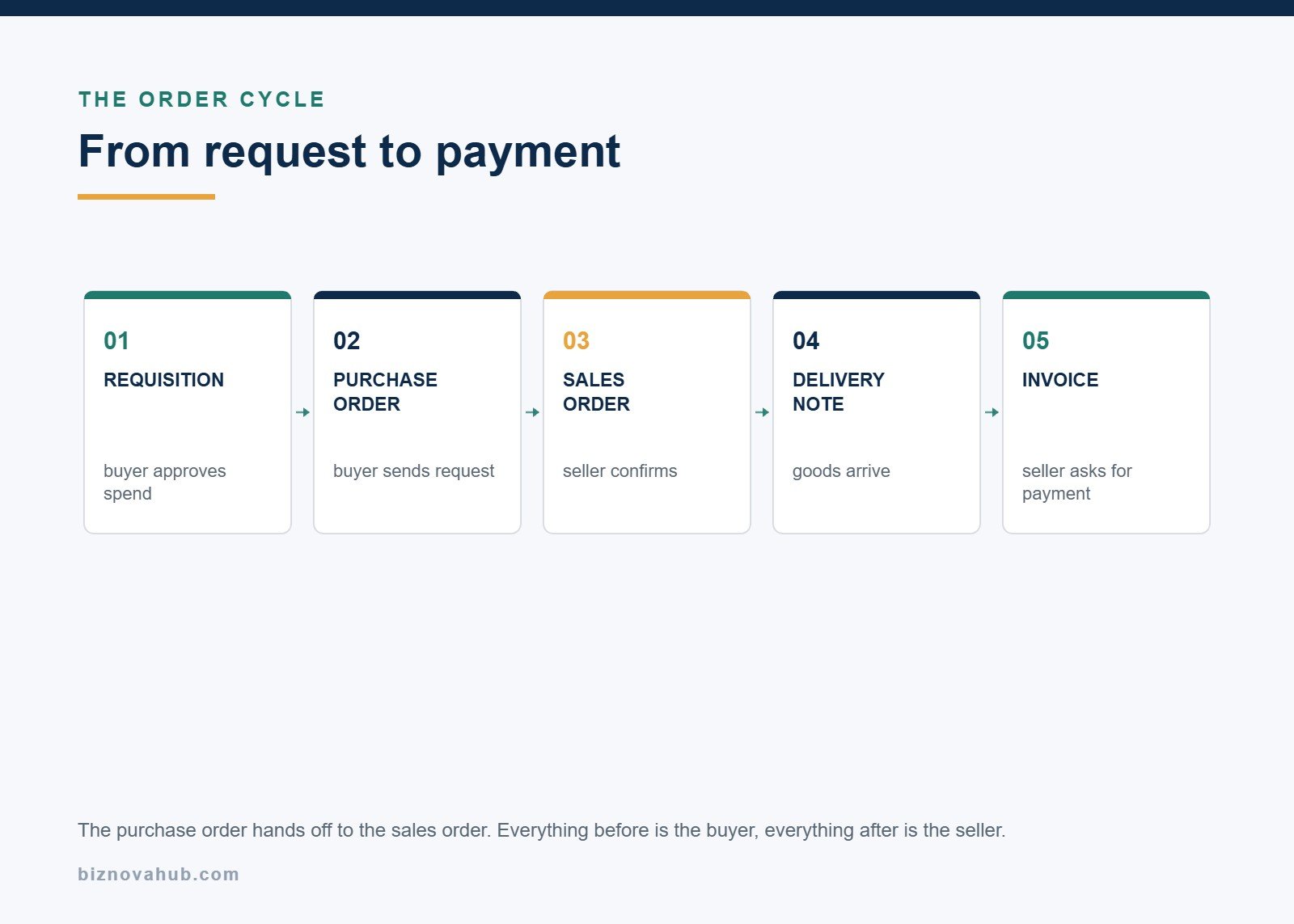
Neither document is the end of the story. Both are links in a chain that runs from the first internal request to payment, and seeing the chain is what makes the pair click.
- Purchase requisition. The buyer approves the spend internally.
- Purchase order. The buyer sends the request to the seller.
- Sales order. The seller confirms it can supply.
- Delivery note. The goods arrive and get checked.
- Invoice. The seller asks to be paid.
Steps two and three are the hinge. Everything before is the buyer getting ready, everything after is the seller delivering and collecting. If purchase order vs invoice is where you lose track, that guide follows the money to the end.
Which side are you actually on?
This is the part that trips up small businesses, because it changes with the deal.
If you run a cafe and order coffee beans from a roaster, you are the buyer. You raise the purchase order, the roaster raises the sales order. Simple.
Now suppose that cafe also supplies pastries to a hotel. For that deal, the cafe is the seller. The hotel sends a purchase order, and the cafe raises a sales order in return. Same business, different hat.
This is why sales order vs purchase order is never really the question. The real question is “am I buying or selling right now.” Answer that, and the correct document picks itself.
Do you even need sales orders?
An honest answer for a very small operation: maybe not, not formally.
If you sell a handful of orders a month and invoice straight away, a full sales order step can feel like bureaucracy. Many sole traders skip it and go straight to the invoice.
Sales orders earn their keep when any of these becomes true:
- There is a gap between agreeing a sale and delivering it, and you need to track what is promised but not yet shipped
- You take partial deliveries or back orders and need to know what is outstanding
- Someone other than you confirms orders and you need a record of what was agreed
- You want to separate “sold” from “invoiced” in your accounts, which matters once you carry stock
That second point is the usual trigger. The first time a customer asks where the rest of their order is, a sales order answers without a dig through your inbox.
Three mistakes that cause disputes
Treating the sales order as new terms. It should confirm the purchase order, not quietly rewrite it. If the seller changes the price or date on the sales order, that is a counter offer the buyer needs to agree to, not discover on the invoice.
Skipping the number trail. A sales order should reference the purchase order it answers, and the invoice should reference both. Break that chain and nobody can match a payment to an order when a query lands later. The same discipline runs through the accounts payable invoice approval process on the buyer’s side.
Letting the two disagree. The purchase order says fifty units, the sales order confirms forty, and nobody notices until ten are missing. When the two sides of the same deal do not match, stop and fix it rather than ship and sort it out later.
Frequently asked questions
Is a sales order the same as an invoice?
No. A sales order confirms what will be supplied and on what terms. An invoice comes later and asks for payment. The sales order says what will be sent, the invoice says what you now owe.
Can one document be both?
Not for the same business, but for the same transaction, yes. Your purchase order is the supplier’s trigger to create their sales order. One deal, two documents, one on each side.
Who raises the sales order?
Always the seller. The buyer raises the purchase order, the seller answers with a sales order. If you are confirming an order someone placed with you, you are raising a sales order.
Does a sales order mean I have been paid?
No. It confirms the sale and starts fulfilment, but payment is a separate step handled by the invoice. A confirmed sales order with no matching payment is money you are owed, not money you have.
Do small businesses really need both?
You need whichever matches your side of each deal. If you only buy, only purchase orders. If you only sell, only sales orders. Most businesses that grow handle both, and the clarity is worth the admin.
The short version
In sales order vs purchase order, the purchase order is the buyer’s request and the sales order is the seller’s confirmation of it. The buyer raises one, the seller raises the other, and they describe the identical goods from opposite sides of the deal.
The purchase order makes the offer and comes first. The sales order confirms it and triggers delivery. Keep the numbers linked, never let the two disagree, and decide which you need by asking one thing: on this deal, am I buying or selling?