How to Start an Online Store Without Inventory: 5 Models That Work
What this guide covers
- What “without inventory” actually means
- The 5 models that genuinely work
- What it really costs to start
- Step 1: Pick one model and commit to it
- Step 2: Choose a niche you can defend
- Step 3: Vet the supplier before you build anything
- Step 4: Set up the store
- Step 5: Price for the margin you actually keep
- Step 6: Get the legal pages right
- The rules that apply the day you open
- How returns work when you hold no stock
- Mistakes that kill no-inventory stores
- FAQ
Almost every guide to opening an online shop assumes you will buy stock first. You find a product, order a few hundred units, fill a spare room with boxes, and hope you picked right. That is the expensive way, and it is the reason most people never get past the planning stage.
There is another route. You can run a real store, take real payments and ship real orders without ever owning a single unit until a customer has paid for it. This guide covers the five models that work, what each one actually costs in 2026, and — the part almost nobody writes about — the consumer and product-safety rules that apply to you from your very first order in the US, the UK and the EU.
What “without inventory” actually means
It does not mean “no work” and it does not mean “no risk”. It means you do not pay for stock up front and you do not store it.
Someone still holds the product: a supplier, a printer, a fulfilment warehouse. What changes is the order of the money. In a traditional shop, cash leaves your account months before a customer pays you. In a no-inventory shop, the customer pays first, and you pay your supplier out of that payment.
That single change is why these models are worth understanding. It removes the thing that sinks most first-time retailers — money tied up in products nobody wanted.
What it does not remove is responsibility. In the eyes of the law you are the seller. If the parcel arrives late, broken or unsafe, the customer’s claim is against you, not your supplier. Keep that in mind as you read the rest of this guide.
The 5 models that genuinely work
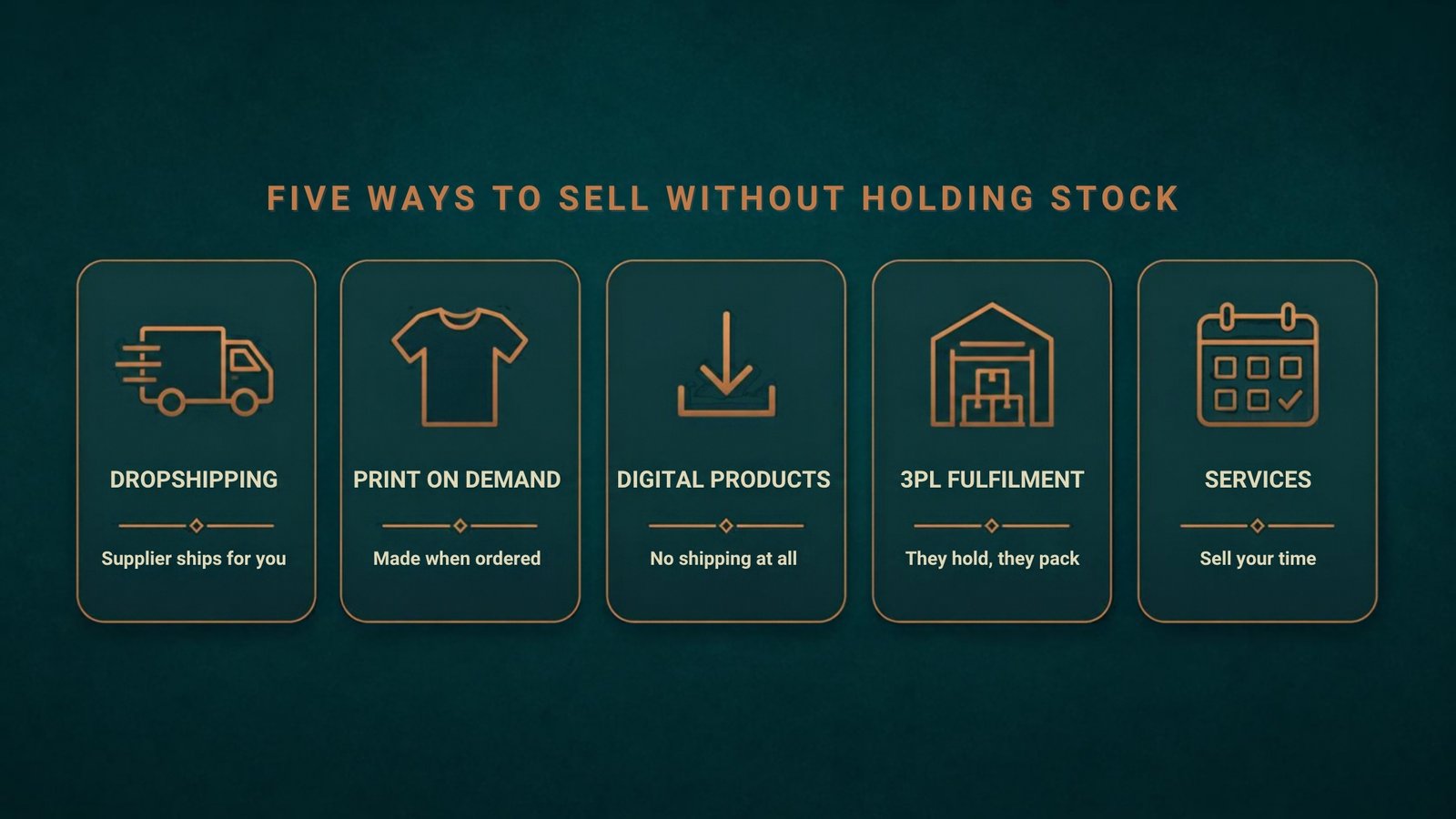
These are the five routes that have a real track record. Everything else is usually a variation of one of them.
1. Dropshipping
You list a supplier’s products. When a customer orders, you forward the order and the supplier ships directly to them. You never touch the product.
Margins are the problem. Because anyone can list the same catalogue, the products are easy to find elsewhere, and price becomes the only differentiator. Dropshipping works when you bring something the supplier cannot: a specific audience, genuinely useful content, or a bundle nobody else offers.
2. Print on demand
You upload designs. A printing partner makes the item — t-shirt, mug, poster, phone case — only after someone orders it, then ships it under your brand.
The product is effectively your design, so you are not competing on an identical listing. Base costs are higher than wholesale, so you need a design people actually want rather than a generic slogan.
3. Digital products
Templates, courses, presets, printables, spreadsheets, ebooks. There is no shipping, no supplier and no unit cost after the first sale.
This is the highest-margin model on the list and the one with the least operational risk. The work is front-loaded: you have to make something good before you earn anything, and you have to keep marketing it.
4. Third-party fulfilment (3PL)
You buy stock, but a fulfilment company stores it and ships it. Strictly speaking you do own inventory — your spare room does not.
Worth including because it is the natural next step once a dropshipped product proves itself. You get faster delivery and better margins, in exchange for buying stock up front.
5. Services and bookings
Not a product shop at all, but it runs on the same software and solves the same problem. You sell consultations, design work, repairs, classes or installations through a storefront with a calendar attached.
Zero product cost, instant start, and it pairs well with digital products later. If you are not sure what to sell yet, this is the fastest way to get a paying customer.
Which model fits you
| Model | Upfront cost | Typical margin | Main risk | Best for |
|---|---|---|---|---|
| Dropshipping | Lowest | Thin | Shipping times and copycats | Testing demand fast |
| Print on demand | Low | Moderate | Base cost eats the margin | Designers and creators |
| Digital products | Lowest | Highest | Nobody wants it | Anyone with expertise |
| 3PL fulfilment | High | Good | Unsold stock | Scaling a proven product |
| Services | None | High | Your time is the ceiling | Getting a first customer this week |
What it really costs to start
The honest answer is less than most people expect and more than the “start for free” headlines suggest. Here is what a working store actually needs in its first month.
| Item | Typical cost | Can you skip it? |
|---|---|---|
| Store platform | Shopify Basic is $39/month billed monthly, or $29/month billed annually | No — but cheaper platforms exist |
| Domain name | $10–$20 a year | No |
| Payment processing | Around 2.9% + 30¢ per online card sale on Shopify Basic | No — it comes out of every sale |
| Product samples | $30–$100 | No. Order one before you sell it |
| Apps and email tool | $0–$30/month | Yes, at the start |
| Logo and brand basics | $0–$100 | Yes, at the start |
| Business registration | Varies by country and structure | Depends — see below |
Realistically you are looking at somewhere between $100 and $300 to open properly, most of it recurring rather than one-off. The single line people try to skip is product samples, and it is the one line you should never skip.
Before you spend anything, decide how you will trade. In the US that usually means choosing between a sole proprietorship and an LLC — we compare the tax, liability and cost differences in LLC vs sole proprietorship. In the UK the equivalent decision is covered in sole trader vs limited company.
Step 1: Pick one model and commit to it
The most common first mistake is trying two models at once — a dropshipped catalogue plus some print-on-demand merch plus a digital download. Each one needs a different supplier relationship, a different pricing logic and a different marketing angle. Running all three badly beats running one well in exactly nobody’s experience.
Pick based on what you already have. Design skill points to print on demand. Specialist knowledge points to digital products. An existing audience points to dropshipping, because you already have the thing dropshippers lack. Nothing yet? Start with services and let the first few customers tell you what to build.
Step 2: Choose a niche you can defend
“Defend” is the operative word. If the only reason a customer buys from you instead of a marketplace is price, you have no business — you have a race.
Good niches for a no-inventory store tend to share three traits: the buyer has a specific problem rather than a general want, the product benefits from explanation, and the category is too small for the giants to bother with. Equipment for a particular hobby, supplies for a specific trade, products for an under-served body type or living situation.
Run a basic demand check before you build anything. Search the product and look at who ranks: if the first page is all major retailers with thousands of reviews, pick something narrower. If the first page is thin, outdated content, that is your opening.
Step 3: Vet the supplier before you build anything
Your supplier is your product, your delivery time and your return process. Choosing one badly cannot be fixed with better marketing.
Order a sample to your own address and record the real numbers: how many days it actually took, what the packaging looked like, whether anything identified the supplier instead of you, and what condition it arrived in. Then ask the supplier, in writing:
- What is your average dispatch time, and what is the delivery window to my main markets?
- Who pays for a return, and who pays when an item arrives damaged?
- Can you ship in unbranded packaging?
- Who is the manufacturer, and can you provide product safety documentation?
- What happens when an item goes out of stock after a customer has paid?
That last question matters more than people realise, and the fourth one is about to matter a great deal if you sell into Europe.
Step 4: Set up the store
Keep this phase short. A store that exists and converts badly teaches you more than a perfect store that never launches.
The minimum viable setup is a homepage that says clearly what you sell and for whom, product pages with real photographs and honest delivery estimates, a working checkout you have tested with your own card, and the legal pages covered in step 6. Everything else — reviews widgets, pop-ups, loyalty points — can wait until you have orders.
Write your own product descriptions. Supplier copy is on hundreds of other sites, reads like it was translated twice, and gives search engines no reason to prefer your page.
Step 5: Price for the margin you actually keep
This is where no-inventory stores quietly fail. The product cost is visible, so people price against it and forget everything else.
For every sale, subtract: the supplier’s price, the shipping you absorbed, the payment processing fee (around 2.9% + 30¢ on Shopify Basic), your platform and app costs spread across your order volume, the cost of refunds and replacements, and whatever you spent to get that customer. What is left is your real margin.
Work the maths on a realistic order value before you launch. If a $25 product leaves you $3 after everything, you need either a higher price point, a bigger basket, or a different product. Thin margins do not improve with volume in this model — they just lose money faster.
Step 6: Get the legal pages right
You need, at minimum: a returns and refunds policy, a delivery policy with honest timescales, terms and conditions, a privacy policy, and your business name and contact details somewhere a customer can find them.
UK sellers should note that GOV.UK requires your business name, contact details and address to be given before the order, along with pricing including taxes, delivery arrangements, cancellation rights and a standard cancellation form. Leaving the cancellation right out is not a small oversight — it extends the customer’s cancellation window to twelve months.
The rules that apply the day you open
These apply to you as the seller regardless of who holds the stock. Not knowing them is not a defence, and in a no-inventory model you are especially exposed, because the delivery time and the product documentation are both in someone else’s hands.
United States: the FTC 30-Day Rule
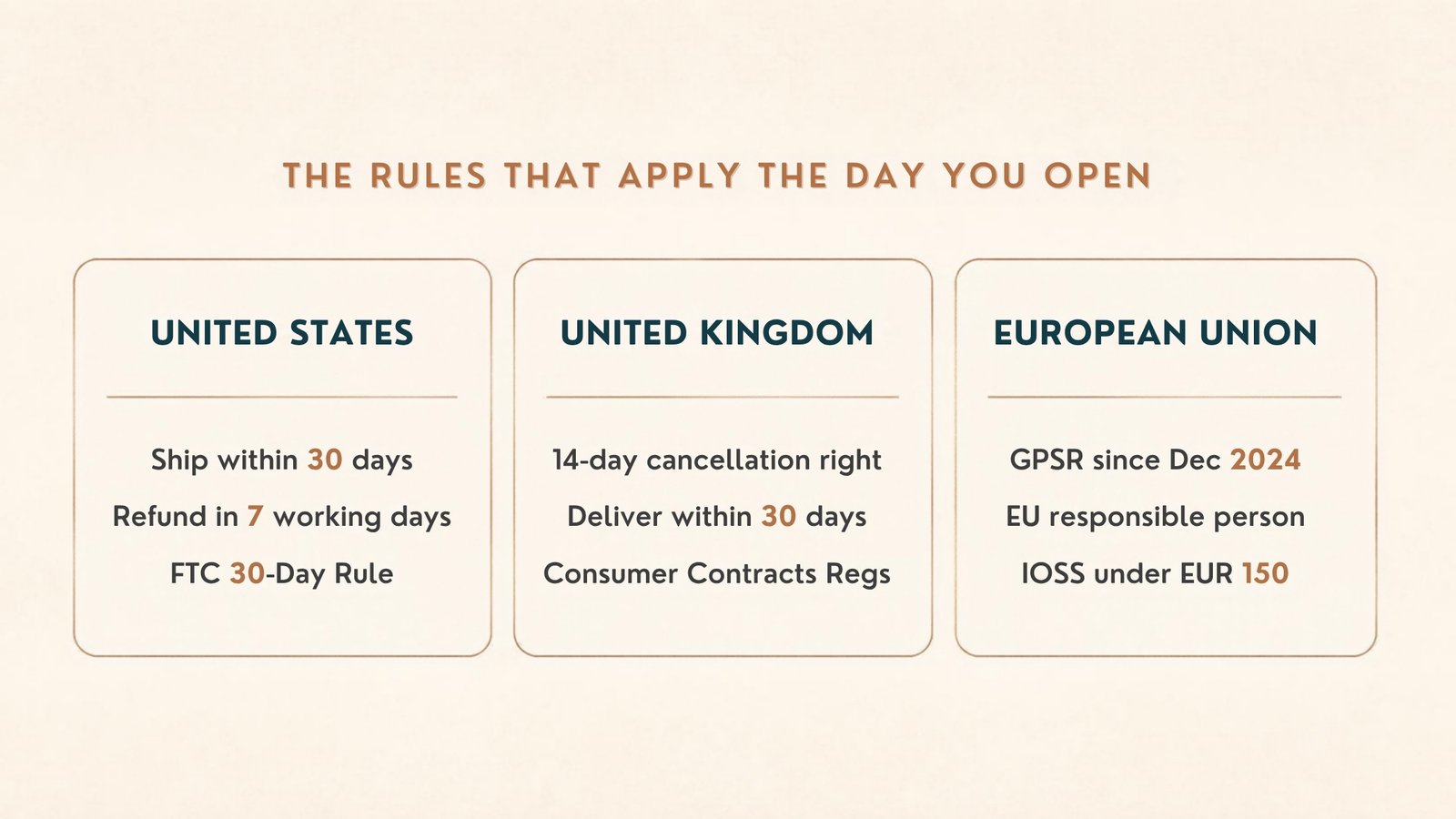
Under the Mail, Internet, or Telephone Order Merchandise Rule, if you do not state a shipping time you must have a reasonable basis for believing you can ship within 30 days. If you cannot ship on time, you must send a delay notice, offer the customer a way to cancel at your expense, and cancel and refund if they do not consent. Refunds must be sent within seven working days for most payment methods.
Read that again with a 21-day overseas supplier in mind. If your product page is silent on delivery and your supplier takes five weeks, you are already outside the rule.
United Kingdom: cancellation and delivery
Customers have 14 days after delivery to cancel without giving a reason. Where no delivery date is agreed, you must deliver within 30 days. And if you never told the customer about their cancellation right, that right lasts up to twelve months.
European Union: GPSR and VAT
Since 13 December 2024 the General Product Safety Regulation has applied to consumer products sold into the EU. According to the US International Trade Administration’s guidance, sellers must carry out risk assessments, hold technical documentation, provide safety information and warnings in the languages of the member states they sell into, include traceability details such as batch numbers and manufacturer information, and designate a responsible person established in the EU who can access the documentation and work with authorities during a recall.
For a dropshipper this is the single biggest change in years. You cannot produce technical documentation for a product you have never seen, which is exactly why step 3 asks your supplier for it in writing.
On tax, the Import One-Stop Shop has applied since 1 July 2021 and covers distance sales of imported goods in consignments not exceeding €150. The old VAT exemption for consignments under €22 was removed at the same time, so every item imported into the EU now carries VAT. If your customer is surprised by a charge at the door, they blame you.
How returns work when you hold no stock
You will get returns. Plan the process now, because improvising it in front of an angry customer is how refund disputes start.
Three things to settle with your supplier in writing before launch: where returns physically go, who pays the return postage, and what happens with a damaged or wrong item. Many dropshipping suppliers will not accept returns at all, which means the item comes back to you — so make sure “you” is an address you are willing to publish.
The practical compromise most small stores land on is to refund low-value items without asking for them back. The postage costs more than the product, the customer is satisfied in one message, and you keep the review. For higher-value items, issue a return label and inspect what comes back.
Whatever you decide, write it on your returns page in plain language and honour it exactly. A clear policy you follow beats a generous policy you argue about.
Mistakes that kill no-inventory stores
- Hiding the delivery time. The fastest way to collect chargebacks. Put the real window on the product page and the checkout.
- Never ordering a sample. You are selling a product you have never held, photographed by someone else, described by someone else.
- Competing on price alone. With an identical catalogue, the lowest price wins until nobody is making money.
- One supplier, no backup. When they go out of stock mid-campaign, you have no store.
- Treating the legal pages as decoration. They are the parts a regulator, a payment processor and an unhappy customer all read first.
- Spending on ads before the funnel converts. Paid traffic to a page that does not sell is a very fast way to discover your margin is negative. The cheaper route is covered in how to get more customers.
Frequently asked questions
Can I really start with no money at all?
Not realistically. You can avoid buying stock, but you still need a domain, a store platform and at least one sample. Budget $100–$300 for a proper start. Services and digital products come closest to zero, because there is nothing to source.
Is dropshipping still worth it in 2026?
As a way to test demand without buying stock, yes. As a long-term business built on a generic catalogue, rarely. Most stores that last either move to their own branded product, switch to print on demand, or add digital products alongside.
Do I need to register a business before I start selling?
In most cases you need to be registered and keeping records from your first sale, not from your first profit. The structure is the real decision — see our comparisons for the US and the UK. This is general information, not legal or tax advice.
What happens if my supplier ships late?
It is your problem, legally. In the US you must send a delay notice and offer cancellation; in the UK you must deliver within 30 days where no date was agreed. Build buffer into the delivery window you publish rather than quoting the supplier’s best case.
Can I sell into the EU without an EU company?
You can sell, but since December 2024 you need a responsible person established in the EU for consumer products under the GPSR, and you will need to deal with import VAT. Many sellers use a fulfilment partner or compliance service to cover the responsible person role.
How long before a no-inventory store makes money?
Anyone who gives you a number is guessing. What is predictable is the sequence: traffic first, conversion second, margin third. A store with no traffic has a marketing problem, not a product problem — and search visibility is usually the cheapest traffic a small store can build.